
Agroforestry Can Help us Deliver Multiple SDGs
Photo: Wolfgang Hasselmann / Unsplash
Agroforestry delivers climate resilience, economic opportunity, and ecological restoration through integrated land-use practices.
With just a few years left to achieve the United Nations Development Goals (SDGs), the world faces an uncomfortable truth for which incremental change will not be enough. Climate instability, soil degradation, food insecurity, and rural poverty are accelerating faster than our current solutions. What is urgently required is not another fragmented intervention, but a system-level transformation of how we produce food, manage land, and sustain livelihoods. Agroforestry offers exactly that, and its time has come.
Climate instability, soil degradation, food insecurity, and rural poverty are accelerating faster than our current solutions.
Agroforestry, the intentional integration of trees, crops, and livestock within the same landscape, is far more than a farming technique, it is a regenerative land-use paradigm that simultaneously addresses climate change, food security, ecosystem restoration, and rural prosperity. Researchers compellingly argue, agroforestry represents one of the most mature and scalable nature-based solutions capable of delivering across multiple SDGs at once.
A climate solution rooted in living systems
At the core of agroforestry’s climate value lies its exceptional capacity for carbon sequestration. Unlike annual monocultures, agroforestry systems rely on deep-rooted perennials, like trees and shrubs that function as long-term carbon reservoirs. Carbon is captured not only in above-ground biomass but also stored durably in soils through enhanced organic matter, improved aggregation, and active and rural microbial communities.
The following are four reinforcing mechanisms that make agroforestry especially effective.
1. Perennial woody vegetation acting as long-term carbon vaults
2. Improved soil structure and fertility, increasing soil organic carbon retention
3. Species diversity, which amplifies overall sequestration potential
4. Reduced emissions, as diversified systems rely less on synthetic fertilisers and fossil-fuel-intensive inputs
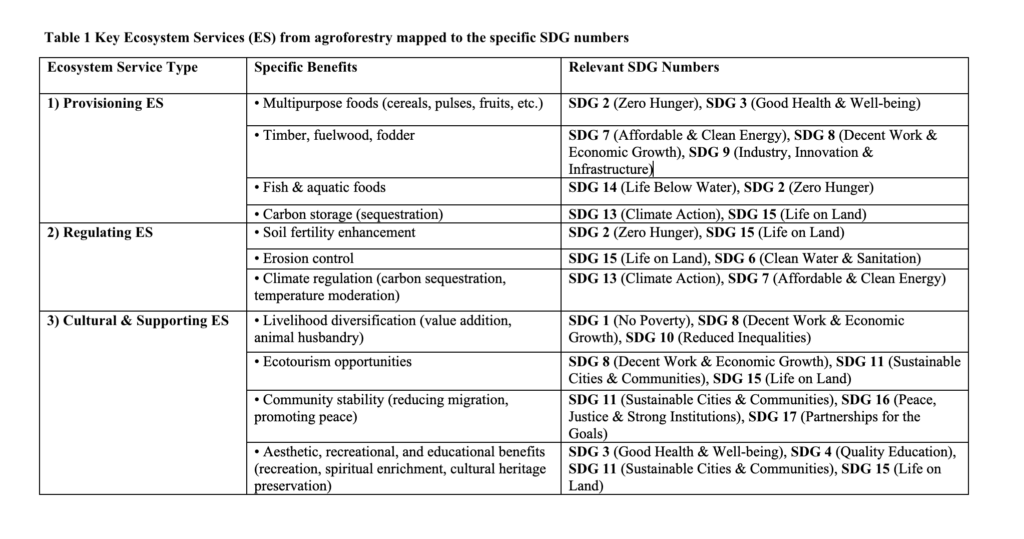
Together, these processes allow agroforestry to mitigate greenhouse gas emissions while strengthening resilience to droughts, floods, and temperature extremes – an essential contribution to SDG 13 (Climate Action: Fig. 1). Those can be elaborated through the following examples as seen from various parts of the globe and especially in India.
Defining the strength of agroforestry lies in its perennial woody components, e.g., trees, shrubs, and palms, that store carbon over decades rather than seasons. For example, teak-crop, mango-based, and cashew-based agroforestry systems in South and Southeast Asia are shown to accumulate substantially higher above- and below-ground carbon stocks than annual monocultures. In semi-arid regions, parkland systems with scattered trees such as Faidherbia albida have transformed degraded croplands into stable carbon sinks while maintaining food production. Communities adopting these systems report cooler microclimates, reduced wind erosion, and improved moisture retention, demonstrating how carbon sequestration and climate adaptation occur simultaneously, directly advancing SDG 13 (Climate Action).
Agroforestry rehabilitates soils through deep root systems, continuous litter fall, and enhanced microbial activity. In rainfed farming areas, farmers integrating nitrogen-fixing trees (e.g., Gliricidia, Leucaena) with cereals and pulses have observed significant increases in soil organic carbon, aggregate stability, and water infiltration. Such improvements reduce vulnerability to droughts and floods while lowering dependency on external inputs. In degraded landscapes once prone to runoff and nutrient loss, agroforestry has enabled communities to restore soil fertility, reclaim abandoned fields, and stabilise yields an essential foundation for long-term food security.
Agroforestry rehabilitates soils through deep root systems, continuous litter fall, and enhanced microbial activity.
The diversity is not incidental but central to agroforestry performance. Multistrata systems – combining timber trees, fruit trees, shrubs, annual crops, and sometimes livestock or fish – outperform monocultures in both carbon sequestration and resilience. For instance, home garden agroforestry systems containing mango, moringa, banana, vegetables, spices, and medicinal plants function as highly efficient ecological units.
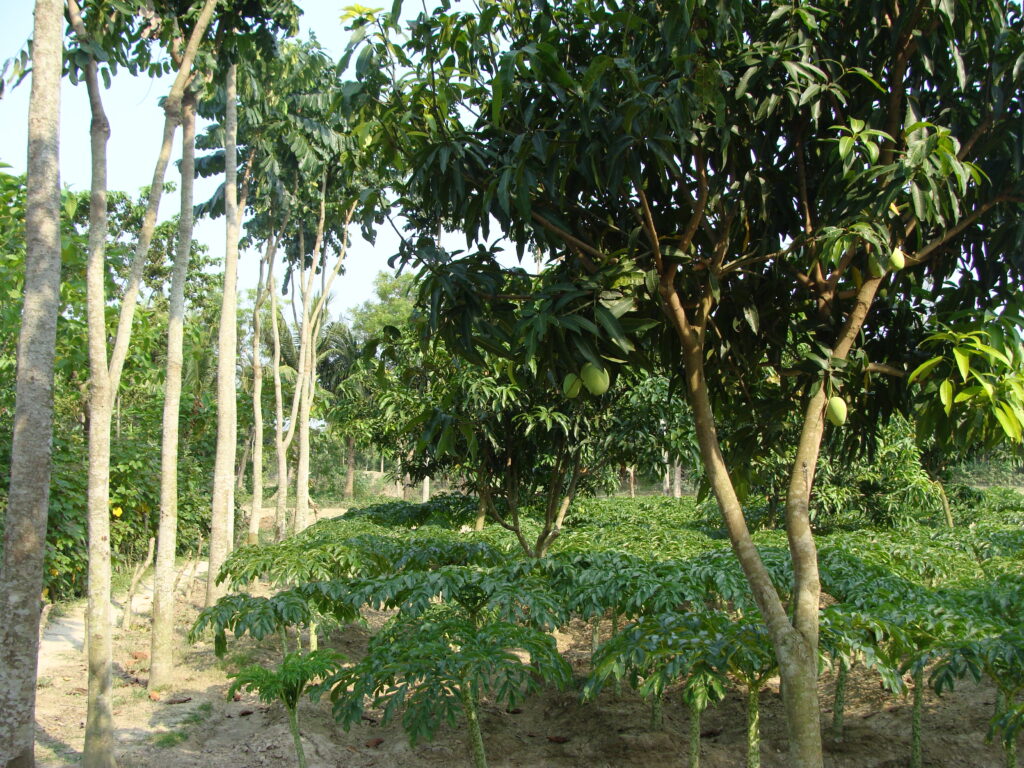
These systems buffer temperature extremes, suppress pests naturally, and spread climatic risk across species. At the landscape scale, communities transitioning from single-crop farming to diversified agroforestry mosaics report fewer total crop failures during climate shocks, reinforcing resilience while enhancing ecosystem services.
Diversified agroforestry systems reduce greenhouse gas emissions by minimising reliance on synthetic fertilisers, pesticides, and fossil-fuel-intensive inputs. This is because organic residues, nitrogen-fixing species, and biological pest regulation are integrated into farm design through agroforestry, input requirements decline sharply. In smallholder systems, this transition not only cuts emissions but also lowers production costs-making farms more economically viable. Communities adopting agroforestry, thus, move away from input-intensive models toward circular, low-emission production systems, reinforcing both climate mitigation and livelihood stability.
Feeding people while restoring the land
Agroforestry directly challenges the false trade-off between productivity and sustainability. In cereal- based systems, the integration of trees such as nitrogen-fixing species improves soil fertility, moderates microclimates, and stabilises yields under climatic stress. Research shows consistent yield improvements in rice, wheat, and sorghum systems when trees are strategically managed rather than excluded.
In many villages, agroforestry homegardens have reduced dependence on market-purchased foods, improved household nutrition year-round, and enhanced resilience during price shocks, thus advancing SDG 2 (Zero Hunger) and SDG 3 (Good Health and Well-being).
Agroforestry also directly addresses “hidden hunger” by enabling nutrient-rich foods to coexist within a single production system. Diverse fruits (mango, guava, etc.), leafy vegetables (moringa, etc.), nuts (cashew, groundnut, etc.), pulses (soybean, green gram, etc.), and even fodder supporting livestock or fish ponds collectively enhance dietary quality. In this way, agroforestry systems enrich diets with vitamins, minerals, protein, and dietary fibre-advancing SDG 2 (Zero Hunger) and SDG 3 (Good Health and Well-being) as listed in Fig. 1.
In many villages, agroforestry homegardens have reduced dependence on market-purchased foods, improved household nutrition year-round, and enhanced resilience during price shocks, thus advancing SDG 2 (Zero Hunger) and SDG 3 (Good Health and Well-being) simultaneously. In this way, agroforestry is not simply about calories; it is about nutrition-sensitive agriculture. Also, agroforestry landscapes support pollinators, regulate pests naturally, and reduce chemical residues in food-benefits that conventional high-input systems struggle to deliver.
Revitalising rural economies through value addition
Where agroforestry becomes truly transformative is at the intersection of ecology and economics. Trees create assets. When combined with value addition-processing fruits into juices or preserves, timber into furniture, medicinal plants into herbal products, through which agroforestry shifts farmers from price-takers to value creators.
Agroforestry reshapes rural economies by diversifying income streams across time-short-term crops, medium-term fruits, and long-term timber or ecosystem services. Women and youth, in particular, benefit through nursery management, processing of fruits and nuts, seed collection, and value-added enterprises. In several documented cases, communities have shifted from seasonal wage labour dependence to more autonomous, locally rooted economies, and become support for diversifying incomes, stabilising household economies, and generating rural employment, particularly for women and youth. Emerging opportunities such as carbon credits, eco-certification, and agro-ecotourism further strengthen rural financial resilience and further enhance rural income stability. This directly advances SDGs 1 (No Poverty), 8 (Decent Work and Economic Growth), and 9 (Industry, Innovation, and Infrastructure) as listed in Fig.1.
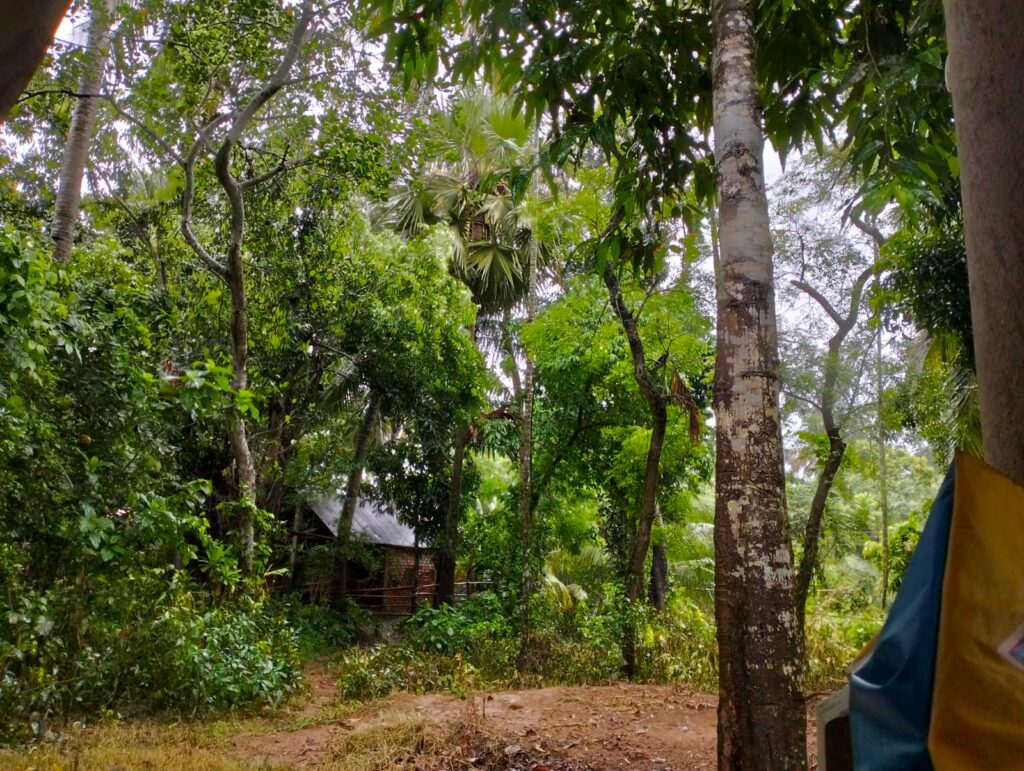
Importantly, value addition also incentivises conservation. Because economic value incentivises ecological stewardship. For example, when trees generate tangible income-through fruits, timber, resins, or ecosystem services, farmers actively protect them. This reverses deforestation dynamics and creates a virtuous cycle where biodiversity conservation, soil regeneration, and water security reinforce economic opportunity. Landscapes once characterised by degradation are gradually transformed into multifunctional production systems, advancing SDGs 12 (Responsible Consumption and Production) and 15 (Life on Land) as listed in Fig. 1.
Agroforestry as an integrated SDG solution
What ultimately sets agroforestry apart is its systems logic. Agroforestry does not pursue climate, food, or development goals in isolation; it weaves them together. By strengthening land tenure security, enhancing equitable access to resources, empowering women through diversified livelihoods, and fostering collective landscape management, agroforestry, thus, contributes to SDG 5 (Gender Equality), SDG 10 (Reduced Inequalities), and SDG 16 (Peace, Justice, and Strong Institutions).
Agroforestry does not pursue climate, food, or development goals in isolation; it weaves them together.
Because communities adopting agroforestry are not merely changing farming practices, they are transforming their landscapes, livelihoods, and social relations in ways that align ecological sustainability with human well-being (Fig. 1).
In these ways, agri-food systems can be regarded as the connective tissue of the SDGs – and agroforestry is among the most integrative models within them.
From vision to action
Despite its proven benefits, agroforestry remains under-scaled. The barriers are not ecological, but institutional because of fragmented policies, short-term planning horizons, limited extension services, and insufficient investment in research and farmer-led innovation.
To realise agroforestry’s full potential by 2030, governments must align climate, agriculture, and forestry policies. To achieve this goal, financial institutions must reward long-term ecological performance; and civil society must amplify farmer knowledge and community participation. Without this alignment, the SDGs risk remaining aspirational rather than achievable.
A closing imperative
Agroforestry is not a romantic return to the past, nor a niche alternative for smallholders alone. It is a scientifically grounded, economically viable, and socially inclusive pathway to resilient development. In a world confronting climate uncertainty, ecological degradation, and widening inequality, scaling agroforestry is no longer optional, it is strategic.
If the SDGs are to become lived realities rather than unmet promises, agroforestry must move from the margins to the mainstream. The roots of a sustainable future are already in the ground. What remains is the collective will to help them grow.
To learn more, read the book Agroforestry: Nature-based solution for climate change and food security, by Subhabrata Panda

