
Turning Renewable Promises into a Global Reality
Photo: Karsten Würth / Unsplash
Renewables are booming globally, but finance, grids, and implementation remain the transition’s biggest barriers.
The global renewable energy transition has entered a decisive new phase. Renewable technologies are now among the most competitive sources of new power generation in many parts of the world. Costs continue to decline, deployment is accelerating, and renewable energy is increasingly central not only to climate action, but also to economic competitiveness, industrial development, energy security, and long-term resilience.
Yet despite this progress, the transition remains too slow – and far too uneven.
The success of the global energy transition will increasingly depend not on whether renewable technologies exist, but on whether all countries can deploy them at the scale and speed required.
The scale of the challenge remains immense. Global installed renewable capacity reached 5,149 GW in 2025, following record additions of 692 GW – the largest annual increase in history. Yet even this record expansion remains below the pace required to stay on track with a 1.5°C pathway.
Closing this gap will depend increasingly on whether developing and emerging economies can scale renewable energy investment, infrastructure, and implementation capacity. Advanced economies alone cannot deliver the transition.
At the same time, electricity systems themselves are becoming more complex. Expanding renewable generation must be accompanied by major investments in transmission and distribution infrastructure, storage, system flexibility, and modern grid planning. In many regions, grid constraints, permitting delays, financing barriers, and insufficient project preparation capacity are emerging as central bottlenecks to deployment.
As we enter a decisive decade of electrification – spanning transport, buildings, industry, and emerging sources of demand such as digital infrastructure and data centres – growing electricity demand will make investment in grids, storage and system flexibility increasingly critical.
This transformation broadens the investment challenge beyond renewable power generation alone. Investment in grids alone will need to almost double — from USD 0.5 trillion in 2025 to around USD 1 trillion annually over the next decade — alongside accelerated investment in storage and flexibility solutions.
While global investment in energy transition technologies reached a record USD 2.4 trillion in 2024, financing remains highly concentrated. In 2023, 80% of international public renewable energy finance commitments flowed to just 29 countries and territories — largely concentrated in a relatively small number of major emerging economies and regional programmes.
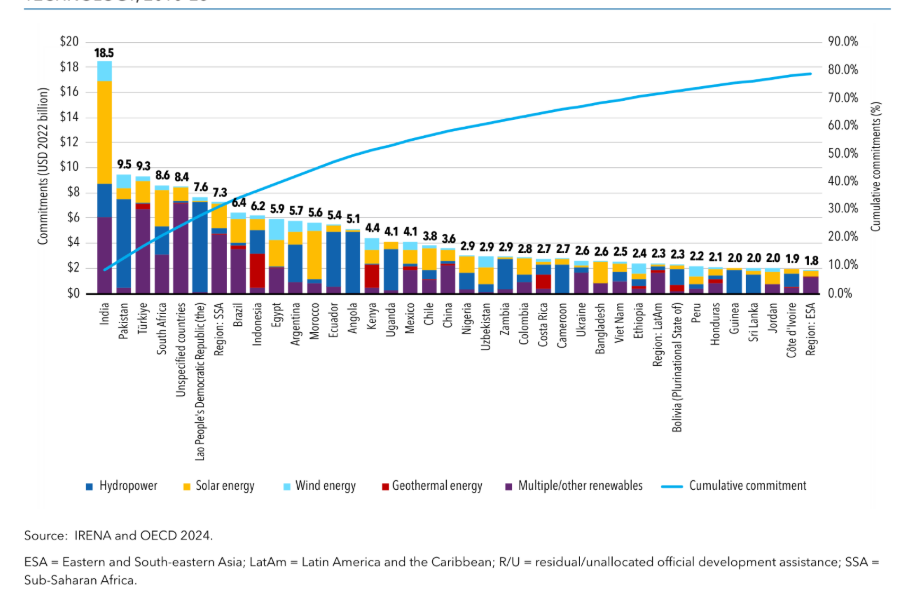
Many developing economies, particularly Least Developed Countries and Small Island Developing States, still face persistently high financing costs, limited access to affordable capital, and fragmented project pipelines.
If these structural imbalances are not addressed, the world risks replacing a system divided by fuel dependency with one divided by access to finance and implementation capacity.
Importantly, the principal barriers to accelerating the transition are no longer technological. Renewable technologies are mature, commercially available, and increasingly affordable. The greater challenge today lies in finance, infrastructure, institutional capacity, and implementation.
This requires broadening our understanding of innovation itself. Innovation must now include new financing structures, risk mitigation instruments, blended finance approaches, pooled procurement models, and institutional frameworks capable of accelerating delivery on the ground.
Practical examples are already emerging. Across Small Island Developing States, pooled procurement initiatives are demonstrating how innovatively aggregating demand through institutional approaches can reduce transaction costs and improve project bankability, helping translate opportunity into implementation.
The technologies are available. The economics are increasingly compelling. What matters now is whether implementation, finance, infrastructure, and international cooperation can move at the pace required by the transition.
The defining challenge of this decade is no longer whether renewable energy is viable. It is whether the global system can deliver it equitably and at scale.