
The Carbon Shadow of Artificial Intelligence
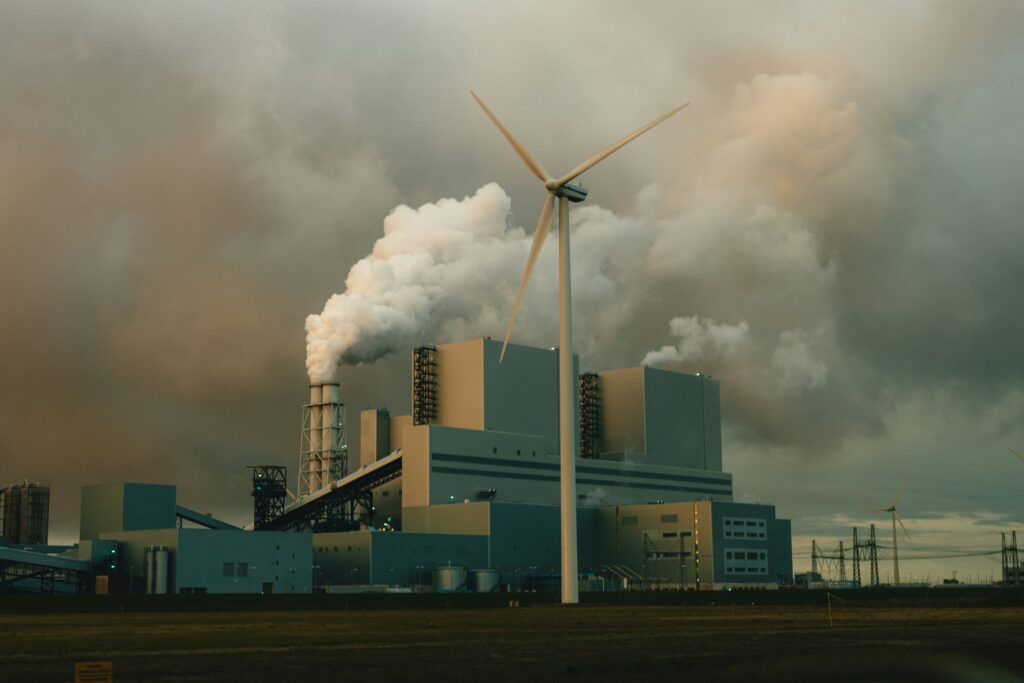
Photo: Chris LeBoutillier / Unsplash
In 2025, a quiet institutional death went unnoticed amid the turbulence of American politics: the Green New Deal Network – a broad coalition of climate, labor, and social justice organisation formally dissolved.
On the final day of 2025, a quiet institutional death went largely unnoticed amid the turbulence of American politics: the Green New Deal Network – a broad coalition of climate, labour, and social justice organisations formally dissolved.
In its closing statement, the coalition acknowledged that “the conditions under which the Green New Deal Network was founded have fundamentally changed,” noting that while “the mission of climate, jobs, and justice is far from over,” the structure built for a particular political moment was no longer a viable vehicle. The coalition’s demise, accelerated by the political realignment that returned Donald Trump to the presidency in 2024, marked not merely the end of an organisational chapter but the symbolic collapse of a specific paradigm of climate politics in the United States.
Yet this collapse coincided, paradoxically, with the emergence of a new and unexpectedly energetic front in the climate struggle: the fight against artificial intelligence data centres. This new front offers an exceptionally illuminating lens through which to examine both the deepening contours of the climate crisis and the political economy of energy that the digital transformation is rapidly reshaping.
AI’s hidden energy cost
I believe the climate movement has, almost by accident, found its most effective battlefield yet — not in Washington’s legislative chambers, but in the fight against artificial intelligence data centres. The quiet collapse of the Green New Deal Network in late 2025 should not be read as a defeat for climate politics. It is, in my view, the symptom of an obsolete model being replaced by something far more potent.
The quiet collapse of the Green New Deal Network in late 2025 should not be read as a defeat for climate politics.
A demand shock the numbers cannot excuse
The scale of AI’s energy appetite is no longer debatable. Lawrence Berkeley National Laboratory documents that U.S. data centre electricity use nearly tripled between 2014 and 2023, with projections of up to 580 TWh by 2028.
The International Energy Agency confirms that AI-dedicated facilities are growing faster than overall electricity demand worldwide. What troubles me most, however, is not the raw figures but the industry’s persistent framing of this growth as inevitable and unobjectionable. A peer-reviewed study estimating AI’s 2025 carbon footprint at up to 79.7 million metric tonnes of CO₂ should not be treated as a footnote to innovation; it should be treated as a policy failure in the making.
Why “green growth” rhetoric no longer convinces me
I am increasingly skeptical of the technology sector’s sustainability commitments when measured against the evidence. Developers facing slow grid connections are turning to onsite natural gas generation — in Washington State alone, this could add 13.5 million metric tonnes of CO₂ annually, undermining the state’s own Climate Commitment Act.
Equally troubling is the spectacle of corporations like Amazon outbidding public utilities for renewable contracts, as Grist reported in the Puget Sound Energy case. This is not decarbonisation; it is the redistribution of a fixed renewable pie toward whoever can pay the most, leaving residential ratepayers to absorb the consequences. I find it difficult to accept industry claims of green progress when the underlying infrastructure tells a different story.
The coalition I did not expect and why it matters
What genuinely surprises me is the political breadth of the resistance. A 2026 Gallup survey found that 75% of Democrats and 63% of Republicans oppose data centre construction in their own communities — a consensus I have not seen on any other energy issue in recent memory. Seattle’s unanimous City Council vote for a one-year moratorium, passed after 52 testimonies in favour and zero in opposition, strikes me as a model worth replicating rather than dismissing as parochial obstruction.
This cross-partisan unity is precisely what the Green New Deal era never achieved.
I would argue this cross-partisan unity is precisely what the Green New Deal era never achieved, and climate advocates should recognise it as a strategic asset rather than a distraction from “real” national policy.
Where I think the real risk lies
That said, I do not think local moratoriums are sufficient, and I say this with some urgency. The rebound effect — where efficiency gains simply enable greater consumption — means that technological optimism alone will not solve this problem. The UNU-INWEH 2026 report reinforces my own conviction that piecemeal, single-metric environmental assessments are inadequate; carbon, water, and land impacts frequently move in opposite directions; a fact regulators have largely failed to internalise.
Toward a regulatory response
I would propose three concrete steps. First, mandatory and independently verifiable environmental disclosure should be required of every data centre operator, not voluntary reporting designed for public relations.
Second, cost-allocation frameworks must legally prevent infrastructure expenses from being silently transferred onto household utility bills.
Third, and most urgently, national and supranational regulators should move beyond municipal-level patchwork solutions and establish binding emissions and water-use thresholds for hyperscale facilities.
I remain convinced that the real significance of this movement lies not merely in the moratoriums themselves, but in what they represent: a rare moment when local democratic action is outpacing institutional climate politics. Whether this momentum can be translated into binding regulatory frameworks, rather than dissolving into scattered local victories, will determine whether the coming decade of AI expansion accelerates or derails the global energy transition. I, for one, believe this is the test the climate movement cannot afford to fail.