
Microgrid Deployment in the US is More Complicated than We Think
Photo: Sreenivas
The trajectory of microgrid deployment pathways depends on who initiates them.
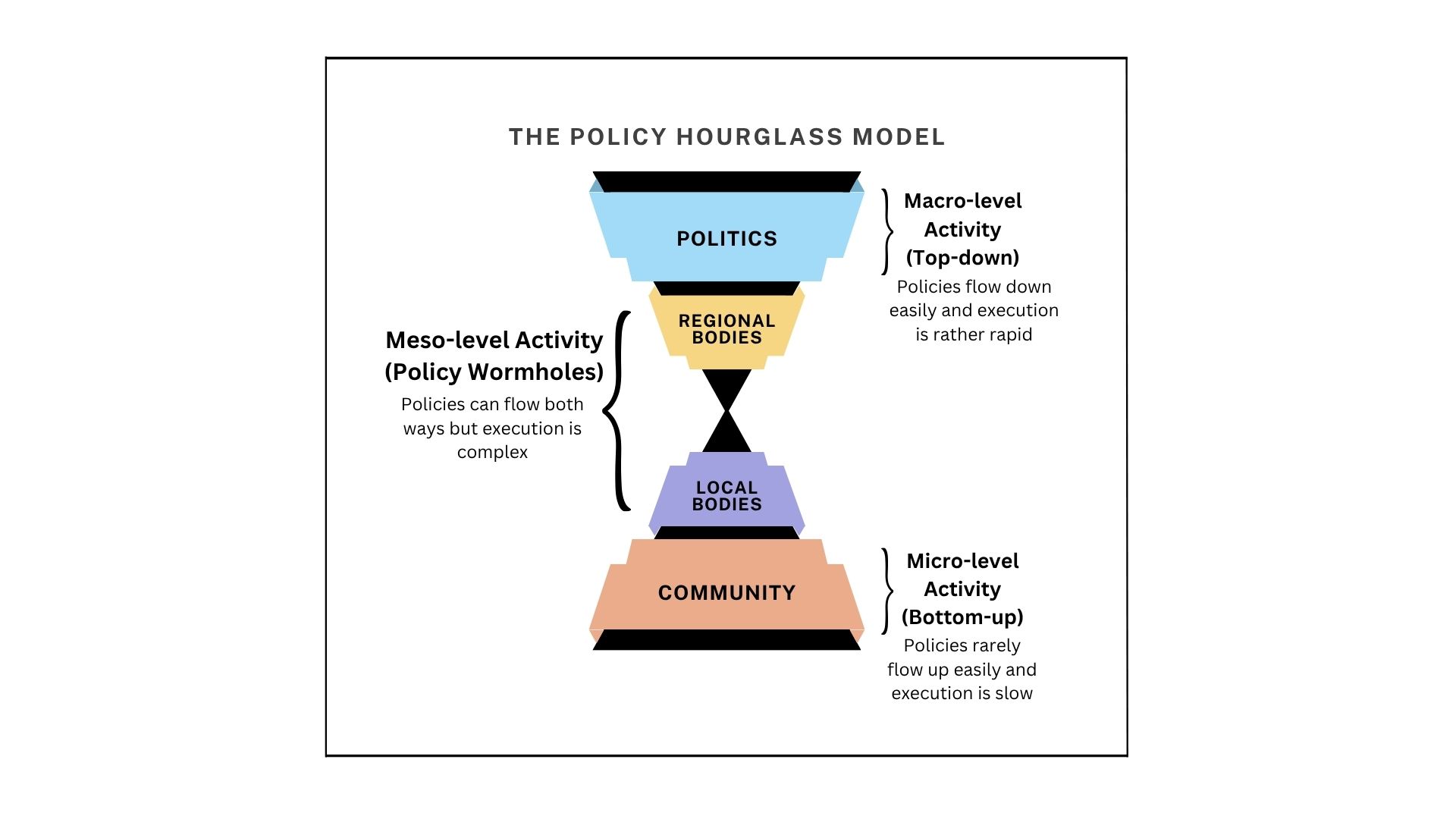
Furqan and Heleno illustrated microgrid deployment policy trends in the US and reflected on high-level policy archetypes for microgrid deployments. Based on the patterns identified, Furqan theorises a ‘Policy Hourglass Model’ (PHM) exhibiting microgrid deployment policy rollouts and adaptation pathways. PHM helps summarise and understand national, state, regional, and local policy blueprints and simplify how they interact with each other. PHM has two main tiers, with two sections each, representing policy origins (Figure 1).
Politics
In the top tier, the top [POLITICS] section represents the political realm and how microgrid policies are being rolled out through legislative processes. This is a macro-level (top-down) way of promoting ideas, making it easy to accelerate implementation as outcomes get trickled down. Politicians and government officials are the biggest decision-makers, political initiation comes from federal or state actors, and it is backed by organised legislation and governance. SB1339 (2018) in California (CA) is an example that led to an extensive rulemaking process to commercialise microgrids. This legislative action inevitably promoted governance and financial flow that the underlying policies persevered in the state, mobilising regional, local, and communal stakeholders, and execution was rather structured. According to the DOE, as of May 2026, there are 190 microgrids in CA, 111 of which came online in or after 2018.
Politicians and government officials are the biggest decision-makers, political initiation comes from federal or state actors, and it is backed by organised legislation and governance.
Community
At the bottom of the hourglass, the bottom [COMMUNITY] section represents local communities and their spontaneous policy initiations. This is the opposite of the political realm, as policies and project outcomes here are on a micro-level (bottom up) and rarely flow upward, as it might take a lot of effort and resources for communities to achieve project success and resolve local resilience issues. These community members, along with local governments and utility/private companies, make decisions and might seek external resources and support. Examples of successful projects could spontaneously motivate microgrid deployment in other communities, but could still struggle to get translated into macro-level state legislation.
Examples of successful projects could spontaneously motivate microgrid deployment in other communities.
Though not impossible, successful project implementation alone is not a strong enough factor to move the influence up to higher tiers. Tennessee is an example of this where without any explicit political effort, communities are trying to solve their local resilience issues through microgrids and already have four microgrids. Another example is Vermont, where Green Mountain Power (GMP), and other community actors have deployed microgrids to support local resilience needs, without any explicitly supportive legislative activity, resulting in four microgrids.
Policy wormholes
Between these two extreme realms, there are ‘policy wormholes’- transient meso-level spaces where policies can flow both ways – that help mobilise resources and connect stakeholders. These wormholes consist of two sections: the top one [REGIONAL BODIES] being the regional realm where regional institutions help implement policies, and the bottom one [LOCAL BODIES] where local institutions play a similar role. An example of a regional body is a public utilities commission (PUC) or a state energy authority that can initiate a policy and make decisions to help resources flow downstream to local bodies, including local governments and companies. These local bodies can then help resources flow further down to communities, including non-profit organizations, research institutions, and local residents.
These local bodies can then help resources flow further down to communities, including non-profit organizations, research institutions, and local residents.
In these two (regional and local) policy wormholes, policy execution is complex, and while they can work independently, these realms often collaborate for smoother policy implementation. Whether or not the policy originates from the top (political) realm, these policy wormholes prove to be defining factors in project success and help all realms communicate effectively, while resources and ideas can also flow both ways. New York and Massachusetts are examples of states where both regional and local bodies are working together to improve resource flow for microgrid deployment in both micro and macro directions, as they also try to organize the top (political) and bottom (communities) realms.
In New York, NYSERDA, along with many private institutions, is one of the microgrid enablers. The state currently has 111 microgrids without any enacted legislation directly supporting microgrids quite yet while several bills are still underway. In Massachusetts, many private owners as well as the MA Clean Energy Center (CEC) is one of the microgrid enablers and the state has 63 microgrids while microgrid-related legislations are still underway.
While politically driven efforts rapidly help scale microgrid deployment, community-led microgrids can emerge without formal policy, but their scale remains uncertain.
PHM reflects on three main policy pathways of microgrid deployment in the US; top-down political action, bottom-up community initiatives, and meso-level “policy wormholes” linking all realms through regional and local actors. While politically driven efforts rapidly help scale microgrid deployment, community-led microgrids can emerge without formal policy, but their scale remains uncertain. ‘Middle’ institutions e.g., utilities commissions, energy agencies and authorities, and local stakeholders can serve as transient enablers and help advance deployment even before any legislation is enacted.