
The Climate Risk of AMOC and Global Consequences
Photo: Andrzej Kryszpiniuk / Unsplash
Ocean circulation disruption could reshape climate, food systems and global stability.
The Atlantic Meridional Overturning Circulation (AMOC) is one of the planet’s most critical climate systems, regulating temperatures, weather patterns, and ocean dynamics across the North Atlantic and beyond. Yet despite its importance, it remains largely absent from public debate. As scientific warnings about a potential tipping point grow stronger, concerns are rising over what a significant weakening, or even collapse, could mean for societies, economies and global food systems.
In this conversation, Justus Lehtisaari, Head of International Cooperation at Operaatio Arktis, and Páll Gunnarsson, Executive Director of the Reykjavik Institute, join Ahmetcan Uzlaşık for Everything is Changing. Drawing on insights from the Nordic Council of Ministers’ report on AMOC tipping points, they explore the risks, uncertainties, and governance challenges surrounding one of the most consequential yet under-discussed climate threats.
Let’s start with the big picture. With ongoing wars and geopolitical crises dominating headlines, do you feel climate risks like AMOC are losing attention?
Páll Gunnarsson: I think, at the macro level, that is unfortunately true. There is a clear shift of political and public attention towards immediate geopolitical crises, and climate issues often get deprioritised in that context. Governments have limited capacity, and when security concerns escalate, they tend to absorb most of that capacity.
However, within more specialised circles, particularly those working on climate risks, tipping points and Earth system science, I actually see a different trend emerging. There is growing awareness that climate change is not just an environmental issue but a security issue. In Iceland, for example, AMOC is increasingly being discussed in national security terms. That reframing changes the conversation significantly.
So, while public attention may fluctuate, within certain policy and research communities, the urgency is actually increasing. We may be moving beyond what some call “green hushing” towards a more serious engagement with systemic climate risks.
Justus Lehtisaari: I would echo that, but I would also emphasise how these crises are compounding rather than replacing each other. It’s not that climate risks disappear when geopolitical crises emerge, they simply become harder to manage simultaneously.
From a cognitive and political perspective, societies can only handle a limited number of risks at once. That creates a real challenge: how do you keep long-term systemic risks like AMOC in focus while dealing with immediate crises like war?
What is interesting, though, is that AMOC is increasingly entering the realm of risk analysis and security thinking. When a country like Iceland frames a climate phenomenon as a national security issue, that is quite significant. It elevates the topic from environmental policy to strategic policy, which could ultimately lead to more serious engagement.
Let’s clarify the basics. For someone completely outside the climate field, what exactly is AMOC, and why should policymakers take it seriously?
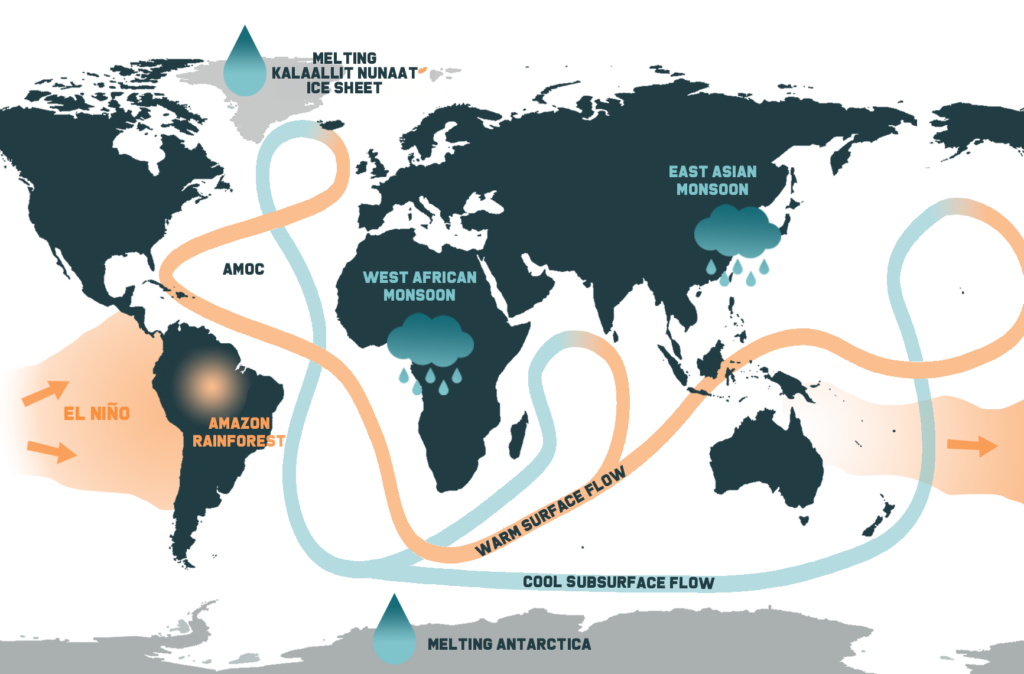
Páll Gunnarsson: At its core, AMOC is a large-scale ocean circulation system that redistributes heat across the planet. Warm water flows northward from the tropics towards the North Atlantic, releases heat into the atmosphere, and then colder, denser water sinks and flows back southward.
This process plays a fundamental role in regulating climate, particularly in Europe and the North Atlantic region. Without it, regional climates would look very different.
But what makes AMOC especially important is not just temperature regulation, it is its influence on precipitation patterns. And precipitation is the foundation of global agriculture. If those patterns shift significantly, the implications for food production could be profound.
Some modelling studies suggest dramatic reductions in agricultural viability in parts of Europe and other key food-producing regions. While there is still uncertainty, the direction of these findings is deeply concerning. So policymakers should not see AMOC as an abstract oceanographic concept. It is directly linked to food security, economic stability and societal resilience at a global scale.
It is directly linked to food security, economic stability and societal resilience at a global scale.
One thing that often comes up is the difference between gradual weakening and a tipping point collapse. What does that actually mean in practice?
Justus Lehtisaari: The distinction is crucial. When we talk about gradual weakening, we are describing a linear process, something that changes incrementally over time.
A tipping point, on the other hand, is non-linear. It involves a threshold. Once that threshold is crossed, the system can shift abruptly into a new state, and importantly, that shift can become self-reinforcing.
A simple analogy is tipping a chair. You can push it slowly, but once it passes a certain angle, it will fall on its own, even if you stop pushing.
From a governance perspective, this creates a major challenge. If you allow the system to reach that tipping point, reversing it may be impossible within human timescales. That’s why the precautionary principle becomes so important. The difficulty is that we are dealing with uncertainty. Policymakers often want precise timelines and probabilities but tipping points don’t offer that clarity. That makes it harder to act – yet also more dangerous not to.
Páll Gunnarsson: And I would add that this dynamic runs counter to how societies typically respond to risk. There is a common assumption that we will act decisively once things become visibly bad.
But with tipping points, by the time impacts are clearly visible, the system may already be beyond recovery. So the real policy challenge is acting early, before the urgency is obvious. That requires a level of foresight and political courage that is not always easy to achieve, especially within short political cycles.
In the report, there were these striking ‘storylines’ about possible future scenarios. If the AMOC changed significantly, what are the first everyday impacts people in Iceland or the Nordics might actually notice?
Páll Gunnarsson: We are, of course, moving into a more speculative space here. But I do think speculation has value when it is disciplined and connected to plausible risk pathways.
My own view is that the first catastrophic impacts may not come directly from climate itself, but from how societies react to the perception of climate catastrophe. I have spoken about this in Iceland, including with people concerned with financial stability. If we imagine a future where scientific pessimism around AMOC continues to increase and early warning systems eventually become good enough to say, in a credible way, that we are very close to a tipping point, or may even have crossed one, then people will not simply wait passively for decades to see what happens. They will act based on expectations.
In Iceland, that could mean capital flight and asset flight. We are a small, relatively isolated economy with our own currency. A significant portion of assets is tied up domestically, whether in property, pension funds or local investment structures. If the perception takes hold that Iceland could become economically or physically unviable in the long term, then the shift in risk perception itself could trigger a socioeconomic crisis. In that sense, a financial or confidence crisis could arrive before the climate effects are fully felt.
At the broader international level, my greatest concern remains food systems and the international order around them. If we were guaranteed that the global community would respond cooperatively, rebuilding food systems together, coordinating, redistributing and managing scarcity, then the future would still be extremely difficult, but perhaps less terrifying. But I think it is at least equally plausible that the opposite happens: worsening geopolitical conflict, trade fragmentation, competition over resources and perhaps even open conflict around access to food and stability. So I do not separate the climate story from the geopolitical and economic story. They are intertwined.
Justus Lehtisaari: We explored some of this more systematically last year through what we called a “science sparring” exercise with the Finnish National Emergency Supply Agency and the Finnish Academy of Science and Letters. The point was to think about plausible implications rather than simply list abstract risks.
One major issue that emerged was infrastructure. Much of the Nordic infrastructure we have today, roads, ports, electricity systems, heating systems, is not necessarily designed for the kinds of more extreme winter conditions that could become plausible in a weakened or collapsed AMOC scenario. We often assume adaptation means adjusting existing systems slightly, but in this case the changes could be much more fundamental.
Another issue is land-based livelihoods. Agriculture, forestry and other climate-sensitive sectors in countries like Finland could be hit hard if winters become colder, drier or otherwise more unstable. Heating demand would likely rise, which raises further questions about energy systems. What happens to hydropower if precipitation patterns shift? What happens to solar, to overall energy demand, to energy planning? These are not small details, they affect the basics of daily life and economic functioning.
And the conclusion we came to was that this would not be normal adaptation. It would require prioritisation under extreme uncertainty. You could not simply preserve everything as it is. You would have to decide what to protect, what to transform and what to let go. That is transformative adaptation, not incremental adjustment.
Páll Gunnarsson: And on the energy side, this really underscores how much more risk-impact research is needed. I have spoken with people at Iceland’s national energy company. Most of our electricity comes from hydropower, and while it is clear that precipitation patterns would change under a declining AMOC, our energy planning still largely relies on climate assumptions built around more linear warming scenarios. Those assumptions may not hold at all under a major circulation disruption.
One thing that confuses many people is this: we have talked about global warming for decades, but now we also hear that AMOC weakening could mean colder winters in parts of the North Atlantic. How does that work?
Justus Lehtisaari: Yes, this can sound contradictory, and politically it is also tricky, because it can easily be misused by climate sceptics. People might say, “Well, first you told us the climate is getting warmer, and now you are telling us it may get colder.” But the key is scale and circulation.
AMOC functions like a major conveyor belt carrying heat northward. If that conveyor belt slows down significantly, then less heat is transported into the North Atlantic. The heat does not vanish, it gets redistributed. In practical terms, that means the south may retain more warmth while the northern regions receive less of the heat they currently do. So you can get regional cooling effects within an overall globally warming world.
I sometimes explain it with a body analogy: if your circulation is poor, your feet can become cold even if the rest of your body is not. That does not mean your whole body has cooled down. It means the system distributing heat has changed.
But there is another layer of complexity: AMOC weakening would happen against the background of ongoing global warming. So we are not talking about a stable climate suddenly becoming colder in one area. We are talking about one major system shifting within an already warming world. That means outcomes depend heavily on timing, background temperatures and other interacting variables. That is why this remains such a complex and uncertain issue.
This discussion is often framed through a Nordic lens, but why should the rest of Europe, or the wider world, care about this? Why should someone in southern Europe, for example, see this as their issue too?
Páll Gunnarsson: For me, the answer is very straightforward: because the most alarming risks are not primarily about local temperature discomfort. They are about global food production and food trade.
This is not even only about AMOC. We already see a broader climate-security conversation emerging around the fragility of food systems. In the UK, for example, recent climate security work has painted a very bleak outlook on food vulnerability. There is a credible scenario in which countries begin scrambling to secure food supplies for their own populations. That means intensified competition between states over access to stable food production and trade.
In such a world, this is not a Nordic issue. It is a global issue. And as is almost always the case, the poorest and least powerful societies would be hit first and hardest. They would pay first, and they would often pay with their lives. So the person in Athens, or anywhere else, should care not because this is an abstract Nordic climate problem, but because systemic climate disruptions reverberate through food, trade, inequality and security everywhere.
This is not a Nordic issue. It is a global issue.
If AMOC were a volcano or an earthquake, we would probably fund monitoring without hesitation. But with the ocean, it somehow still feels optional. What would a serious AMOC early warning system look like in practice, and who should fund and coordinate it?
Justus Lehtisaari: There are several dimensions to this. First, it is important to note that some relevant initiatives already exist. For example, there is significant work underway in the UK around the subpolar gyre, another ocean circulation system connected to the Greenland ice sheet and deeply relevant to AMOC behaviour in many models. ARIA, the UK’s Advanced Research and Invention Agency, has invested heavily in trying to build an early warning capability there.
But more broadly, a serious warning system would require much more coordinated and sustained monitoring. We have had continuous direct measurements of AMOC only since 2004. That is not very long at all for something so large and complex. There are projects ongoing, but from a European perspective, they are not yet coordinated enough.
That was one of the key messages in the Nordic Council of Ministers report: Europe needs to invest in coordinated monitoring and early warning systems, rather than relying on scattered research initiatives. And it is not enough just to produce scientific signals. The system also has to deliver policy-relevant information that governments are willing and able to act on.
Europe needs to invest in coordinated monitoring and early warning systems, rather than relying on scattered research initiatives.
There is also a strategic dimension here. The United States has historically played a major role in climate and ocean observation. But given the political volatility around climate in the US, Europe cannot assume it will always be able to rely on American data or continuity. So, from a European perspective, there is a strong argument for bringing observational capacity and data sovereignty more firmly into European hands.
Páll Gunnarsson: I think this is exactly the right framing. A real warning system would require both physical monitoring capacity and institutional commitment.
On the monitoring side, the scientists I speak with often point to the funding problem. Much of this work still depends on competitive, short-term grants. That may be fine for research questions, but it is not how you build an operational warning system. If you want something comparable to earthquake or volcano monitoring, you need long-term, predictable funding, something much closer to core public infrastructure than to temporary academic funding.
At the EU level, there are opportunities. The ongoing Ocean Act discussions could provide a pathway toward institutionalising some sort of early warning platform. New ocean observation initiatives could potentially incorporate this more explicitly. Existing institutions could also evolve in that direction. But beyond the science there is another crucial question: what is a policy-relevant signal?
Imagine that a warning system becomes highly successful and tells us that a critical AMOC-related subsystem is likely to tip within ten years. That is scientifically significant, but for a policymaker, it is not enough simply to know the risk exists. They also need to know what to do. What actions become urgent? What economic or governance measures should follow? That action-oriented side of warning systems is still very underdeveloped. In some ways, it is the next frontier.
Climate impacts are never only physical. They reshape communities and institutions too. In an AMOC disruption scenario, what social system would you watch most closely?
Páll Gunnarsson: For me, it is food security above all. That is the central system. Agriculture, fisheries, food trade, those are the areas where physical climate disruption translates most directly into social disruption.
I am actually quite radical on this point. I would like to see much faster movement toward food production systems that are less climate-dependent. For example, forms of modular protein production using bacteria, fungi or algae, linked to stable energy systems, could provide resilience that conventional climate-dependent agriculture does not. It sounds futuristic, but the logic is simple: if you are facing a world where climate variability becomes extreme, then food systems that can function independently of specific weather conditions become strategically essential.
There were even old emergency plans during the Cold War that thought in similar terms, how to maintain food supply when ordinary agricultural systems fail. In my view, that is not a fringe conversation anymore. Everything else, migration, inequality, employment, mental health, political instability, flows from whether people can reliably eat. If we miss that, we miss the core of the problem.
And the timing issue matters here too. If we delay until risk signals become severe, we may find ourselves trying to build resilient food systems in the middle of financial instability and climate panic. That would be far harder than starting now.
Final question. If you had a magic stamp and could make one decision happen within 12 months, no bureaucracy, no delays, what is the single most important action Nordic governments should take right now to reduce AMOC tipping risk?
Justus Lehtisaari: You are essentially asking me to become a benevolent Nordic dictator for a moment. I am not sure I will give you the neatest answer, but I do think there is one underlying point that matters most.
Humanity has a very poor track record when it comes to preparing for risks that are seen as unlikely until they happen. A lot of recent history shows this. Warnings may exist, but governments hesitate because the scenario still feels improbable, politically inconvenient, or economically disruptive. Then the event happens, and everyone admits that they should have prepared earlier.
For me, the same lesson applies here. The most important thing Nordic governments should do is to fully accept radical uncertainty and build governance capacity around it. That means developing serious future scenarios, serious preparedness plans and serious response options for outcomes that may seem unlikely but are very much possible.
Uncertainty should not be interpreted as an excuse for paralysis. And that happens far too often. When people hear uncertainty, they assume it means the risk is not real enough to act on. In fact, uncertainty in the presence of massive possible harm should often push us to act more, not less.
So if I had your magic stamp, I would use it to force governments to stop hiding behind the comfort of probability language and to start systematically preparing for unacceptable futures, even if they are not the most likely futures. That shift in mindset would, in my view, be one of the most important possible steps forward.