
Exposing Big Tech’s Climate Claims
Photo: Geoffrey Moffett / Unsplash

AI’s climate promises are masking rising emissions, fossil fuel expansion, and the unchecked growth of data centres.
Artificial intelligence is often presented as a climate solution, but its rapid expansion is driving a surge in energy demand, data centre growth, and emissions. At the same time, major tech companies continue to position AI as part of the green transition, raising questions about transparency and accountability.
In this conversation, climate and energy analyst Ketan Joshi joins Ahmetcan Uzlaşık for Everything is Changing to unpack how AI is reshaping energy systems, and how its environmental impact is being communicated. Drawing on his report The AI Climate Hoax, he explains why the narrative around AI and climate often obscures more than it reveals.
To begin, can you walk us through your background and how you came to this topic?
I started my career in renewable energy in Australia, working at a wind farm company where I was involved in operations, data analysis and market participation. That gave me a practical understanding of how energy systems function, from forecasting to maintenance and optimisation.
Over time, I realised I was more drawn to communication, advocacy, and explaining complex issues. I began combining technical knowledge with writing and public engagement, first within the company and later in broader roles, including at a government renewable energy agency.
I eventually wrote a book on energy politics and climate in Australia, and after moving to Norway, I worked on corporate accountability in Europe. Now, as a freelance analyst, I focus on how industries communicate about climate, particularly where narratives diverge from reality. The AI space is a natural extension of that, because it sits at the intersection of energy, technology, and public perception.
Your report highlights how companies frame AI as a climate-friendly innovation. What makes this narrative so problematic?
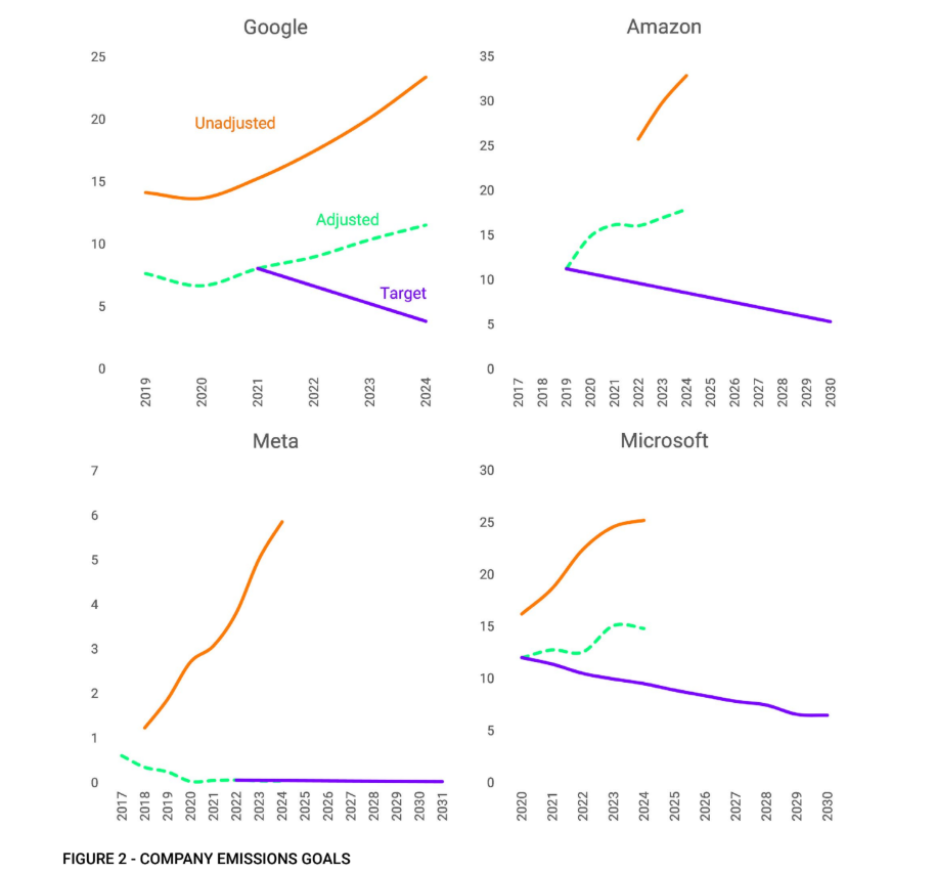
What stands out is not just the scale of the claims, but how they are constructed. A few years ago, we saw a wave of ambitious net-zero commitments from major tech companies. These were presented as tech leading the way for sustainability, but what has happened since is the opposite. Emissions have increased significantly, largely due to the rapid expansion of data centres and AI infrastructure.
This creates a problem for companies. They have made strong public commitments, but their actual trajectory contradicts those promises. So instead of revising the narrative, they reshape how the story is told. They highlight selective examples, emphasise future solutions and avoid drawing attention to the overall trend.
The result is a disconnect between perception and reality. On paper, these companies still appear aligned with climate goals, but in practice, their emissions are rising rapidly.

You make an important distinction between traditional and generative AI. Why does that matter?
It matters because they are fundamentally different technologies with very different energy profiles. Traditional AI, or machine learning, is something we have used for years. It involves analysing existing data and making predictions or classifications. It is relatively efficient and can often run on standard hardware.
Generative AI is entirely different. It does not just analyse data, it creates new content, and that process is far more computationally intensive. Traditional machine learning systems, like photo recognition or wind forecasting, match patterns in existing datasets and can often run on relatively low energy, even on a laptop. Generative AI, by contrast, must produce new outputs every time you prompt it, which requires large-scale data centres and significantly more energy.
The difference becomes even clearer when you move from text to images and then to video. Generating text is already energy-intensive, but generating images requires far more computation. Video is the most demanding of all, because it is essentially a sequence of images. For example, creating just one second of AI-generated video can require around 25 frames, meaning the system must generate 25 separate images. On top of that, higher resolution does not increase energy use linearly but exponentially, as each increase expands the total number of pixels being computed.
This is why comparing different types of AI under a single label can be misleading. The systems often cited for climate benefits are not the same ones driving the rapid growth in energy demand.
So, when companies claim AI will help reduce emissions, are they talking about the same technology driving energy demand?
In most cases, no. That is exactly the issue. Many of the positive climate claims are based on traditional AI applications, like improving efficiency in energy systems or logistics. Those are real and valuable.
But at the same time, generative AI is expanding rapidly and driving a surge in electricity demand. When these two are combined into a single narrative, it creates the impression that AI as a whole is beneficial for the climate.
It’s like comparing bicycles and airplanes and calling them both “transport solutions” without acknowledging their vastly different impacts, which is a quote from Karen Hao who recently published a book called Empire of AI, which I highly recommend. The framing matters, because it shapes how policymakers and the public understand the trade-offs.
Do you think this is deliberate greenwashing or just poor communication?
It is difficult to prove intent, but the pattern is very familiar. We have seen similar strategies in other sectors, particularly fossil fuels. Companies highlight small positive actions while downplaying larger negative impacts.
In this case, the structure of the communication serves a clear purpose. It diverts attention from rising emissions and reinforces the idea that these companies are still part of the solution. Whether intentional or not, the effect is the same. It obscures the scale of the problem.
One striking point in your report is that the evidence behind many climate benefit claims is weak. What did you find?
We looked at the sources behind major claims about AI reducing emissions. Some reports suggest very large global benefits, even at the scale of gigaton reductions. That is an enormous claim, so you would expect strong evidence.
In reality, much of the supporting material is not rigorous. Some references are academic, but a significant portion comes from corporate websites or unverified case studies. In some cases, the evidence is extremely thin or unclear. There’s a claim in the IEA’s report where they talk about a specific cruise line company, I think it’s Carnival Corporation, reducing their fuel use by 5% thanks to AI deployment. And that’s a lot. Five percent is pretty massive for such a major company. So I looked up the source and it was just a website with maybe 15 paragraphs of text, no links, no author, nothing that made it possible to verify where the information came from. It even had the look of AI-generated text. Then when I checked Carnival’s own sustainability reporting, what they actually seemed to describe was some software optimization related to reducing food waste in kitchens, not the dramatic AI-driven emissions reductions that were being claimed publicly.
This does not mean AI cannot contribute to emissions reductions. It can. But the scale and certainty of the claims often go far beyond what the evidence supports. That gap is important, because it influences policy and investment decisions.
Beyond communication, how significant is AI’s actual climate impact today?
Even conservative estimates show that AI is already contributing substantially to emissions, mainly through data centres. According to the International Energy Agency, data centres accounted for around 1.5% of global electricity demand in 2024, and this could double by 2030 as AI adoption accelerates.
Looking specifically at AI, researcher Alex de Vries estimates its global footprint could reach between 32.6 and 79.7 million tonnes of CO₂ annually by 2025. That is roughly comparable to the emissions of a mid-sized country or a large U.S. state like New York. And these figures are likely underestimates, since many companies do not fully disclose the energy use of their AI systems.
What is particularly concerning is the infrastructure being built to support this growth. In some regions, especially in the United States, new fossil fuel power plants are being constructed specifically to supply data centres. That is a major shift, because it ties digital expansion directly to increased emissions rather than decarbonisation.
The current numbers may not yet dominate global emissions, but the trajectory is what matters. If growth continues unchecked, the impact could scale rapidly and lock in new sources of carbon-intensive energy for decades.
What can policymakers and the public realistically do in response?
There are two main areas. First is regulation. Governments need stricter rules around data centre development, energy sourcing and transparency. At a minimum, companies should be required to match their energy use with genuinely additional renewable energy and disclose their emissions clearly.
Second is public awareness and behaviour. This is more complex, because these tools are integrated into daily life. But awareness still matters. Questioning how and why we use certain technologies can influence demand over time.
It is also important to remember that change is not happening in isolation. There is growing opposition to data centre expansion, and regulatory pressure is increasing in many regions. These signals show that pushback is possible and can have an effect.
Finally, what is the key takeaway from your report?
The core issue is not just the technology itself, but how it is being framed. AI is being presented as inherently beneficial for the climate, while its negative impacts are downplayed or deferred into the future.
These are choices. Companies are deciding how to build, power and communicate their technologies. That means the current trajectory is not inevitable. It can be changed.
Recognising the gap between narrative and reality is the first step. Once that is clear, it becomes much easier to have an honest conversation about what role AI should play in a sustainable future.