
Cities Must Shape Europe’s Mobility Future
Photo: Bluestork / Shutterstock

Europe’s competitiveness depends on cities leading sustainable mobility, not simply deploying the latest transport technologies.
As Europe places competitiveness at the centre of its political agenda, cities are becoming increasingly influential in shaping the future of mobility. From public transport and automation to industrial policy and urban planning, local governments are making decisions that will determine whether innovation supports climate goals or undermines them.
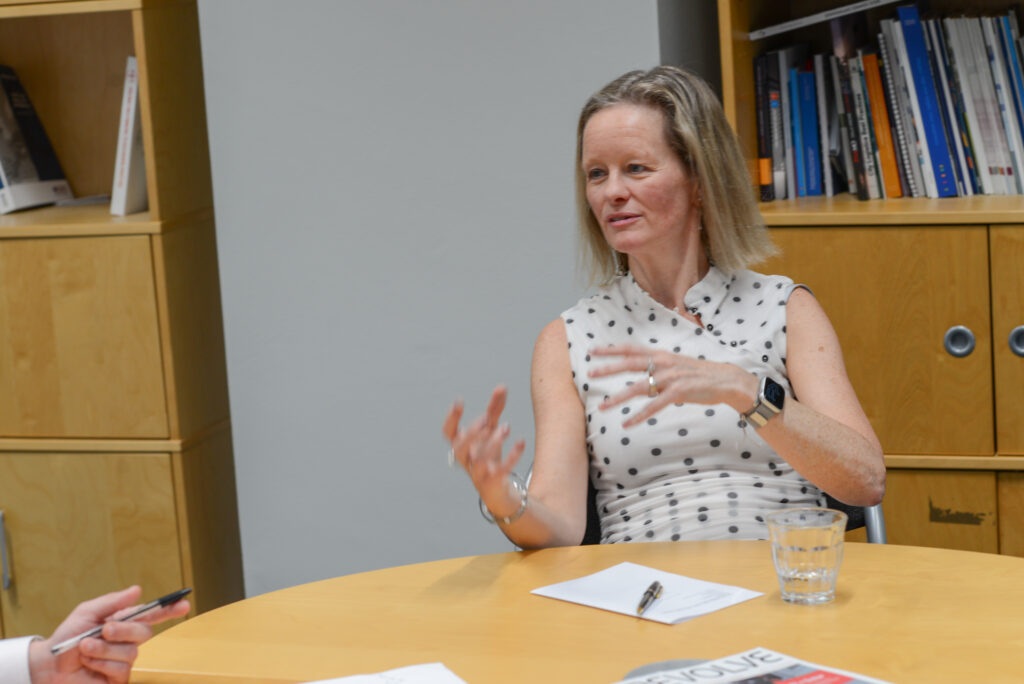
Karen Vancluysen, Secretary General of POLIS, a European network of cities and regions working on sustainable urban mobility, spoke with REVOLVE about why cities should be recognised as market shapers, how Europe should approach automated mobility, and why sustainable transport remains essential to Europe’s competitiveness.
The discussion is framed around POLIS Network’s forthcoming policy paper, ‘Climate, Cohesion & Competitiveness: the Transport Cocktail for a Prosperous Europe,’ which argues that competitiveness, climate action, and social cohesion should be treated as mutually reinforcing objectives rather than competing priorities.
Europe has made competitiveness its new political priority. Your upcoming paper argues that the original meaning of the word “compete” is to “strive together.” Has Europe framed this debate too narrowly?
Competitiveness has certainly become the dominant political narrative, replacing many of the discussions around the Green Deal that shaped the previous legislative cycle. But the two should never be separated. Climate action and competitiveness are not competing objectives – they reinforce one another.
We should stop thinking that ecology and economy cannot go together or are enemies. That represents short-term thinking. We should go back to the original sense of the word, which means that they should be aligned and go hand in hand because, given the current climate challenges that we are facing, we need long-term visions.
If you think that climate and competitiveness don’t go together, that would be short-term thinking. If we don’t invest now in climate mitigation and climate adaptation, the bill in the future will be so much bigger.
We see today in a very tangible way what climate change means. Look at the heatwaves, but also at the bigger geopolitical context that we’re in and our oil dependence. We really need to move away from that and think about alternatives. With all the negative externalities that we are facing, we need a new paradigm shift in the transport sector.
At the same time, we have to make sure that this is an inclusive transition, that we don’t leave anyone behind. Climate, competitiveness and cohesion need to be aligned. Innovation will help us deal with these challenges, so that’s where competitiveness and the private sector come in. If we align these three priorities, then we’re on the right track.
Mobility is often discussed as a transport issue rather than an economic one, do policymakers underestimate its economic importance?
Absolutely. Mobility underpins almost every aspect of the economy because it gives people access to employment, healthcare, education, and public services. Without efficient mobility systems, economic activity simply cannot function effectively.
At the same time, transport comes with huge costs to society, whether we talk about congestion, greenhouse gas emissions or air quality. We need to improve our air quality, and transport is a major contributor to air pollution. That also comes with a huge cost in terms of the health of our citizens.
If you look at the sustainable equivalent, active travel comes with huge health benefits, and that’s something we can quantify in economic terms. If people are more active and have more physical activity, we will have healthier people.
That’s why today people from the health insurance sector are starting to look at how to improve air quality, because ultimately that will reduce costs for them in the longer run when it comes to the health impacts of air pollution. So it is all linked and it’s all coming together.
What we still see today is that we do not sufficiently internalise these negative externalities. We still indirectly subsidise polluting traffic, and we don’t factor in the economic cost of congestion. There are a lot of hidden costs impacting the economy.
On the one hand, transport is crucial for the economy because it provides access to services. On the other hand, we finally need to internalise the external costs of unsustainable transport to society.
Your paper argues that cities are becoming market shapers rather than simply policy implementers. What does that mean in practice?
Cities are no longer passive recipients of European policies. They are major infrastructure managers, mobility providers, and public procurers. Every decision they make about buses, charging infrastructure, digital systems, or public space influences the technologies that succeed in the market.
For Europe to reach its ambitions and targets, we need cities and regions. They hold the keys to many of Europe’s ambitions, whether we’re talking about competitiveness, climate goals, safety goals, or health goals. We need each other.
When we talk about competitiveness, we feel that the instrumental role of cities and regions as major clients to the industry is not sufficiently recognised. Normally, you would think it is a given that industry listens to its major clients. But within the whole competitiveness discussion, it is not a given that cities and regions have a seat at the table. A lot is being said above their heads. They are being talked about, but not talked with.
Cities are infrastructure managers, mobility service providers, and procurers of innovation and products. They really have a big impact and can steer the market in a certain direction. It would only be normal to listen to their needs and to what they want.
Innovation is valuable, but cities should not adopt technology simply because it exists. We need policy-responsive innovation, innovation coming from the private sector that helps the public sector reach its policy goals. A smart city is not a city that jumps on any and every technology coming its way. A smart city chooses those technologies and products that help achieve its policy goals. That’s also a way to shape the market, and that’s why the market should listen to what cities and regions are looking for, and not looking for.
Automation is returning to the centre of mobility debates. Does automation automatically mean sustainability?
Not at all. The first question should always be: what problem are we trying to solve? What solution is the most suitable to address that problem? Is automation the first solution we think of, or the second, or the tenth? Or maybe not a solution at all to the particular challenges we want to address?
After a couple of years of silence and maybe disappointment, the hype around automation is back. But it is an excellent example of why innovation should help us reach our policy goals.
When it comes to automation, Europe has an opportunity to do things differently. I don’t think Europe has necessarily missed the boat. We can make a difference by looking at automation in a way that is linked to what we are trying to achieve in terms of sustainability and safety, so that we put public value front and centre in the conversation around automation.
Automation is a technology, not an objective. Innovation only succeeds if it helps cities achieve broader policy goals.
Should Europe prioritise automated public transport over robotaxis?
That is certainly the direction many European cities support. They want to prioritise automation in relation to public transport. Automated shuttles feeding public transport networks or autonomous buses addressing workforce challenges can provide genuine public value. They strengthen existing mobility systems rather than compete with them.
“If we open our city doors to the robotaxi, or even worse, the privately owned automated car in the same way as we opened our city doors to the conventional car a couple of decades ago, then we’re not going to solve any problem. On the contrary, we might be flooded with even more cars because people will perceive travel time differently, as they can do something else while travelling. We might have more kilometres driven, more urban sprawl, and cities full of automated pods where no one is walking or cycling anymore. That’s not the kind of vision we have for the future of our cities.
What is important today is to set the rules of the game for what will be arriving tomorrow. Cities and regions have the power to regulate services on their territories, so it is important for industry to listen to what cities are looking for in view of these sustainability and safety objectives.

If we prioritise robotaxis, I don’t think we are going to meet the targets we have. If we prioritise public transport use cases, then we really can make a difference, including in lower-density areas where mass transit is less efficient and for mobility-impaired people. That’s where automation can really help make our transport system more inclusive.
I see a lot of potential and a lot of good use cases, but it can also go in the wrong direction if we don’t think carefully and learn from the mistakes made elsewhere. We really have an opportunity to be slower, but better.
Cities want greater control over automated mobility. Where should Europe draw the line between encouraging innovation and protecting public space?
For any innovation that is coming our way, there is a lot of uncertainty. We don’t know what’s going to be next or what’s going to stay. But what we do know is that the majority of these innovations are being rolled out on city streets, and that’s no different for automation.
The governance of innovation is always about striking the right balance between allowing innovation to thrive and making that innovation policy responsive.
Cities are more powerful than you think because they are in charge of urban space. They can decide which modes they prioritise by giving more space to one transport mode or taking away space from another. They can introduce congestion charges, low-emission zones, or zero-emission zones that tackle air quality and CO₂ challenges.
Having said that, not always the right competence is with the right level. What we’ve seen in the United States is that cities’ hands were tied because the competence to regulate robotaxis was at the state level. Cities like San Francisco were faced with chaos on their streets but could not always intervene in the way they needed to.
Cities have a lot of power, but it will also be important for the different levels of government to be aligned so that we can really decide where automation makes sense and where it does not. Europe, the national level and the local level need to work together. In an ideal world, the national level should empower cities and regions because we all need each other to deliver on the targets.
Europe also faces growing geopolitical concerns around technology dependence. Can Europe achieve mobility sovereignty while remaining open to global innovation?
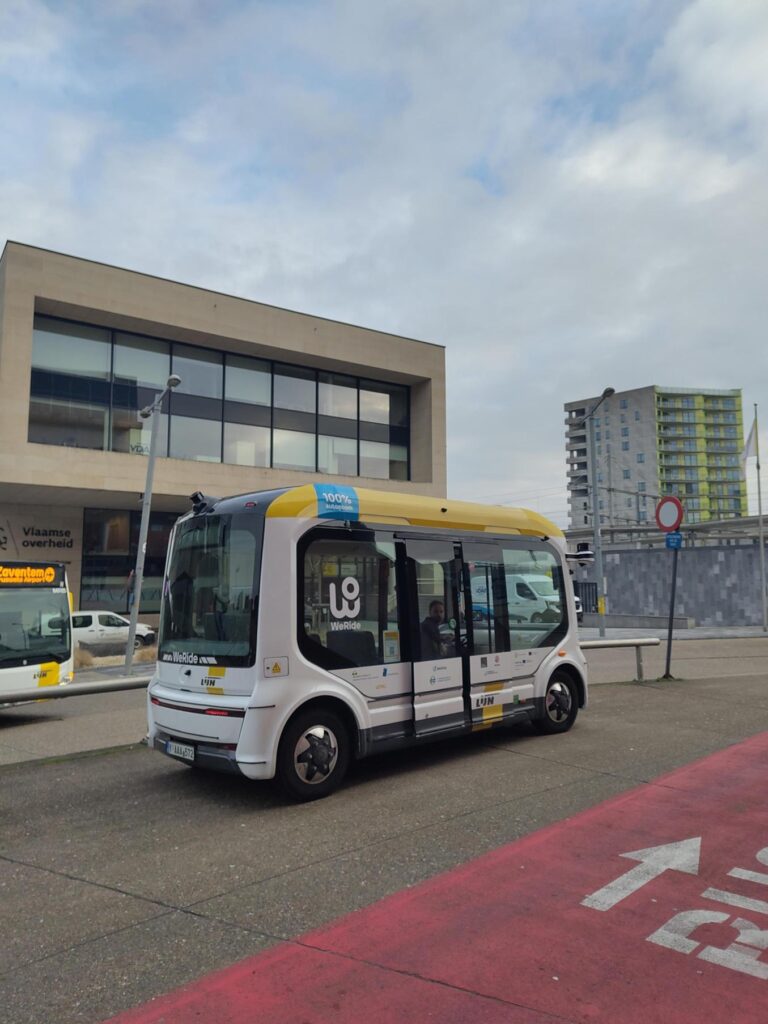
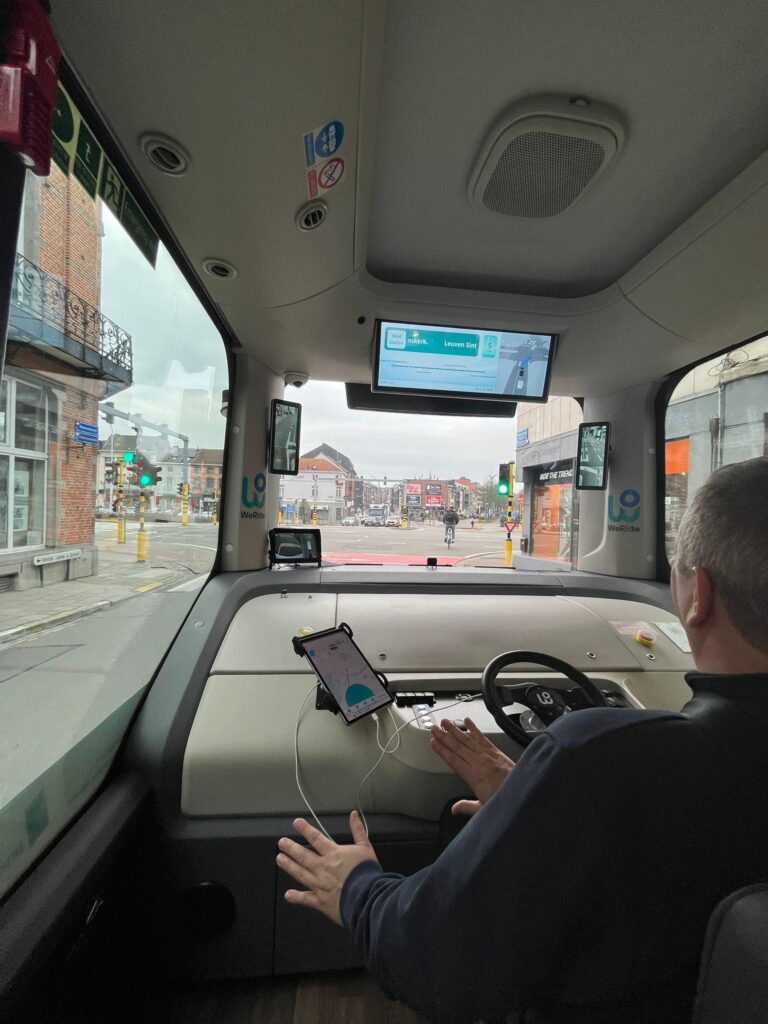
It is an interesting discussion. To make it very concrete, Leuven’s autonomous shuttle feeding public transport, which is currently running as a pilot, uses Chinese technology. When we look at the market, the number of manufacturers offering solutions for public transport use cases is very limited.
If you want customers and if you want a market, listen to those customers, co-create innovation together, and tailor your products to what the market is looking for – in this case, cities and regions.
Cities want to buy European. They really do. But if they cannot find what they are looking for at a reasonable price, within a reasonable timeline, in the volumes they need, and at a high level of quality, then they might be forced to look elsewhere.
We already see this happening with electric buses, even before we start talking about automation. The message we keep getting from cities and regions is that they cannot find what they need on the European market according to those criteria, and they are forced to go elsewhere.
If we want to safeguard Europe’s competitiveness, cities want to buy European, but industry must talk to them, listen to them, work with them and provide what they are looking for.
Five years from now, what would convince you that Europe has genuinely transformed urban mobility?
The biggest transformation would not necessarily be a new technology, it would be a reallocation of public space. We want cities for people, not cities for cars, even if they are electric or automated. We want to safeguard quality of life and create cities where it is nice to live, where children can play and people can move around.
We are coming out of decades of car-centric planning, and we need to do something about it. Give more space to pedestrians, give more space to cyclists, but also to the growing range of light mobility modes. It is no longer just bikes. It is e-scooters, electric bikes, speed pedelecs, fat bikes, and cargo bikes. They cannot all fit on one small bike lane, if there is a bike lane to begin with.
We also need to tackle transport poverty and the urban-rural divide. We need solutions, including automation, that can overcome forced car ownership and car dependence in lower-density areas.
If competitiveness is only going to be about industry, if transport is only going to be about automotive and not about the wider integrated transport system, then we are heading for a very bad future. Cities and regions must remain eligible partners for European funding and not depend solely on the goodwill of the national level.
Finally, one of the most important tools for moving forward is the Sustainable Urban Mobility Plan. It helps cities develop long-term visions, integrate innovation to serve policy goals, involve citizens and stakeholders, and connect transport with climate, energy, health, the economy and housing. We need to bring all of these policy domains together.
Many citizens feel mobility is becoming more complicated rather than easier. Why should they believe this transition will improve their daily lives?
Transport policy today reflects much broader social and political challenges, including increasing populism and polarisation. It is no joy to hold a mobility portfolio. Political leaders are expected to keep their eyes on the target while not being distracted by what is often a very loud minority that is against almost everything.
There is actually a much bigger majority that agrees with measures in favour of sustainable mobility. Sustainability is about the economy, the environment and the social dimension. Sustainable mobility is inherently inclusive. When people don’t feel left behind, they are much more likely to support the measures being taken.
From day one, you need to co-create. You need to talk to your citizens, explain why you are doing what you are doing, and how it serves the greater good. Political leadership is always about finding the right balance between what the individual citizen wants and what the city as a whole needs.
We cannot only bring out the carrots. We also have to bring out the sticks and introduce measures that may not always be popular but are necessary to address the negative externalities we have been talking about. As Pascal Smet, former Mobility Minister of the Brussels-Capital Region, often says, sometimes you have to make people happy against their own will.
People are resistant to change. But once you have pedestrianised an area and people can sit on terraces, children can play, and neighbours can meet each other, very rarely do they want to go back to the way it was before.
One of the most powerful ways to win people’s hearts and minds is to pilot new solutions and let them experience what change feels like. During COVID-19, people could experience cities with fewer cars and more walking and cycling, and that helped many cities accelerate the transition towards cities for people rather than cities for cars.