
Homeless in a Heatwave
Photo: Milan Cobanov / Unsplash
Heatwaves are becoming deadlier across Europe, but people experiencing homelessness remain among the least protected.
Every day, the European Parliament district serves as a crossroads for debates shaping Europe’s future: climate action, social inclusion, housing affordability and the resilience of European societies. The institutions surrounding Place du Luxembourg have long positioned themselves at the centre of these conversations. Yet just metres away from the Parliament’s offices, another reality unfolds.
Around the trees, benches and metro entrances of the European Quarter, dozens of people experiencing homelessness navigate the daily challenges of life on the streets, a reality made increasingly difficult by rising temperatures and a changing climate.
In early July 2026, Brussels, like much of Western Europe, was gripped by one of the most intense early-summer heatwaves in recent memory. Temperatures climbed well above seasonal averages as daytime highs exceeded 35°C across much of Belgium.
Authorities activated the national heatwave plan as scientists warned that such extreme events are becoming more frequent and intense in a warming Europe. Night-time temperatures were forecast to remain above 25°C in parts of the capital, creating so-called “tropical nights” where the body receives little opportunity to recover from daytime heat.
For most Brussels residents, the advice issued by authorities was relatively straightforward: stay indoors, close curtains, drink water, avoid physical activity, and seek cool spaces such as shopping centres or libraries.
But what happens when you have no home?
“People think summer is easy for us”
Sacha has been living around the European Quarter for nearly three years.
At 53 years old, he knows every shaded corner between Luxembourg Station and the European Parliament complex. For nearly three years, the European Quarter has been both his neighbourhood and his shelter. Just a few hundred metres from the institutions where policymakers debate climate adaptation, social inclusion and housing affordability, Sacha spends his days searching for shade, water and a place to rest. Sitting beneath a wall not far from the Parliament, he watches commuters stream past.
“People think summer is easier for us, it’s actually the opposite,” he says.
Like many people experiencing homelessness in Brussels, Sacha’s days revolve around basic necessities that most people take for granted: finding water, finding a bathroom, finding somewhere to sit without being moved on, and protecting the few possessions he still owns.
“There are parks where it’s cooler,” he explains. “Bois de la Cambre, Forest Park. They’re beautiful. But they are several metro stops away.”
For him the problem is not simply reaching those places. “My things are here. People who know me are here. Sometimes people give me food or a little money here. If I leave all day, I lose that.”
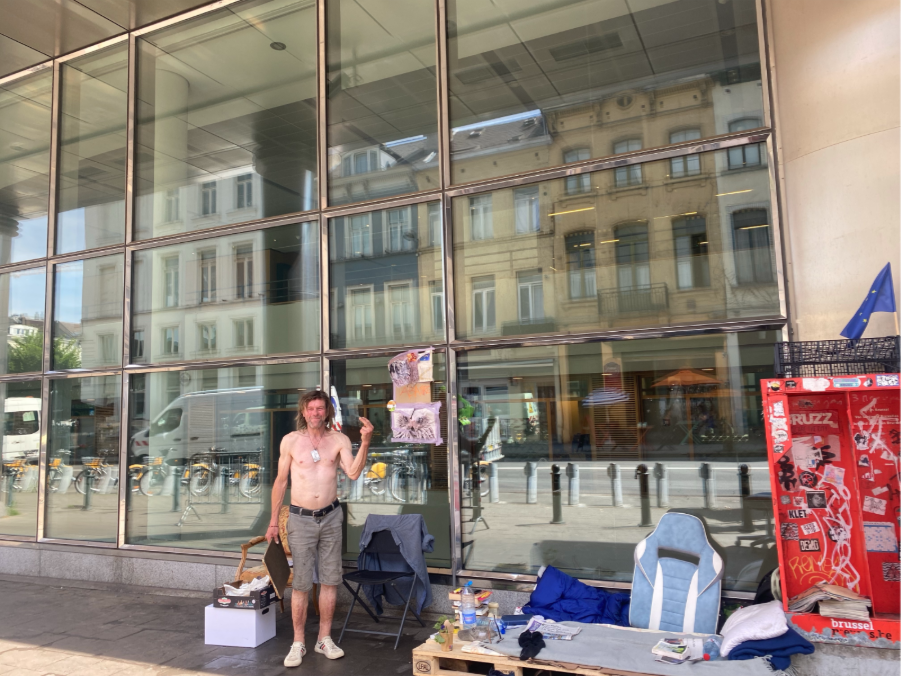
The last bicycle he owned was stolen. Now he has to walk under the searing heat. “Today, for example, I’ve been here all day. If I still had my bicycle I would have gone somewhere else already.”
Water, meanwhile, comes mostly from municipal fountains. As he speaks, he holds up a battered plastic bottle, its sides dented and partly crushed from months of use. “I drink a lot of water,” he says with a smile. “And less beer.”
The joke hides a more serious reality for the nearly 10,000 people experiencing homelessness in Brussels. For many, access to water can determine whether or not a heatwave spells genuine danger to life. During periods of extreme heat, dehydration, heat exhaustion, and heat stroke can quickly become life-threatening, particularly for people already living with chronic health conditions.
Simona Barbu, policy officer at FEANTSA, a European network focused on ending homelessness, notes that many homeless people spend long hours outdoors on concrete surfaces that absorb and radiate heat. In dense urban areas such as Brussels, this phenomenon is intensified by the urban heat island effect, where concrete, asphalt, and buildings trap heat during the day and slowly release it at night, making cities significantly warmer than surrounding rural areas.
“People sleeping outdoors often have limited access to water, shade and rest,” Barbu says. “Combined with existing health problems, this can lead to premature death.”
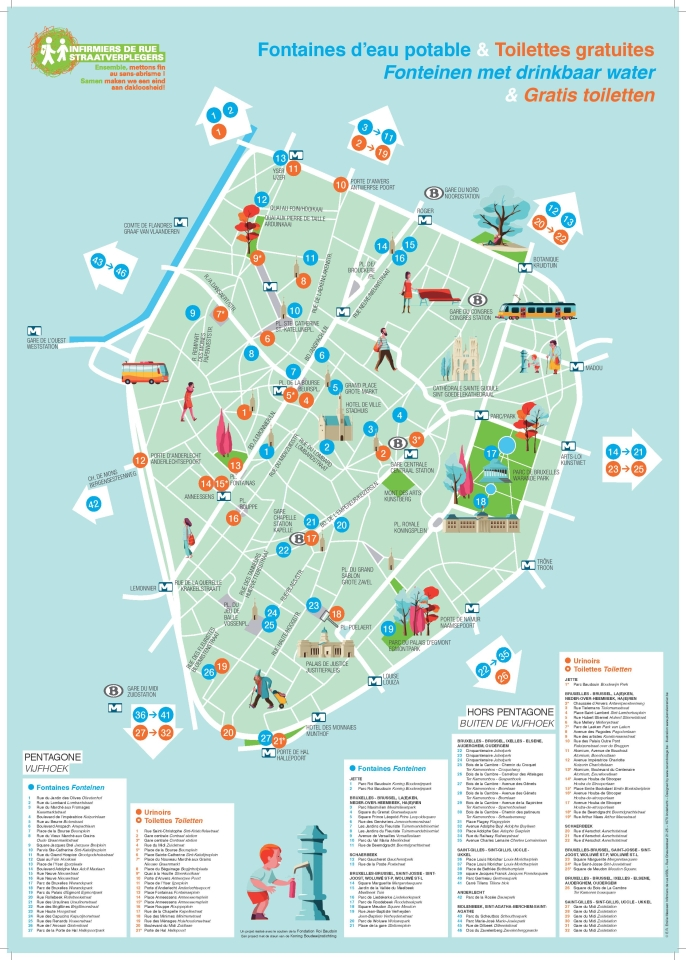
For people like Sacha, staying hydrated requires constant planning. Municipal fountains scattered across Brussels have become part of his daily geography. He cannot simply return home, open a fridge or take a cold shower when the heat becomes unbearable. Every litre of water has to be found, carried, and conserved.
“Another thing is the shops in the Gare du Luxembourg. People sometimes offer me coffee or sandwiches there. As a homeless person I can buy something there, but I’m not allowed to stay. Homeless people are not allowed to sit there,” he said.
Homelessness overlooked in summer
Heatwaves are becoming increasingly common across Europe.
According to the World Meteorological Organization, 2024 was the hottest year ever recorded globally. Across Europe, temperatures exceeded 40°C in multiple countries. Heat-related deaths have increased by approximately 30% over the past two decades, and scientists warn that Europe is warming twice as fast as the global average. As of July 3, 2026, at least 3,700 excess deaths had been reported deaths had been recorded.
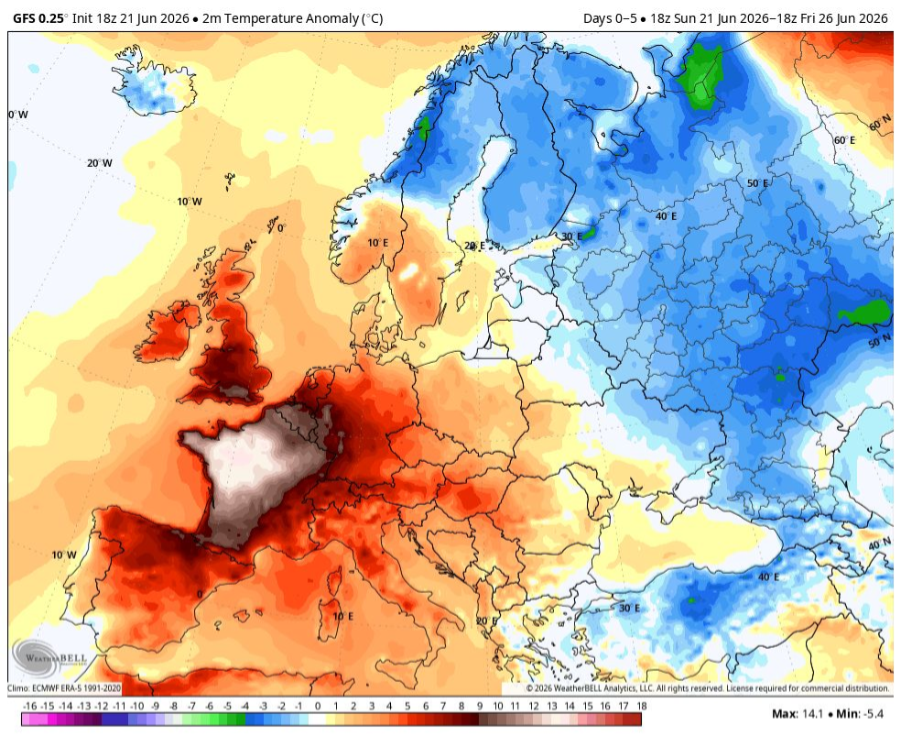
The late June heatwave that stretched across Western Europe offers another glimpse of what the future may look like.
France recorded its hottest day since records began in 1947. Nearly 1,800 schools have closed due to extreme temperatures. Parts of Spain, Italy, Croatia, Hungary, and Poland spent days under severe heat alerts. Iconic landmarks such as the Eiffel Tower, the Louvre, and Brussels’ Atomium reduced opening hours because of the heat.
For people without shelter, however, there is no closing time.
According to FEANTSA, heatwaves are becoming a major but largely overlooked public health threat for people experiencing homelessness.
“People associate homelessness with freezing temperatures and hypothermia. But evidence increasingly shows that heatwaves can be equally dangerous.”
Research cited by FEANTSA found that in some cases more homeless people die during summer than winter. A 2024 report by FIO.PSD shows that mortality rates among homeless populations were almost identical in both seasons, while in Phoenix, Arizona, roughly half of all reported heatwave deaths during 2023 involved people experiencing homelessness. The contrast is reflected in public policy responses: in January 2025, Brussels activated its Extreme Cold Plan, opening an additional 160 emergency shelter places on top of the city’s existing 2,600 shelter beds, while also keeping several metro stations and Brussels South Station accessible to people sleeping rough during freezing temperatures.
Sacha notices the difference immediately. “In winter there is a plan,” he says. “Every day the municipality sends a van with hot meals and coffee. They open a place where homeless people can gather from 8 a.m. to 4 p.m.”
During heatwaves, Brussels activates a broader municipal heat plan that includes water distribution, outreach by welfare workers and coordination with Samusocial to support vulnerable residents, including people experiencing homelessness. However, unlike the winter plan, it does not automatically expand emergency accommodation capacity, prompting homelessness organisations to argue that summer responses remain insufficient.
The Climate Crisis Meets the Housing Crisis
The homelessness crisis itself is growing. Brussels officially recorded more than 9,700 homeless people in its latest count, but many organisations believe the true figure is considerably higher once undocumented migrants and those outside official systems are included. The shortage of emergency accommodation has become so severe that in April 2026 the European Court of Human Rights ruled that Belgium had subjected asylum seekers to degrading treatment by leaving them homeless in Brussels for months despite legal obligations to provide shelter.
Walking through the city, Sacha sees the changes firsthand. “Years ago, homeless people were mostly older men with alcohol or addiction problems,” he says. “Today you see families. Children. Young people.”
He points around the Parliament district. “There are two brothers in their 20s. Another young man around 20. An elderly man who is 86 years old behind Parliament. Two Romanian men in their late 60s. Another man over 70.”
His description mirrors a broader European trend. According to FEANTSA, homelessness has increased across most of Europe over the past decade, driven by rising housing costs, inflation, stagnant wages, and insufficient affordable housing.
“Anyone walking through Brussels can see that the situation has worsened,” Barbu says.
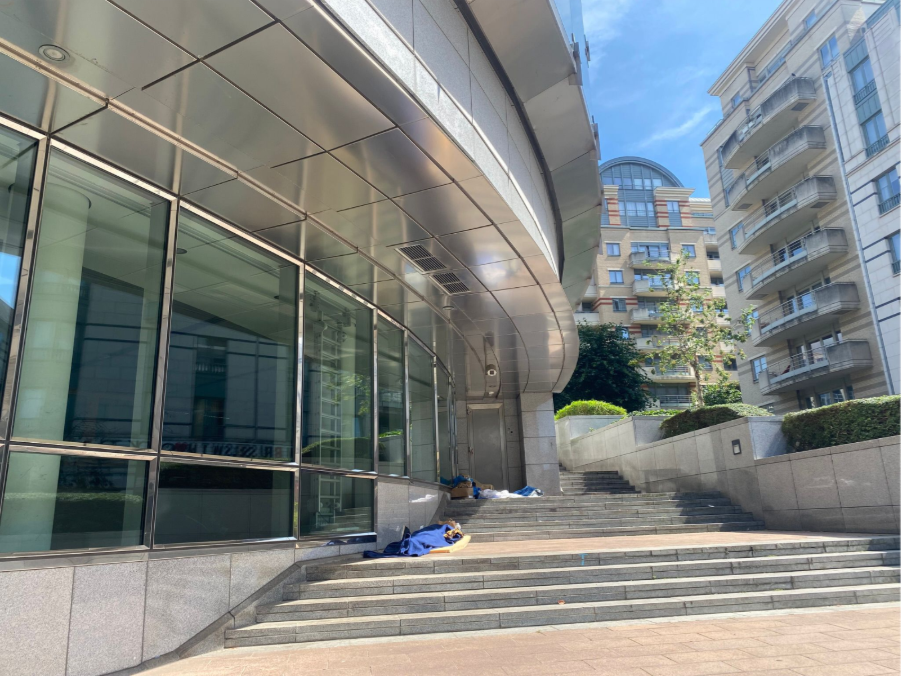
The heart of the EU – home to institutions that champion both climate action and social rights – is simultaneously struggling with both a housing crisis and rising climate vulnerability. The irony is written in the streets and it’s people trapped between the two who are feeling the heat.
Heat Doesn’t Kill Like We Think It Does
The late June heatwave across Europe was linked to dozens of deaths across the continent while hospitals also reported a surge in admissions as the temperature soared above 40°C in several countries. For people living on the street, extreme heat can add a layer of stress on top of an already vulnerable existence.
“Heat-related deaths are frequently not recognised as heat-related,” Barbu explains. “Someone may die from a heart attack. But if that person has been sleeping rough, unable to hydrate properly, exposed to extreme temperatures and already suffering from poor health, the heat may have played a major role.”
The Hidden Struggle for Water and Toilets
One of the lesser discussed aspects of homelessness during heatwaves is sanitation.
Access to water remains challenging. Access to toilets can be even harder. Sacha describes a daily routine of relying on public fountains to refill bottles. Toilets, however, are another story.
“There are toilets at Luxembourg Station,” he says. “But you need to ask for the key.”
In theory, the facilities are available. In practice, many homeless people feel unwelcome. “They don’t always want to give the key to homeless people because some people leave the toilets dirty.”
The result is a constant search for facilities many housed residents take for granted. Barbu argues that sanitation issues extend far beyond simple convenience.
“It affects dignity, well-being, and mental health,” she says. “For women, the challenges can be even greater. Lack of sanitation creates constant stress and anxiety.”
Several organisations in Brussels like Infirmiers de rue, have attempted to address the issue by creating maps identifying public fountains, toilets and shaded spaces. Yet awareness remains limited, and reaching these facilities is not always easy for people carrying all their possessions.
Hostile Architecture, Hostile Summers
The design of cities also plays a role when it comes to surviving for homeless people. Across Europe, urban planners and local authorities have increasingly installed what critics describe as hostile architecture: benches designed to prevent sleeping, metal barriers under bridges, and spikes in sheltered spaces.
A 2016 survey by the UK homelessness charity Crisis found that six in ten homeless people in England and Wales had observed an increase in such measures, while more than a third reported being unable to find places to sleep or rest as a result.
These features are intended to discourage rough sleeping. But during a heatwave, they can remove some of the few places where people might otherwise find shade or protection.
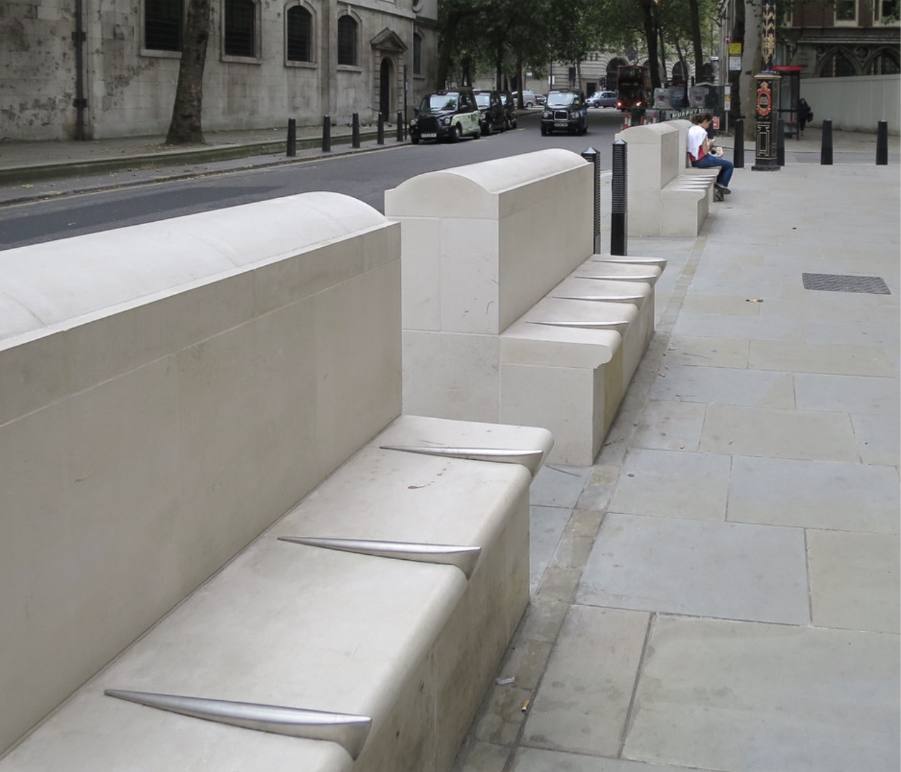
“In many cities, people experiencing homelessness are moved away from places where they seek shelter,” says Barbu. “Even when those places provide shade or protection from the weather.
The result is a paradox. At a time when the EU needs to invest €70 billion per year in climate adaptation up to 2050 some vulnerable residents are simultaneously being pushed away from the very infrastructure that could help them survive extreme heat.
Looking Beyond Emergency Responses
The latest climate models suggest heatwaves will become increasingly common. Europe is now the fastest-warming continent on Earth.
According to the Copernicus Climate Change Service and the World Meteorological Organization, 95% of Europe experienced above-average temperatures in 2025. Scientists estimate that nearly half a million people globally die from extreme heat every year.
For FEANTSA, this means homelessness must become part of climate adaptation planning. “We can learn from winter emergency plans,” says Barbu. “Cities already have systems for responding to extreme cold. Similar mechanisms could be adapted for heatwaves.”
Charities in England react to the heat by handing out water, wet wipes, ice lollies, sun cream, and toiletries to people experiencing homelessness.
But ultimately, emergency measures are not enough. “Homelessness is a housing issue,” argues Barbu. It requires a systematic response from city government and urban planners.
That could include extended shelter hours, cooling centres, water distribution points, and increased outreach efforts during periods of extreme heat.
But ultimately, she argues, emergency measures alone are not enough. As temperatures continue to rise, climate adaptation, and housing policy can no longer be treated separately.
Back beneath the Parliament’s shadow, Sacha watches another wave of office workers hurry towards Luxembourg Station.
He says there is one final irony about summer: “When it’s cold, people think about us.” In winter, people often stop to offer coffee, food or spare change. “In summer, they see the sun and think everything is okay.”
“This is the municipality of Ixelles. In winter, the government puts in place a homeless winter plan. Every day the municipality sends a van with hot meals, coffee and things like that. They open a place where all homeless people can gather from 8 a.m. to 4 p.m.
“But in summer, it’s over. There is nothing for homeless people.”