From Waste to Cleaner Fire
Photo: Belén G. Carmona / REVOLVE
Pellets made from waste could fuel cleaner, circular agroecological systems.
In many rural areas of the world, cooking remains heavily reliant on the use of firewood or charcoal. While these fuels are traditional, their use represents an urgent challenge for health, the environment, and social equity. Around 83% of the population in Sub-Saharan African use wood or charcoal for cooking, according to the African Development Bank Group.
This dependency generates profound impacts: an estimated $526.3 billion in health costs annually, mainly from respiratory diseases; $225.8 billion in economic losses associated with gender inequality and productivity; and $39.3 billion in climate damage from emissions and deforestation.
Cooking with firewood not only limits the well-being of millions of women and children, who are largely responsible for collecting fuel and maintaining the fire, but also compromises global efforts to achieve the Sustainable Development Goals. Faced with this scenario, pellets made from agricultural or forestry waste emerge as an agroecological alternative that transforms waste into useful energy. Rather than promoting their purchase from large producers, rural communities can be empowered to manufacture their own pellets, taking advantage of locally available waste. This approach promotes energy autonomy, reduces costs, and strengthens community resilience in the face of environmental and economic challenges.
What are pellets and why are they a good alternative for firewood?
Pellets are small compact cylinders made from dry organic waste such as straw, leaves, husks, sawdust, or crop residues, which are ground, dried, and compressed through heat and pressure. Their uniform shape and density allow for more efficient, clean, and controlled combustion compared to traditional firewood.
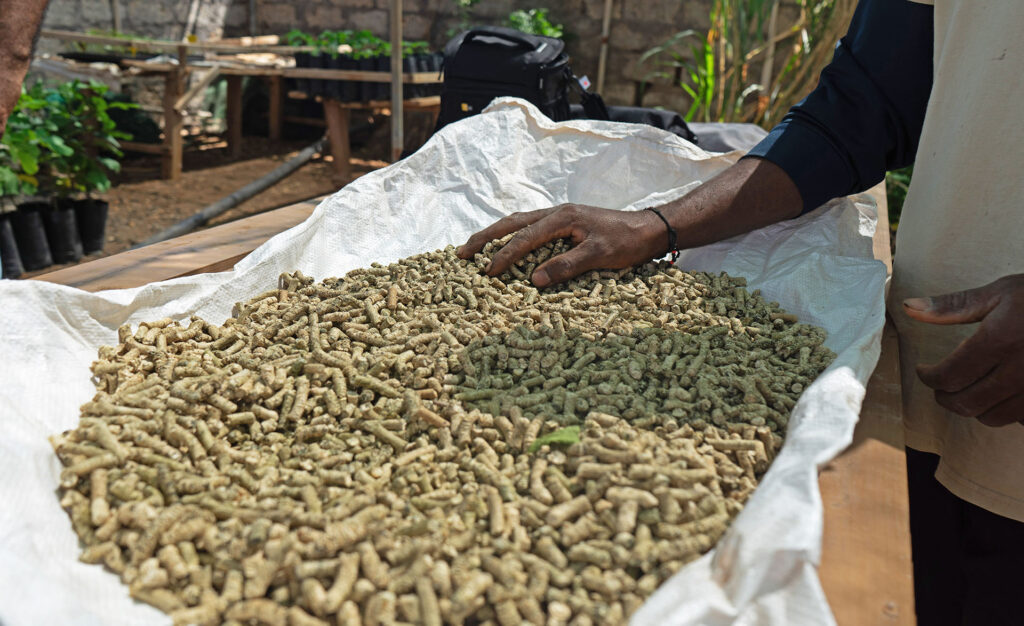
Unlike firewood, which is required in large volumes, generates smoke, and demands time for collection, pellets offer a modern and accessible solution. They consume less space, produce less smoke, and generate more heat per unit of mass. Additionally, being made from local waste, they don’t depend on tree felling, which helps conserve forests and reduce pressure on ecosystems. But what’s most transformative is that it is not necessary to buy them from large producers.
With simple tools and basic training, communities can manufacture their own pellets from the waste they already generate. This means that agricultural waste can become useful energy for cooking, without the need to spend money or depend on external supply chains. In this sense, pellets not only represent a technical improvement but an opportunity for community empowerment. But what happens when this technology is put into practice? Let’s look at four examples that are already transforming communities.
Pellets in action: four inspiring experiences
The transition to cleaner and more accessible energy sources is not a utopia: it’s already happening in rural communities across different regions of the world. Various real experiences demonstrate how pellets can be a powerful tool for local energy autonomy. Each of the following cases provides a different perspective, but all share the same principle: converting waste into solutions.
Two pilot sites funded by the Climate and Clean Air Coalition introduced pellet-fuelled stoves in urban and peri-urban communities in the Kenyan countries of Kisumu and Siaya. Although they faced challenges related to equipment costs and lack of local pellet production, the initiatives demonstrated that, with microfinancing and community distribution models, it’s possible to bring this technology to households that traditionally cook with charcoal or firewood. Along the same lines, in the Kakamega region, great potential was identified for community production of pellets from sugarcane bagasse, an abundant agricultural residue. Although still in an exploratory phase, the project proposes a decentralised model that could directly benefit rural communities, promoting local use of waste, job generation, and access to clean energy.
In the Chilean town of Villa Mininco, located in the forested La Araucanía region, locals are accustomed to collecting eucalyptus and pine trimmings to use as firewood or charcoal. In 2023, however, a committee of 140 of these collectors proposed the installation of a modular pellet plant that would allow them to capitalise on their forest waste and increase community income through a cleaner product with higher added value (Ayuda en Acción & Desafío Levantemos Chile, 2023).
Across the border in Argentina’s Neuquén province, the Neuquén Forest Corporation and the state company Gas y Petróleo del Neuquén supported the establishment of a plant that can produce 6,000 tons of pellets annually from sawdust and wood shavings, supplying more than 2,500 households. The model combines responsible forest management, industrial development, and job creation, demonstrating how pellets can be part of a regional energy strategy.
In Surabaya, East Java, Indonesia, a local company developed a pellet plant with a capacity to produce 100,000 tons per year using rice husks, corn stalks, and sugarcane bagasse. The project not only responds to energy demand but also reduces waste burning, generates rural employment, and aligns with government sustainability policies. The plant operates with advanced technology and strict environmental controls, showing that pellet use can scale without losing its ecological focus.
These four cases in Kenya, Chile, Argentina, and Indonesia show that pellets can be adapted to very diverse contexts, from rural communities with limited access to clean fuels to semi-industrial initiatives with export vocation. Although some projects depend on imported pellets or advanced machinery, all share a common vision: transforming waste into useful energy.
What distinguishes the proposal of this article is its emphasis on community and decentralised production, oriented toward rural energy autonomy. Unlike commercial or institutional models, here it’s proposed that communities themselves manufacture their pellets with the resources they already have, reducing costs, dependency, and emissions. In that sense, the cases presented not only inspire but also confirm the technical and social viability of this agroecological alternative.
CIRAWA: Pellets as an agroecological tool for climate resilience
The EU-funded CIRAWA project seeks to strengthen climate resilience, food security, and agricultural sustainability in rural communities of West Africa. Its approach is based on implementing agroecological practices in demonstration plots under the Living Labs model, which creates collaborative spaces where solutions are co-created with active participation of farmers, researchers, and local actors.
Among the project’s key strategies are the valorisation of agricultural waste, production of biofertilizers, phytoremediation of saline soils, use of high-quality local seeds, and sustainable management of soil and water.
In this framework, community pelletisation is presented as an agroecological technology consistent with CIRAWA‘s objectives. It allows valorisation of local waste such as husks, prunings, or bagasse, transforming them into useful energy, reduces pressure on forests by offering an alternative to firewood, empowers rural communities by facilitating their production of their own fuel, contributes to climate mitigation by reducing particulate and CO₂ emissions, and strengthens energy autonomy, all in line with the goal of reducing external dependency and promoting sustainable food systems.
The project’s Living Labs, established in Cape Verde, Ghana, Senegal, and The Gambia, are designed to test and adapt solutions like this, integrating local knowledge with technological innovation. Community pellet production could be incorporated as a demonstrative activity, especially in areas where cooking with firewood remains predominant and where pelletisable waste is available.
In this sense, pellets are not only an energy solution but also a tool for social and environmental transformation, aligning with CIRAWA‘s vision of building sustainable food systems from a community-based approach.
In every pellet manufactured by rural hands, there is more than energy: there is autonomy, there is dignity, there is innovation. This technology, simple but powerful, not only transforms the way of cooking but also the way of living. In a world seeking sustainable solutions, community pelletisation reminds us that change begins where we least expect it: in waste, in kitchens, in communities.