
Digital Agriculture Means Better Summers
Photo: Milada Vigerova / Unsplash
As clean freshwater vanishes, can Europe’s farmers trust the water they have left?
As climate change brings more frequent droughts to southern Europe, freshwater is becoming harder to find. Greece is among the countries under the greatest pressure, with agriculture consuming more than 80% of the country’s water while drier summers continue to strain rivers, reservoirs, and groundwater supplies.
Falling groundwater levels, saltwater intrusion, and pollution are leaving many farmers with little choice but to irrigate with treated wastewater or other alternative water sources. That challenge is driving researchers to develop digital tools that help farmers make informed irrigation decisions before a single drop reaches their fields.
Water scarcity reality
Today, approximately 30% of the EU territory and 33% of the EU population are affected by water scarcity conditions. Relative changes of rainfall also influence this trend; for instance, 2023 saw lower water scarcity compared to 2000-2023.
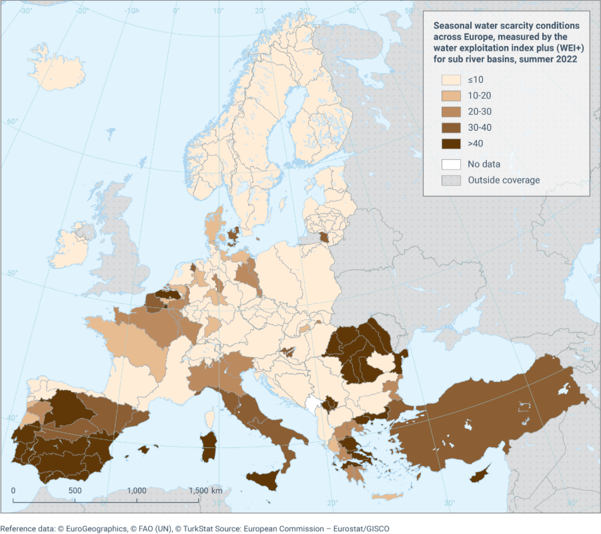
Climate change is intensifying Greece’s water scarcity through declining rainfall, more frequent droughts, and longer dry periods. As surface water becomes less reliable, farmers and irrigation networks are increasingly turning to groundwater. Decades of over-extraction have pushed groundwater levels down, particularly in coastal areas, where seawater intrusion is increasing salinity.
“Climate change is certainly one of the biggest drivers of water scarcity,” said Manos Lekakis, Head of the Agronomist Department at AgroApps in Thessaloniki.
“After decades of over-exploitation, groundwater levels have fallen significantly,” explained Manos Lekakis, Head of the Agronomist Department at AgroApps, a company based in Thessaloniki, Greece. “This is particularly pertinent in coastal areas where seawater has started to intrude into aquifers, increasing salinity.”
Compared with Europe as a whole, the circumstances develop differently in Southern Europe, where water scarcity is prevalent all-year-round. Agriculture, public water supply, and tourism put high pressure on freshwater resources as 30% of the population is located in areas where there is permanent water scarcity, and 70% in areas with seasonal summer stress.
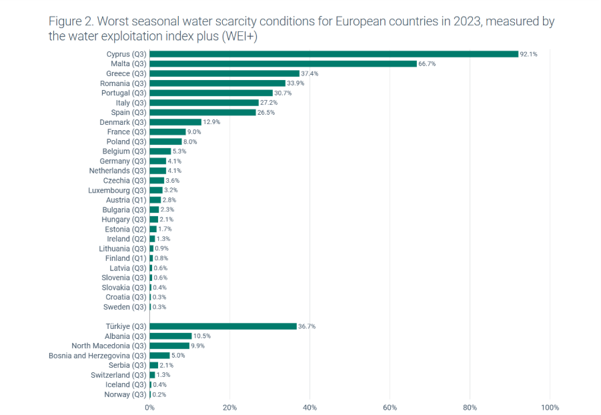
Southern Europe continues to bear the effects of water scarcity, with Cyprus, Malta, and Greece recording the highest levels of seasonal water stress in 2023, according to the European Environment Agency. Moreover, the climate crisis has the effect of increasing the frequency and intensity of droughts.
Chronic Greek problem
Growing pressure from the climate crisis, tourism, and inefficient irrigation is pushing Greece’s already strained water resources closer to their limits. 2025 data of the World Resources Institute shows that Greece ranks 19th globally in terms of water scarcity risk, where high levels of baseline water stress and drought risks are present.
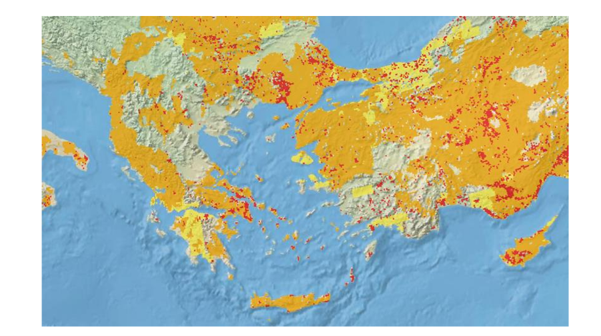
As Greece shows water shortages in many of its regions, especially in the Aegean Sea Islands and the Attica region, the climate projections of 2050 show the country needs to adapt to the changing conditions. An expected 10-30% fall in rainfall by 2050 could mean 30% of Greece will be facing desertification within a few decades.
One of the underlying reasons for water scarcity is the outdated distribution networks that cause a 50% loss of water. Next to this, thirsty agricultural practices account for the biggest share of water use. According to the European Commission, agriculture consumes over 80% of water resources and puts particular pressure on water supply.
Summer crops, like cotton, are affected the most by water scarcity and declining water quality. According to the European Commission numbers, Greece produces 80% of the Union’s cotton. According to Lekakis, although cotton is relatively tolerant to drought, farmers still irrigate extensively to achieve high yields.
Other water-intensive crops include maize, tomatoes, cucumbers, and leafy vegetables, while citrus fruits such as oranges, lemons, and mandarins also rely heavily on irrigation.
Meanwhile, the water storage capacity is far from being adequate. Greece’s limited water storage capacity means valuable rainwater is lost to the sea, with heavier post-drought rainfall causing erosion rather than restoring depleted water reserves. According to 2026 data, Greece’s national reservoir storage capacity is approximately 11,770 hm3.
Mixed with the more frequent droughts, farmers are increasingly turning to treated wastewater and other lower-quality water sources to keep their crops alive. Research shows that treated wastewater could already replace about 12% of freshwater used for agricultural irrigation globally.
While reclaimed water can provide a reliable supply that is less dependent on seasonal rainfall, using it safely requires careful assessment of its quality.
When there is not enough fresh water
When freshwater supplies run short, treated wastewater can provide farmers with an alternative source for irrigation. Unlike rainfall-dependent supplies, reclaimed water can offer a more reliable source during drought, but its quality still needs to be assessed before it reaches crops.
Groundwater salinisation presents a different challenge. As drought increases dependence on groundwater, excessive extraction in coastal areas can allow seawater to intrude into aquifers. Irrigating with highly saline water can reduce crop productivity, degrade soils and damage irrigation systems.
“Our approach is not simply to encourage the use of alternative water sources, but to help farmers understand when and how they can safely use them. For example, water with high concentrations of dissolved solids can damage drip irrigation systems, while excessive salinity can affect crop productivity and soil quality,” Lekakis said.
Before using any alternative water source, farmers therefore need to understand whether it is suitable for their crops and how it should be managed. This is precisely the challenge WaterIQ was designed to address.
Insightful-water
WaterIQ was developed to help farmers and irrigation managers make informed decisions when using alternative water sources. Rather than focusing solely on how much water is available, the platform addresses another growing challenge: understanding whether that water is safe to use.
The system builds on digital farm management tools that many farmers already use. According to Lekakis, instead of replacing existing irrigation planning services, WaterIQ adds a new layer by assessing water quality. Farmers, irrigation organisations, or water authorities can upload laboratory analyses of irrigation water into the platform, which then evaluates its suitability for agricultural use.
Rather than simply presenting laboratory measurements, WaterIQ translates technical data into practical recommendations. It assesses the possible impacts of a water source on crops, soils, irrigation infrastructure, groundwater, and nearby surface waters before advising users how to proceed.
As Lekakis explains, “The system complements existing irrigation scheduling services by helping users assess not only when to irrigate, but also whether the available water should be used in the first place.”
Instead of forcing farmers to interpret complex laboratory reports on their own, the platform converts water quality indicators into a practical risk assessment. It evaluates salinity, heavy metals, nutrient concentrations, and other chemical parameters against European guidelines before estimating their potential effects on crop production and the surrounding environment.
The recommendations are designed to support decisions rather than simply identify problems. In some cases, WaterIQ may suggest diluting highly saline water with freshwater. In others, it recommends alternating between different water sources or avoiding a particular source altogether if the risks outweigh the benefits.
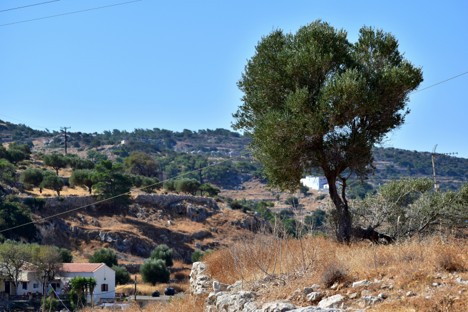
Farmers upload a laboratory water analysis and assign the water source to individual fields. WaterIQ then provides irrigation schedules, risk alerts, and recommendations.
WaterIQ is currently being tested on vegetable, horticultural, and arable crops in Greece and Spain, allowing researchers to evaluate the platform under different climatic conditions and farming systems.
WaterIQ is being developed under RAINS (Resilient Agricultural Irrigation systems for water Scarcity in Europe), a four-year Horizon Europe project running from 2024 to 2028. Funded by the European Union with €4.87 million, the project brings together 17 partners from six countries and is testing 10 solutions aimed at making European agriculture more resilient to water scarcity. These include alternative water supplies, improved soil water retention, and digital irrigation tools such as WaterIQ, with solutions demonstrated on farms in Greece and Spain.
Within the project, AgroApps leads the development and customisation of WaterIQ. The company plans to integrate the tool into its commercial farm management platform, already used by more than 20,000 Greek farmers, after the project ends.
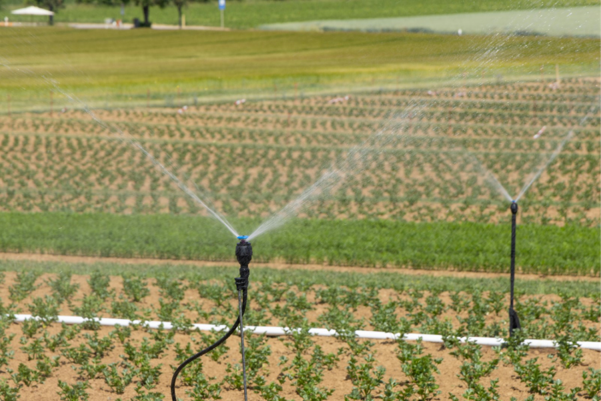
“When we first developed our farm management system in 2015, many of today’s digital agriculture technologies seemed far beyond the state of the art,” says Lekakis. “Today, farmers routinely use Earth observation data, meteorological information, and Internet of Things technologies. We believe the same evolution will happen with water quality management.”
“We’ve seen young farmers reject digital tools completely, while farmers in their seventies regularly contact us to discuss satellite data or crop indicators,” he says. “What really matters is whether people trust the information and find it useful.”
Rather than marketing directly to individual farmers, AgroApps works mainly through cooperatives, agricultural consultants, agri-food companies, and irrigation organisations, integrating its digital tools into services farmers already use.
“In essence, WaterIQ is about empowering farmers,” he says. “It gives them the knowledge and confidence needed to safely manage both conventional and non-conventional water resources while improving the sustainability of agricultural production.”
As Europe faces more intense droughts, farmers will need to make better use of the water available to them. Tools like WaterIQ can help them understand which water is safe to use and how to use it without putting their crops, soil, or future harvests at risk.