
Intertidal: Entranced by Nature
Photo: Margaret Szarzynski / Unsplash
The Sea is Not Made of Water: Life Between the Tides
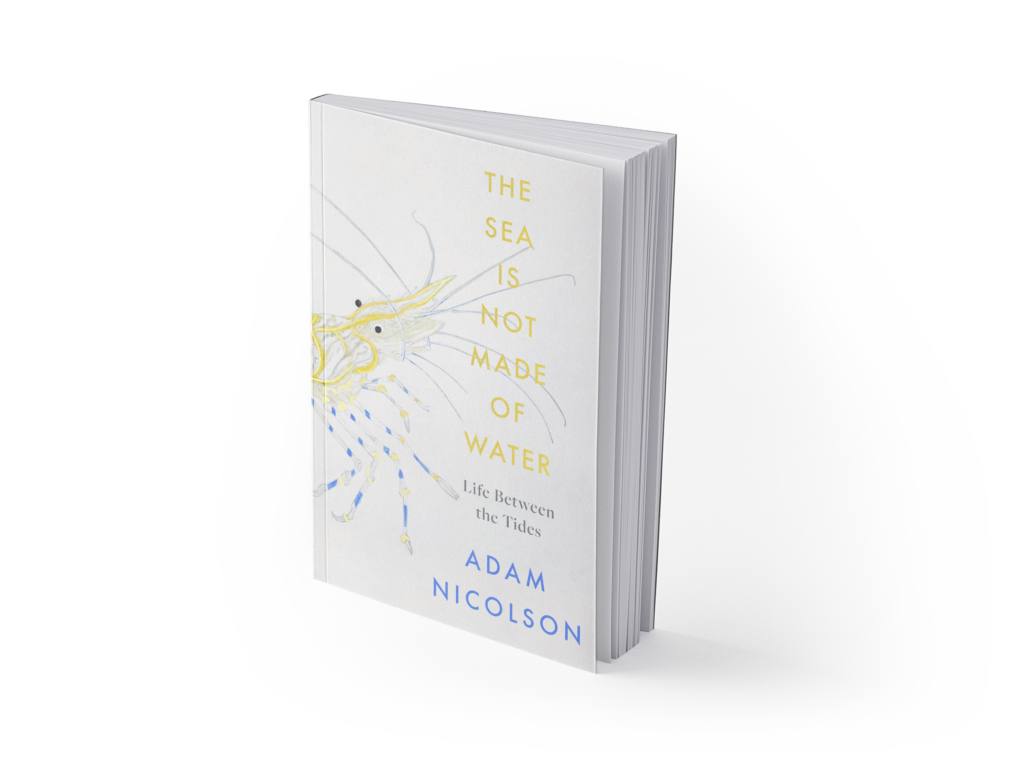
Adam Nicholson
London: William Collins, 2021, 370 pages.
Coming back from a week at Zuydcoote in French Flanders where the wide beaches extend for kilometres, and where sand life abounds in that wet zone between the tides, I picked up The Sea is Not Made of Water to understand better what’s going on with intertidal life.
There’s a lot going on between the tides, much more than we realise, and so by extension, there’s a lot of going on in Adam Nicholson’s ambitious book about sandhoppers, prawns, winkles, crabs, anemones, and all their cascading interactions: microcosms of large life, life in miniature.
Nicholson asks permission from the Scottish Crown to build three little tidal pools along a cove on the northern edge of the Sound of Mull in the Scottish Highlands, and from this most rudimentary level he builds out multiple layers of observations, references, and insights into our existence.
Threading together nature writing with literature (Stevenson, Shakespeare, Woolf, and others) and philosophy (Heidegger, Plato, Aristotle, and others) and polymaths (Galileo, Newton, Kepler, and others), the breadth of knowledge is as immense as the movement of the waters being described.
Nicholson is a lifetime searcher of profound truths. This is the culmination of decades of writing, researching, observing, and living, of transcribing, translating, and transmitting his entrancement with nature. Woolf was “entranced by liquidity” (p.36). T.S. Eliot was “entranced by that granite coast” (p.130). The word itself ‘entranced’ epitomises the feeling of awe, wonder, surprise, and revelation that one gets when understanding the bigger picture of life on Earth.
The Earth is not round, not a perfect sphere. The tides do not come in and out. The tide ‘bulges’ from the sea’s inertia. The gravity of the moon draws the nearest parts of the sea towards it, causing these tidal bulges. The Earth spins in this “water ovoid, hence two high tides and two low tides a day.” (p.182) Isaac Newton cracked the code with his tidal theory when he was in his early twenties.
In essence, the tides are sloshing back and forth, constantly in motion, with the currents too, and:
the drag of the tide in these shallow seas is slowing the earth […] by about 2 to 2.5 milliseconds every century. Five hundred million years ago the earth was rotating faster […] I am witnessing, unfelt by me, a world being dragged to a stop, the spin of time seeping out towards the final entropy. All will be quiet in the end, the sea at an everlasting still-stand […]. (p.186).
This magnificent, perspective-changing passage sums up Adam Nicholson’s lifetime of searching.
And in the meantime, there are limpets to explain what is going on. Limpets are intertidal ‘ecosystem engineers’. They eat algae, wrack, and other seaweeds keeping the ecosystem regulated. Without limpets, the system goes “into extraordinary spasms of reaction and recovery” as what happened by the oil-tank wreckage and seepage in 1967 on the rocks of Seven Stones reef, between Land’s End in Cornwall and the Scilly Isles. The limpets were decimated and the weeds were the first to return causing a complete imbalance in the system (p.313-320).
You remove a key actor in any ecosystem, and the cascading effect has disastrous implications and unexpected results: decades after the 1986 Chernobyl nuclear disaster, nature is rebounding in extraordinary fashion, but the zone is still unsafe for humans. The message should be clear: just let nature do its thing whenever and wherever possible. A profound truth: nature reconquers all things.
Back on Zuydcoote coast, the rusted carcass of the Crested Eagle – a British steam paddle boat sunk by the Germans in 1940 – appears when the tide goes out, and so do hundreds, thousands, countless little rubbery siphons protruding from the wet sand. You crouch down and watch them spewing streams of sand that form little piles of spaghetti turds.
Perhaps they are clams that old couples are scavenging for with their buckets and scoopers. You see little crabs being tossed around gently tumbling in the little waves breaking and pushing the creatures around. God knows what they are doing or where they are going… When you finish reading The Sea is Not Made of Water, you feel like you got so much, and that you missed so much, like life, like the tides coming in and out.
Time to start over, again and again.