
Mobility Transition for Whom?
Photo: Ahmetcan Uzlasik / REVOLVE
Europe is redesigning how people move, but too often it is designing for the same people.
Picture the typical user of a shared bicycle or e-scooter. Chances are that they are young, urban, physically able, comfortable with a smartphone, and capable of travelling independently. Yet children and families, older people, and people with physical impairments make up a significant part of the population and are still often overlooked when shared mobility systems are designed.
If Europe’s mobility transition is meant to transform how everyone moves, designing it primarily around young, urban, able-bodied users – rather than considering people with reduced mobility from the outset – is not enough.
“Inclusive shared mobility is a very broad term,” Esen Köse told REVOLVE. “Shared mobility on its own is very broad.”
Perhaps the difficulty is not defining inclusive mobility. Perhaps it is that exclusion has been treated as normal for too long.
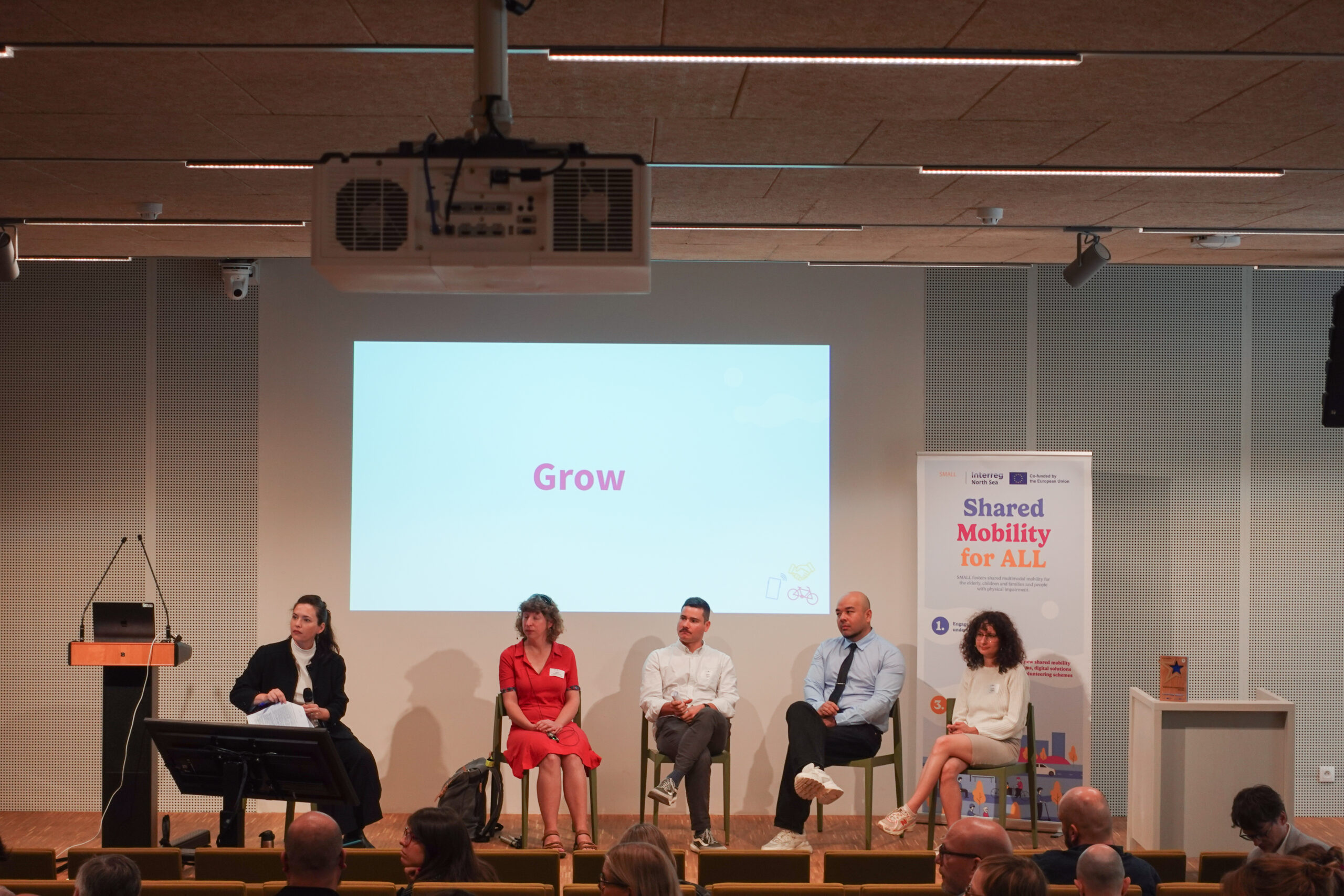
This was the challenge at the centre of the SMALL final conference in Ghent on 16 September 2026. Led by Belgian NGO Mpact and co-funded by the Interreg North Sea Programme, SMALL (Shared Mobility for All) has spent four years testing how shared mobility can better serve people with reduced mobility. Its work has involved users in designing services, and testing adapted vehicles, digital solutions, and volunteering initiatives.
There is no standard passenger
The SMALL project points towards a basic principle: people should not have to adapt themselves to mobility systems. Mobility systems should accommodate the people who use them.
Mobility systems should accommodate the people who use them.
That requires looking beyond the standard shared bicycle or e-scooter.
Köse told REVOLVE that SMALL experimented with different vehicle designs, including tricycles, wheelchair bikes, and cargo bikes. Digital accessibility formed another part of the work, since booking and accessing shared transport increasingly depends on platforms that are not equally easy for everyone to use.
But technology is only one part of the equation.
SMALL also explored volunteering schemes and the role of human contact. For somebody who needs assistance travelling, the difference between mobility and immobility might not be another app or a more sophisticated vehicle. It could simply be another person.
This is why co-creation matters. Designing for people with reduced mobility without designing with them risks reproducing the same problem in a more accessible-looking package.
Accessibility is climate action
The stakes become greater as European cities attempt to reduce car dependence and expand cleaner forms of transport.
Isabelle Clement of Wheels for Wellbeing told REVOLVE that disabled and older people can be particularly exposed to the consequences of climate breakdown, from air pollution to difficulties reaching safety during floods and fires.
“We need to start reducing motorised transport and make inclusive mobility solutions available to those who need them first,” Clement told REVOLVE.
That exposes a contradiction at the heart of the green mobility transition.
A city can install thousands of shared bicycles, electrify vehicles, and build sophisticated mobility platforms. But if substantial parts of its population cannot use them, that means technological progress has not automatically produced social progress.
Inclusive mobility should therefore not be treated as a specialist branch of sustainable transport. It should be one of its starting conditions.
The question facing cities is not just how many people can be persuaded to abandon private cars. It is whether the alternatives being built allow people with different bodies, ages, abilities, and circumstances to participate.
Not everyone can or should be the ideal passenger. Smart and sustainable transportation has to be designed around the reality that there is no ideal passenger.
Project website: Shared multimodal mobility, for everyone SMALL | Interreg North Sea