
Watching the Trees Grow
Photo: Wikimedia Commons
A Mountain to the North, A Lake to the South, Paths to the West, A River to the East

László Krasznahorkai
Translated by Ottilie Mulzet
London: Tuskar Rock Press, 2024
Reading Krasznahorkai can be a daunting and laborious task after a few pages of run-on sentences that don’t seem to ever end, and when they do almost end, another comma or semi-colon appears, and you are off for another tangent of a few pages, so this short novella of 130 pages is a great introduction to the 2025 Winner of the Nobel Prize in Literature.
Despite the very long title, possibly the longest title you have ever seen on the cover of a book, there are 50 concise chapters in Roman numerals, minus the first chapter… yes, the first chapter is missing. At first, you think it’s a printing mistake, and you flip to the back of the booklet to see if Roman numeral “I” is there, but no…it’s omitted on purpose, it’s very clever.
In Buddhism, everything is part of a larger essence, and nothing is whole without everything else. The missing chapter may well be The Tale of Genji – the Japanese classic 11th-century epic by Murasaki Shikibu – that Krasznahorkai’s novella builds upon. His protagonist is the grandson of Prince Genji from Shikibu’s epic tale, set in modern times somewhere in the hilled forests outside of present-day Kyoto. The missing chapter could also be a narrative structural ploy to show that there is no beginning to anything, which would also be aligned with Buddhism and the concept of endless rebirth and the fluidity of realms between past, present, and future. This is the beauty of the missing chapter: you can fill it with what you want for the story to be whole, as if it were not full enough!
It takes patience and attention to read Krasznahorkai, just like the medieval carpenters needed patience and attention to watch the trees grow. A most insightful moment comes almost exactly halfway through the novella when you realise that the “chief actor” of the story – the entire story of Buddhist monasteries in Japan – is not the lost, somewhat sickly grandson of Prince Genji, but the hinoki cypress tree. To give you a flavour of Krasznahorkai:
“[…] a hinoki, the mere selection of which took months, including the selection of a certain mountain and its acquisition, that is to say the selection of a certain mountain upon which trees had grown for at least one thousand years, straight-trunked trees with foliage that was neither light nor pale, already this first phase took months, so that subsequently years passed during which, in view of the more impatient and less well-informed leaders of the monastic order, nothing, unforgivably, happened, although they were reassured […] the miya daiku [the artistic master of the carpenters] knows what to do, just as the miya daiku truly did know what to do, because all his ancestors had also known, going back centuries, they had known what the task was, now and in the years to follow, namely that while the miya daiku must industriously and intensely count and measure, draw and draw again, his main task was to observe the trees, and truly he did nothing else for long, long years […]” (p.49)
What a life! Watching trees grow… the miya daiku respected the trees above all and promised to give them a second “life of beauty”. The selected Japanese cypresses were felled, transported, and left to soak for one full year in the River Kamo. Then they were prepared and planed and made into the beams, lintels, roofs, and the rafters of the Buddhist monasteries with great care.
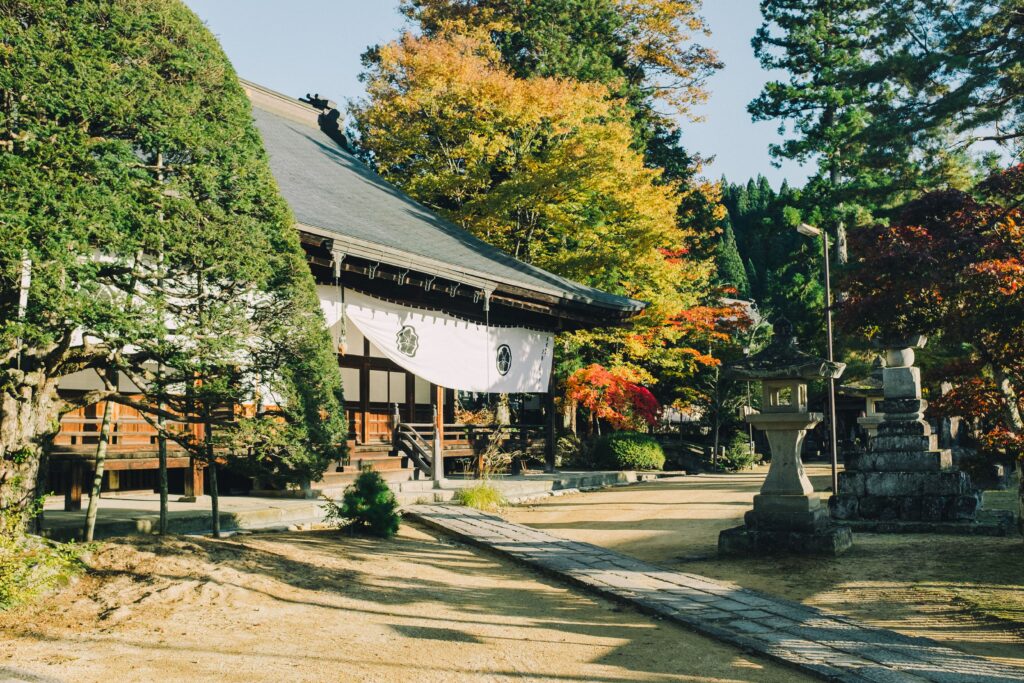
Meanwhile, the grandson of Prince Genji is continuing his search for some secret garden, but you don’t care or notice that search because the trees and their foliage have taken over somehow. In his dreamlike, feverish condition, the grandson finds solace and tranquillity in the abundance of nature around him. Kraznahorkai reaches incredible levels of poetic prose here when the little lost human is immersed in the fairy-tale-like story of the eight hinoki cypress trees.
And the pathetic grandson doesn’t really find what he is looking for, or at least it doesn’t really feel like he does, or that the search matters anymore. You see him somehow in the one hundred billion grains of pollen seeds floating down and around him, and he is reflected in that adjacent realm of nature and recognizes himself in “that solitary hinoki tree in the monastery courtyard.” (p.116)