Agroecology’s Political Potential
Photo: Belén G. Carmona / REVOLVE
West African policymakers have farming solutions galore, they need only look.
Before “Agroecology” had a name, farmers across West Africa were practising it. From the shea trees intercropped with millet, sorghum, and groundnuts, to Faidherbia trees that shed their leaves during the rains – offering forage when it’s needed most – to the stone terraces that harvest rainwater and prevent soil erosion. Agroecology is deeply embedded in the farming wisdom passed down through generations.
Some of these traditional practices have been sidelined in recent decades, however, by state agricultural policies that encourage conventional farming methods in a bid to boost yields and food security. While well-intentioned, these methods fall short for farmers who are being forced to adapt to a changing climate and unpredictable global markets.
To carry these once widespread agroecological practices into a resilient future, agroecology needs to be officially adopted at the political level. Farmers need these policy changes to underpin a viable agroecology strategy with incentives for new technologies, certifications for agroecological produce, and market opportunities that can offset initial investments and short-term fluctuations in yield.
Benefits of agroecology are well known
Farmers who engage with agroecological techniques are plainly aware of the benefits, according to Professor Saa Dittoh, Agricultural Development and Food Systems Economist at the University for Development Studies in Tamale (UDS), northern Ghana. They know from first-hand experience that reducing chemical input improves soil health, that producing their own fertilisers can shield them from international market volatility, and that increased biodiversity as a result of farming in harmony with nature, rather than against it, can help mitigate the effects of climate change. Agricultural researchers and NGOs agree, according to the professor.
“In terms of food and nutrition security, ecosystems enhancement, biodiversity, and soil enhancement, agroecology seems to be the solution,” the professor told REVOLVE in an interview on the sidelines of the CIRAWA Agroecology Conference, which took place in Accra between 1-3 July 2026.
“How to go from where we are to where we should be is something we all have to discuss – without the policymakers seeing it our way, it will be difficult to get policy to go where we want it to go,” he added.
The case of Ghana
Around 80% of Ghana’s farmers operate smallholder farms,according to figures from the agriculture ministry, and an estimated 75% of rural jobs are agriculture-related, a figure that drops to roughly 30% nationally, per the African Development Bank (AfDB).
Like others across the West Africa region, Ghana’s farmers face myriad challenges. These range from the socio-economic, such as lack of financing and gender inequality – women play a core role in the agricultural sector but face major inequalities regarding land access and credit – to climate issues like soil degradation and decreased rainfall, on which many smallholders rely for irrigation.
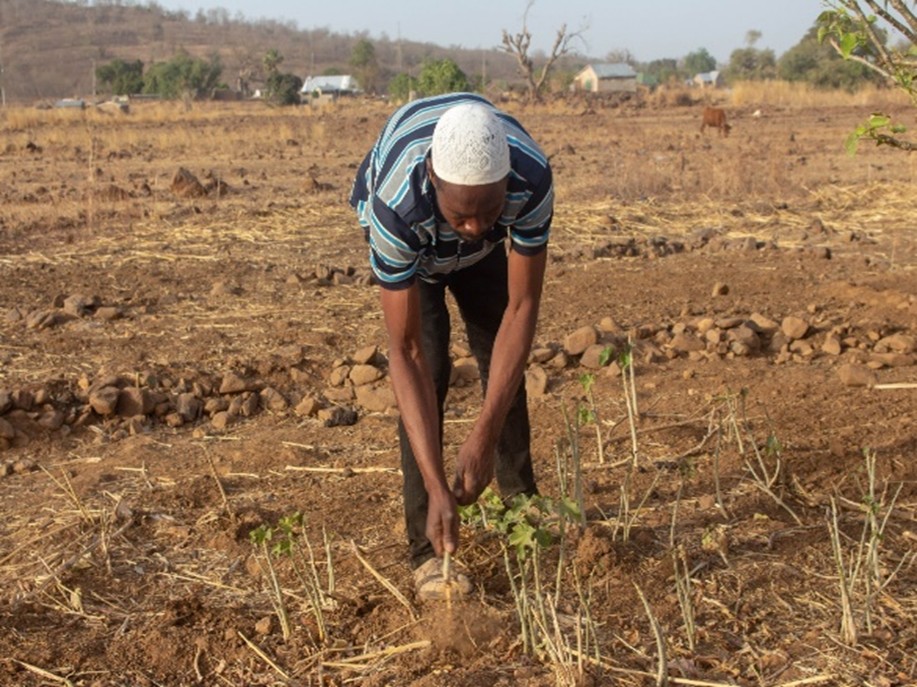
Saa Dittoh and his UDS team, along with the Frontier Institute of Development Planning Foundation (FIDEP), are engaged with the EU-funded CIRAWA project in the research and implementation of agroecological farming practices in two distinct regions of Ghana – the Central Gonja District and northern Nabdam District.
Here, they are conducting fertility studies to better understand soil health and nutrient dynamics, the results of which will lay the groundwork for tailored farmland interventions. Building on this knowledge, they seek to promote innovative composts, bio-based fertilisers, and materials for household energy production, providing farmers with sustainable alternatives to conventional practices.
The EU-funded CIRAWA project is also supporting soil conservation and crop management practices to mitigate the effects of soil erosion and degradation, safeguarding the long-term productivity of agricultural land.
Are they listening?
This momentum in the growing agroecology movement was recognised in a statement from the Vice President of Ghana, Professor Naana Jane Opoku-Agyemang, delivered in person at the CIRAWA conference by her Chief of Staff Alex Percival Segbefia.
We must move away from the systems that are not delivering the results we need but we must also be clear about where we are moving to.
“We must move away from the systems that are not delivering the results we need but we must also be clear about where we are moving to,” the statement from the VP read. “The government of Ghana has committed, through its flagship Feed Ghana programme, to promoting the mainstreaming of agroecological practices as part of the country’s wider agricultural transformation agenda.”
The statement added that the government would support agroecological practices such as crop diversification, agroforestry, improved soil fertility and management via compost and other techniques, the production and use of biofertilisers and biopesticides, farmer-led irrigation, simple mechanisation systems, and the local production of high-yielding seed varieties.
“Building on this commitment, there is a need for a national agroecology strategy. The work is intended to advance the broader transformation of our food systems and to contribute to the achievement of the Sustainable Development Goals,” the statement continued.
Changing course
Shifting agricultural policy is not easy. For decades, governments across West Africa, including Ghana, have sought to bring about greater yields and food security by promoting high-input conventional farming methods that are heavily reliant on chemical fertilisers, part of the so-called African Green Revolution.
While these conventional methods can lead to short-term upticks in production, there are trade-offs. The heavy use of synthetic chemical inputs degrades soil health and damages ecosystems over time, leaving land prone to degradation and desertification and less resilient to climate change.
High water demand places stress on natural water resources in regions witnessing climate change-driven fluctuations in hydrological cycles. This is particularly pertinent considering that most smallholder farms rely on rainfed irrigation. Over-reliance on imported products like fertiliser also leaves farmers exposed to the whims of the global market and its increasingly unpredictable behaviour. The Russian invasion of Ukraine being a case in point after skyrocketing fertilser prices for farmers in Ghana and across West Africa.
Agroecology as an act of resistance
Edmond Moukala, the head of UNESCO’s office in Accra, described the CIRAWA conference as a “historic junction” where policy, science, and ancestral wisdom converged to address one of today’s most urgent challenges: how to feed people while restoring the planet.
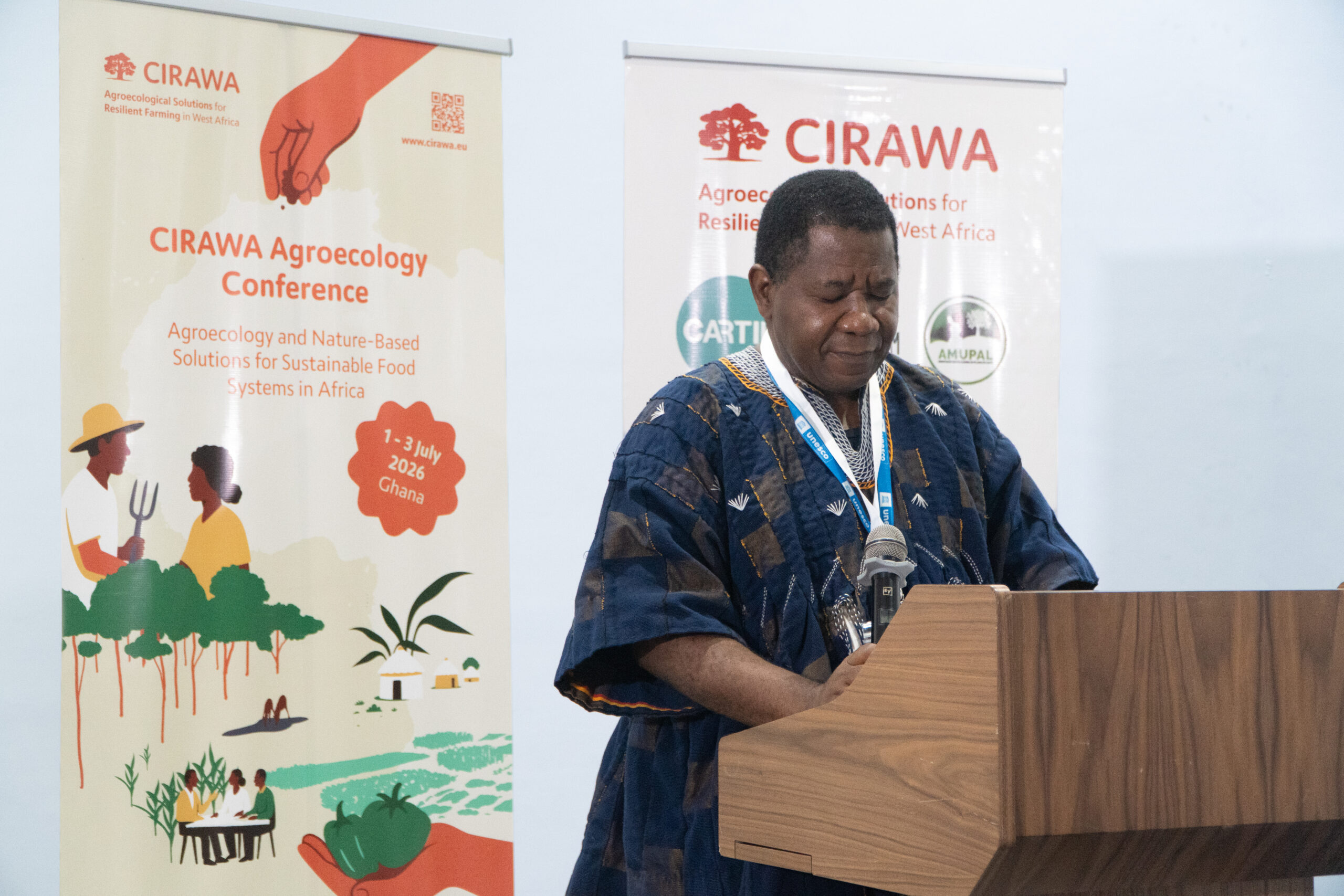
“Africa is on the frontlines of a climate crisis it did not create,” he said. “Agroecology is not just a farming method, it is an act of resistance, it is a way for African nations to declare their food sovereignty and refuse to be dependent on global supply chains that are fragile and, in most cases, exploitative,” he told the audience.
Africa is on the frontlines of a climate crisis it did not create.
Professor Saa Dittoh, one of the hosts of the conference, added: “The agroecological transition has immense potential, but it will depend on responsible science and strong local, national, and governmental movements. We have to lobby, and that’s why coming together to do this is very important.”
Policy challenges
Direct farmer-politician dialogues, youth engagement, social movements, and clear market certification processes can help dismantle the policy constraints holding agroecology back from its wider implementation in West African nations. These were some of the conclusions drawn from a high-level policy roundtable held at the conference.
The panel was formed of Dr. Jacques Somda, Country Director of the International Union for Conservation of Nature (IUCN) in Burkina Faso, Dr. Moumini Savadogo, Executive Director of the West and Central African Council for Agricultural Research and Development (CORAF), Prof. Oluwole Fatunbi, the Acting Director of Research and Innovation at the Forum for Agricultural Research in Africa (FARA), and Dr. Marc Corbeels, Senior Researcher at the French Agricultural Research Centre for International Development, Paris (CIRAD).
The panel agreed that one measure to convince policymakers to include agroecology in legislation was to frame recommendations as a problem that the politician already owns. Agroecology is public health. Agroecology is climate resilience. Agroecology is food security. Presented like this, a politician is presented with a challenge and a solution. Agroecology, therefore, unlocks answers to many issues that will inevitably land on a policymaker’s desk.
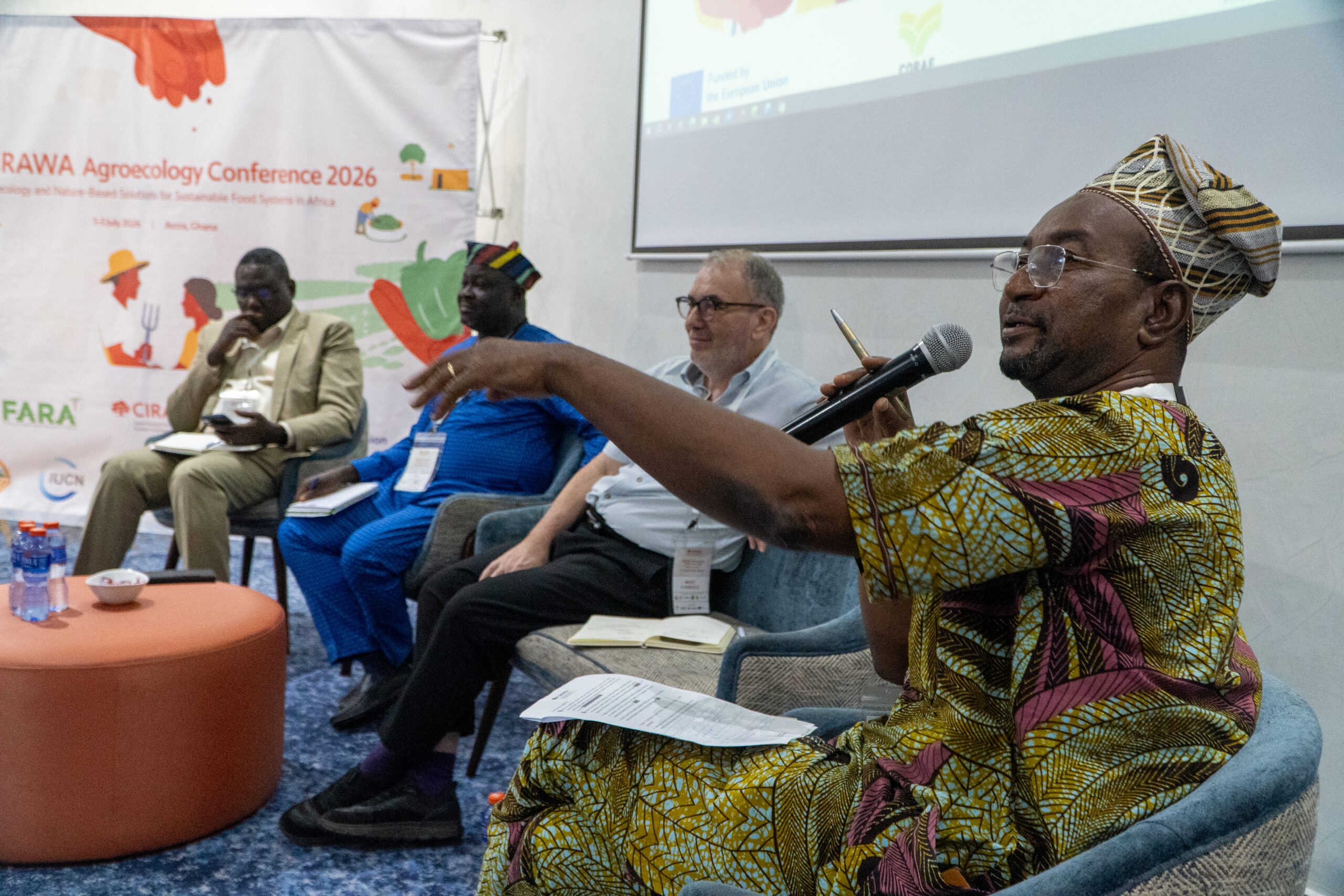
Another, as mentioned by CORAF’s Dr. Moumini Savadogo, is to bring farmers’ voices to the political discussion table.
“The problem is we sometimes talk to the policymakers but do we have the farmers’ perspective on subsidies?” He asked the audience in Accra. “Bring farmer organisations to prepare messages that they can take along. We can bring the evidence; they can bring their message.”
Agroecology as a social movement
Grassroots activism and evidence-based advocacy are powerful persuasion tools for policymakers, too, said FARA’s Fatunbi. A burgeoning movement cannot be easily ignored by politicians.
“Agroecology needs to be a social movement, a polite agitator, until it becomes that, policymakers won’t listen,” he said.
He emphasised that to engage aspiring young farmers, agroecology must be framed as the farming methodology of the future, with agroecology-compliant tillage and mechanisation systems that reduce labour costs. When agroecology becomes embedded in a social movement that spans farmers, youth, and members of the public, politicians are more inclined to listen in order to keep winning votes. It is, in effect, creating demand for a response.
Clear communications and certification
A stumbling block for agroecology’s wider uptake is a lack of clarity when it comes to the marketing and certification of agroecological produce. It is often conflated with organic produce, which is not always the case – organic practices are not a prerequisite of agroecological produce. There are also questions raised about the premium pricing that agroecological products could benefit from in the marketplace, which in turn opens a debate on who should foot those bills – the farmer, the consumer, or institutions?
Corbeels of CIRAD said the indicators of agroecological input that could serve to grant label are often “fuzzy” and needed defining.
“What we try to do is to set up a system of indicators – if you do this then this you can certify your product through an association. Only with a certification can we ask for a premium, but then is it right to ask the consumer to pay that?”
Cross-border collaboration
For agroecology to flourish, it cannot be simply imposed or parachuted in as an abstract concept by academics. Instead, agroecological practices must be co-designed with the farmers entrusted to apply them at ground-level. This co-design strategy must also stretch to policymakers and researchers, who act as promoters and guides to the farming transition.
It was in this spirit that the CIRAWA Agroecology Conference in Accra drew in over 100 attendees, including many from CIRAWA’s participatory nations of Cape Verde, Ghana, Senegal, and the Gambia but also from as far away as South Africa and Spain. This cross-border collaboration fosters knowledge exchange and mutual learning, with visitors taking new insights back to their home nations.
“Co-creation, co-innovation are very important, and they have happened at this conference,” Professor Saa Dittoh told REVOLVE. “I’m sure we are all going back far better than when we came because we have learned a lot from each other.”