
18 June 2026
Guimarães, Portugal (EURESFO 2026)
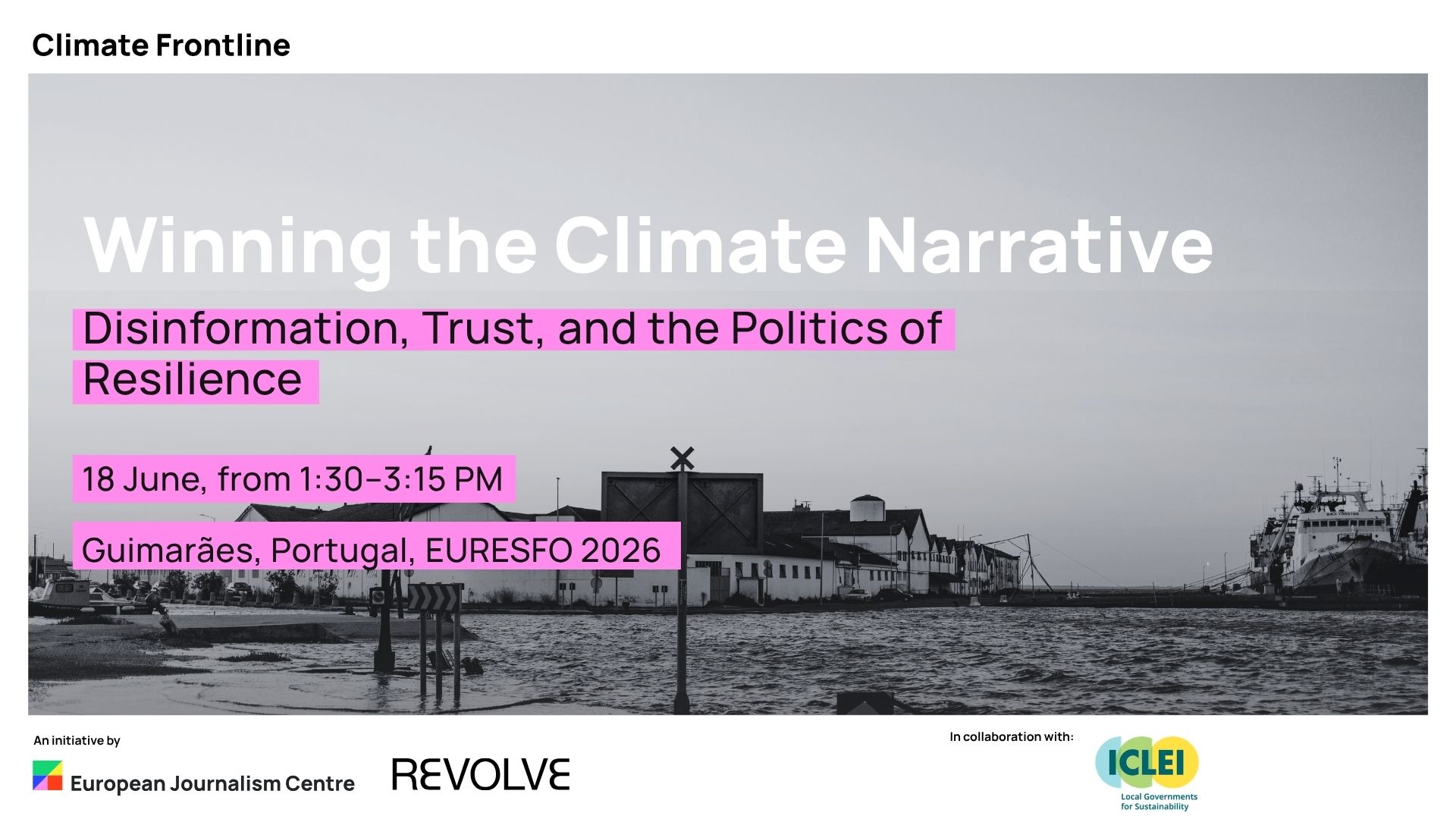
Rebuilding trust, countering disinformation, and putting communities at the center of the climate story
Who controls the climate story? Climate resilience is increasingly undermined by a widening gap between scientific knowledge and public understanding, compounded by declining trust in media and the rising spread of disinformation. Coverage of climate risks is often reactive, fragmented and disconnected from the communities most affected, focusing on extreme events while neglecting the crucial phases of preparedness and recovery.
As part of the European Urban Resilience Forum (EURESFO 2026), the Climate Frontline project (an initiative by REVOLVE and the European Journalism Centre) joins forces with ICLEI to co-organise a session which examines how climate communication can move from episodic and crisis-driven coverage towards continuous, local and trust-based narratives that strengthen preparedness, accountability and long-term public engagement.
Resilience itself poses a communication challenge: it is largely preventive and invisible, defined by avoided harm rather than visible outcomes, which makes it harder to sustain public and political attention. The session will explore three key challenges: improving the quality and integrity of climate information, strengthening the institutional and political conditions for credible communication, and rebuilding public trust.
The session will feature the four grantee newsrooms of Climate Frontline, who will present the cross-border investigations and community-rooted reporting they have developed within the project. Patricia Carbonell, Head of Communication at REVOLVE, will introduce the Climate Frontline Toolkit, a practical resource designed to support journalists, communicators and local actors in reporting on climate emergencies before, during and after they unfold.
Local and regional media play a critical role due to their proximity to communities and their ability to provide sustained, contextualised coverage. Strengthening these media ecosystems, alongside community networks and communication infrastructure, is essential for fostering risk awareness, accountability and coordinated responses. The discussion ultimately aims to surface practical recommendations to support coherent, evidence-based and locally grounded climate communication.
Date and time: 18 June 2026 | 13:30 – 15:15
Location: Guimarães, Portugal (EURESFO 2026)
Key themes
- Improving the quality and integrity of climate information in an era of disinformation.
- Strengthening institutional and political conditions for credible communication.
- Rebuilding public trust through continuous, people-centred communication.
- The role of local and regional media in resilience and risk awareness.
- Connecting expert knowledge with the lived experience of affected communities.
More information on the full session agenda and speakers will be coming soon.
For more information about EURESFO 2026, visit urbanresilienceforum.eu.