On Whaling in Iceland
Photo: Stuart Reigeluth / REVOLVE
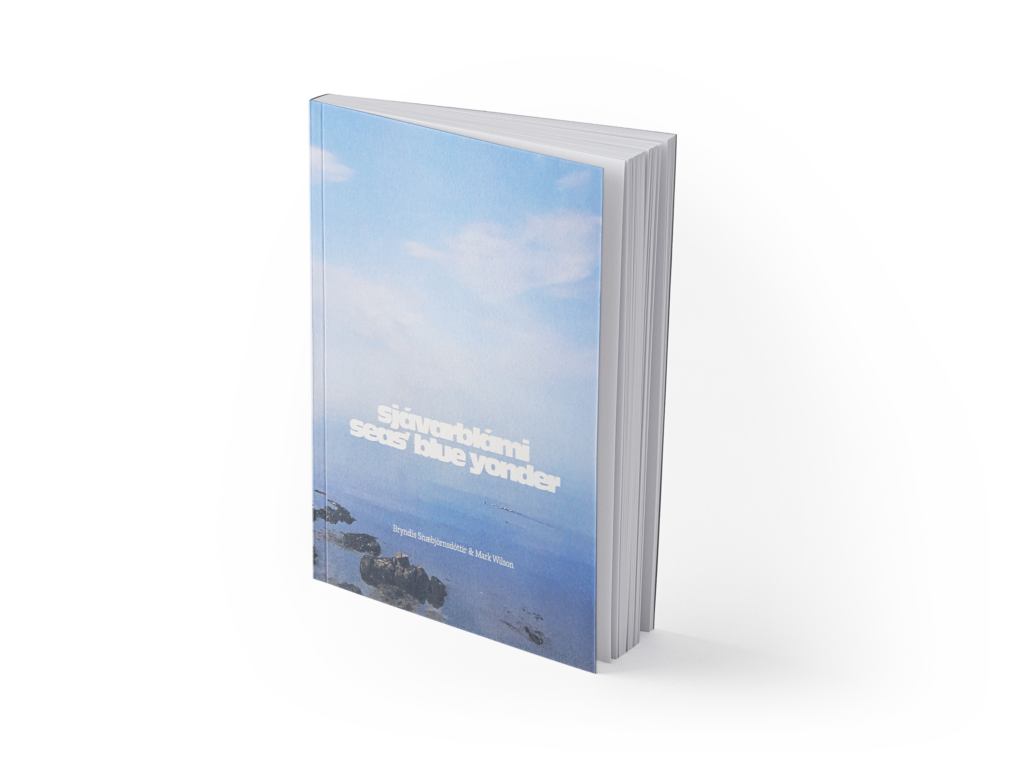
Sjávarblámi / Sea’s Blue Yonder
Bryndís Snæbjörnsdóttir & Mark Wilson
Exhibition, National Gallery of Iceland, Reykjavik Sunday 25 January – Sunday 10 May 2026
Exhibition Book. Reykjavik: Husavik Whale Museum, 2025. 248 pages.
The little exhibition room in the modest National Gallery on the eastern side of the Tjörnin Pond does not do justice to the magnitude of the topic: whaling in Iceland… and beyond. The small space means that the curation crammed different pieces and formats together that created a confusing and unsatisfying experience. Arguably, the point was to provide different formats together to give the visitor a more comprehensive experience, but they came across as too many fragments.
The ‘Apparition’ installation piece on the ground is a replication of a whale’s back surfacing for air, appearing out of the floor, and then disappearing in the photos that surround the replica; the disappearing spots on the photos are calm areas on the surface of the sea where the whale was a few moments before submerging again, after having appeared for breath, breaking the surface. The movement is there, but it is not understood at first without an explanation.
The explanation the visitor gets is of a young woman on a video describing what it was like to grow up with her father working in the whaling industry and how natural is all was and how beautiful the sea and environment always were, almost hiding – even ignoring the savagery of the whaling all around; and the other audio in the room is of a whale supposedly breathing under water, making gargling sub-sea sounds, bubbling, playing, just being underwater; it’s hard to tell, you are not sure, maybe that is the point.
The highlight of the exhibition is the series of 21 Japanese black-ink paintings based on photos of stranded (hvalreki) whales. It is unclear why whales come onto beaches to die, and most of the causes of death are either unknown or clearly visible due to propeller cuts from a ship. The short descriptions under each painting reveal: ‘no confirmed cause of death, but recent orca bite marks evident’ and ‘malnourishment – no sign of trauma’ and ‘malnourished – died after beaching’ and ‘suspected ship’s propeller strike’ and so on…
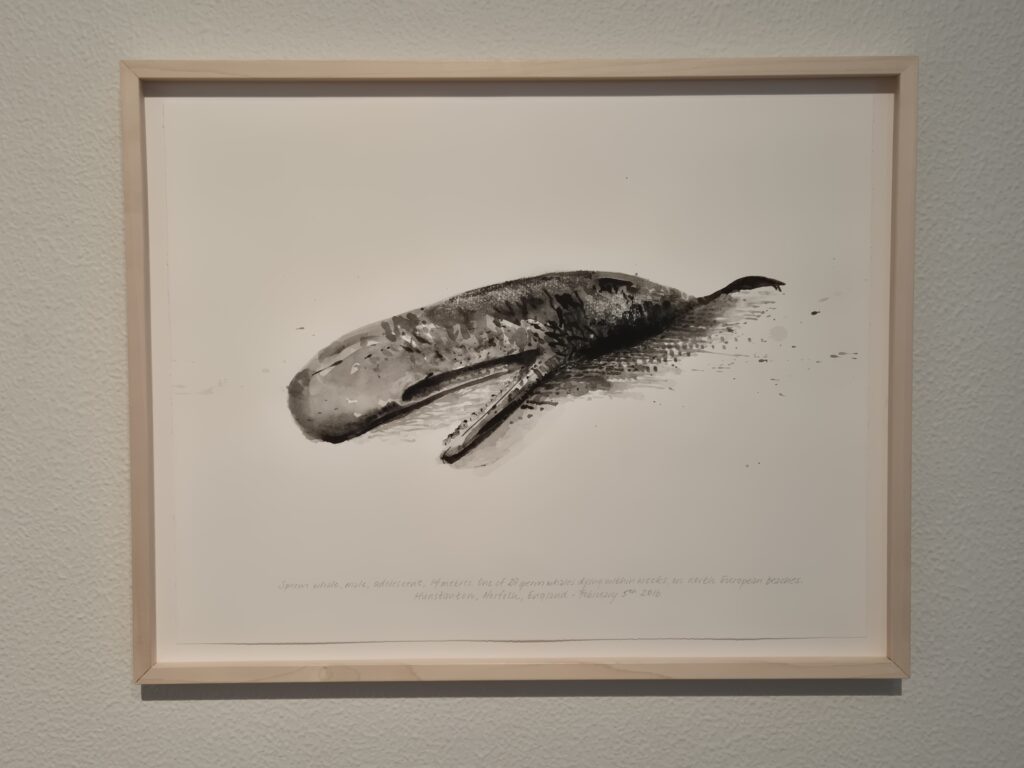
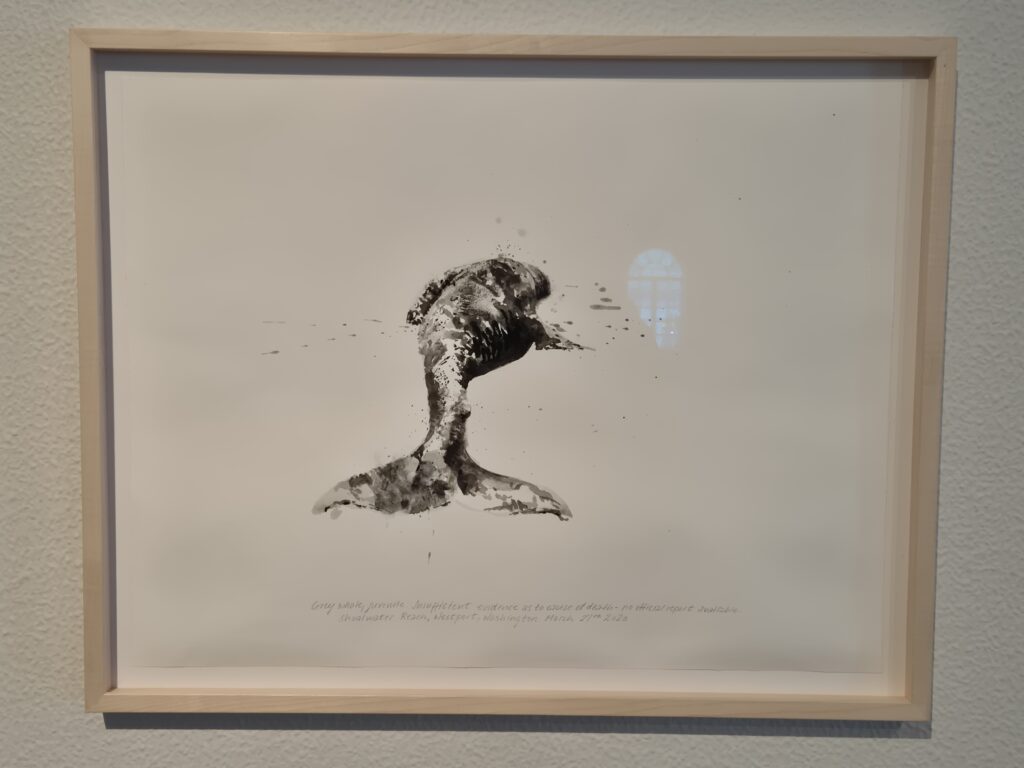
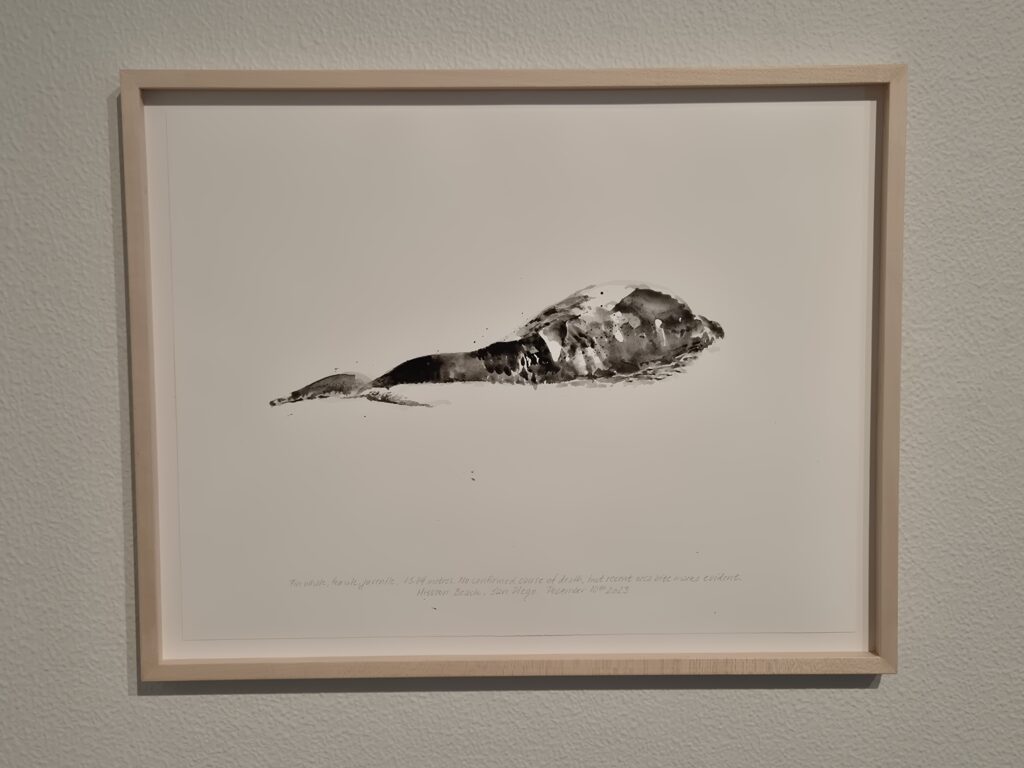
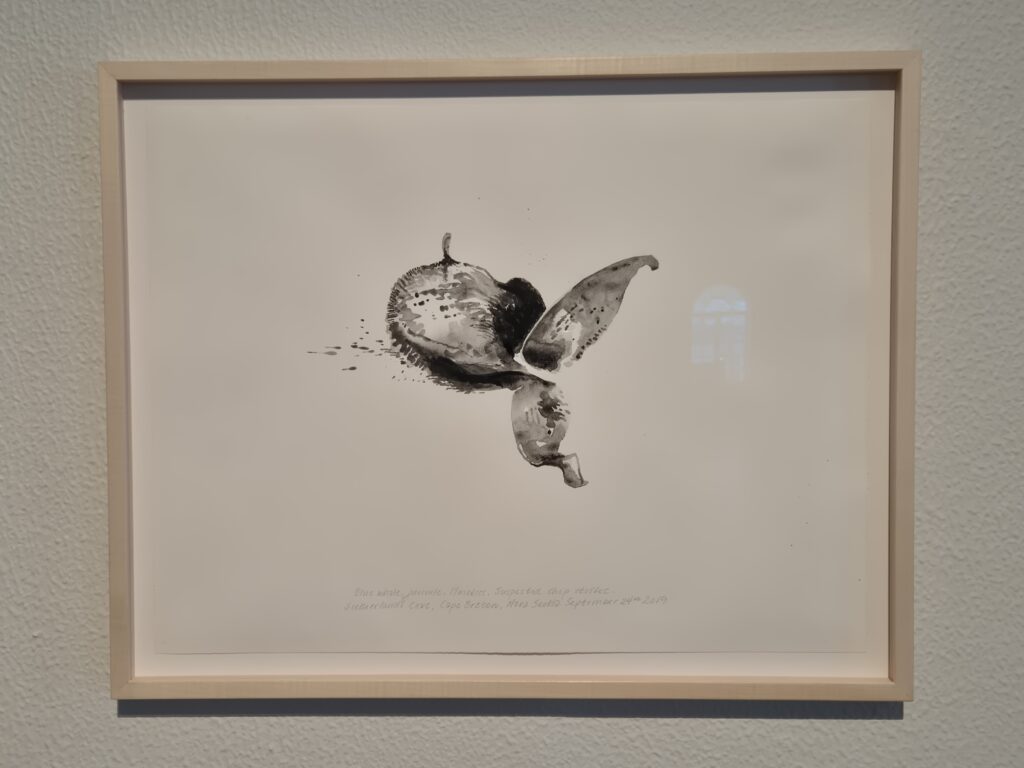
“Once land mammals themselves, over eons their nostrils have migrated from the front of their heads to the top […] whales were once land mammals.” (p.139, 147) Does this explain why whales come to shore to die? Not all whales do, so why do some whales beach and not others? As underwhelming as this exhibition may be, it serves its purpose in raising questions for the inquisitive visitor that are answered in detail in a well-curated bilingual Icelandic-English book about this two-year project.
Traditional Icelandic farming culture welcomed the beaching of whales as an “occasion for celebration. Farmers would come together to collect its abundant flesh, blubber, and oil, providing sustenance for months. The Icelandic term hvalreki means good fortune.” (p.51) Today, the beaching of whales is seen with sadness at the massive sea mammal’s demise and also with frustration by the local authorities that have to dispose of the multi-ton carcass, often dragging it back into the ocean.
The transition from farming to whaling occurred in the mid-19th century in Iceland with the influx of foreign enterprises that considered whales to be the moving oil wells of the ocean. Whales provided meat and blubber for human consumption as well as many auxiliary products such as whale oil for lamps (and streetlamps were proliferating exponentially in Europe and beyond) and whale bones for the manufacture of women’s corsets (which were quite the fashion among Europeans during the era of industrialisation).
The transition from farming to whaling occurred in the mid-19th century in Iceland with the influx of foreign enterprises that considered whales to be the moving oil wells of the ocean.
Iceland begins to own its whaling industry and in 1948 establishes a whaling station in Hvalfjordur (Whale Fjord) in west Iceland by repurposing a US Navy station from World War II. The repurposed whaling station becomes a tourist attraction, for Icelanders and foreigners alike who are interested in seeing the “bloody spectacle of the flensing plant amid relics of military occupation.” (p.61) ‘Flensing’ is the industry term for the bloody practice of stripping blubber, fat and skin from whales (and seals).
While the industry is significantly in decline, whaling in Iceland will continue disgracefully until 2029 at least, unless new legislation is passed.
The savagery of whaling is hard to comprehend today. While the industry is significantly in decline, whaling in Iceland will continue disgracefully until 2029 at least, unless new legislation is passed. Japan and Norway are the only other two countries that continue whaling. As Iceland transitions into the 21st century, the island is exploiting more renewable natural resources such as geothermal energy from the earth and hydropower from rivers, unfortunately both of which are being used to grow another foreign-imposed industry: aluminum.
Featured in