Remains of the Glacier
Photo: Stuart Reigeluth / REVOLVE
In south-eastern Iceland, the Vatnajökull mega ice cap that still covers roughly 8% of the island is slowly but surely transforming into pools of meltwater.
The glacier is glowing. You see a strange light in the rearview mirror and pull over to get a better look: from behind the brown hill that separates the ‘outlets’ of Svínafellsjökull Glacier coming down the right and Skaftafell Glacier on the left, there is a soft white glow that seems to pulsate as it dissipates into the overcast sky.
Where is the light coming from? It’s too early for moonglow – it’s late afternoon, close to five pm, when dusk falls fast and dilutes the contours of things. Maybe the mega glacier of Vatnajökull is refracting and releasing the daylight it absorbed. Maybe it’s simply an optical illusion, a natural phenomenon of ice and snow particles playing with the light. Maybe it’s the Almighty: for sure, if there is a God, then She is to be found in the light of a glacier.
It’s raining now, and large drops hit the windshield. The wipers are working hard. Past the rain that streams along the windows, you can see the massive Skeidararjokull Glacier extending in a milky smudge across the horizon to the right. This outlet emanates from the big mama icecap, Vatnajökull – the “Glacier of Lakes”; and she surprised you when you stood on the hill looking at the other adjacent outlets, appearing behind you, as if she were waiting for you to notice Her.
Views of fields and farms and horses standing in the rain: the land is saturated in hues of hay and spots of snow. The snow congregates mostly on the edges of streams that flow down from the glaciers and mountains. The asphalt road ringing around the island has snowdrifts, but they melt quickly. The temperature on the dashboard reads 6 degrees Celsius. It was 20 degrees Celsius at Christmas in Reykjavik. There has been no snow since last October – no significant snowfall for an entire winter in Iceland.
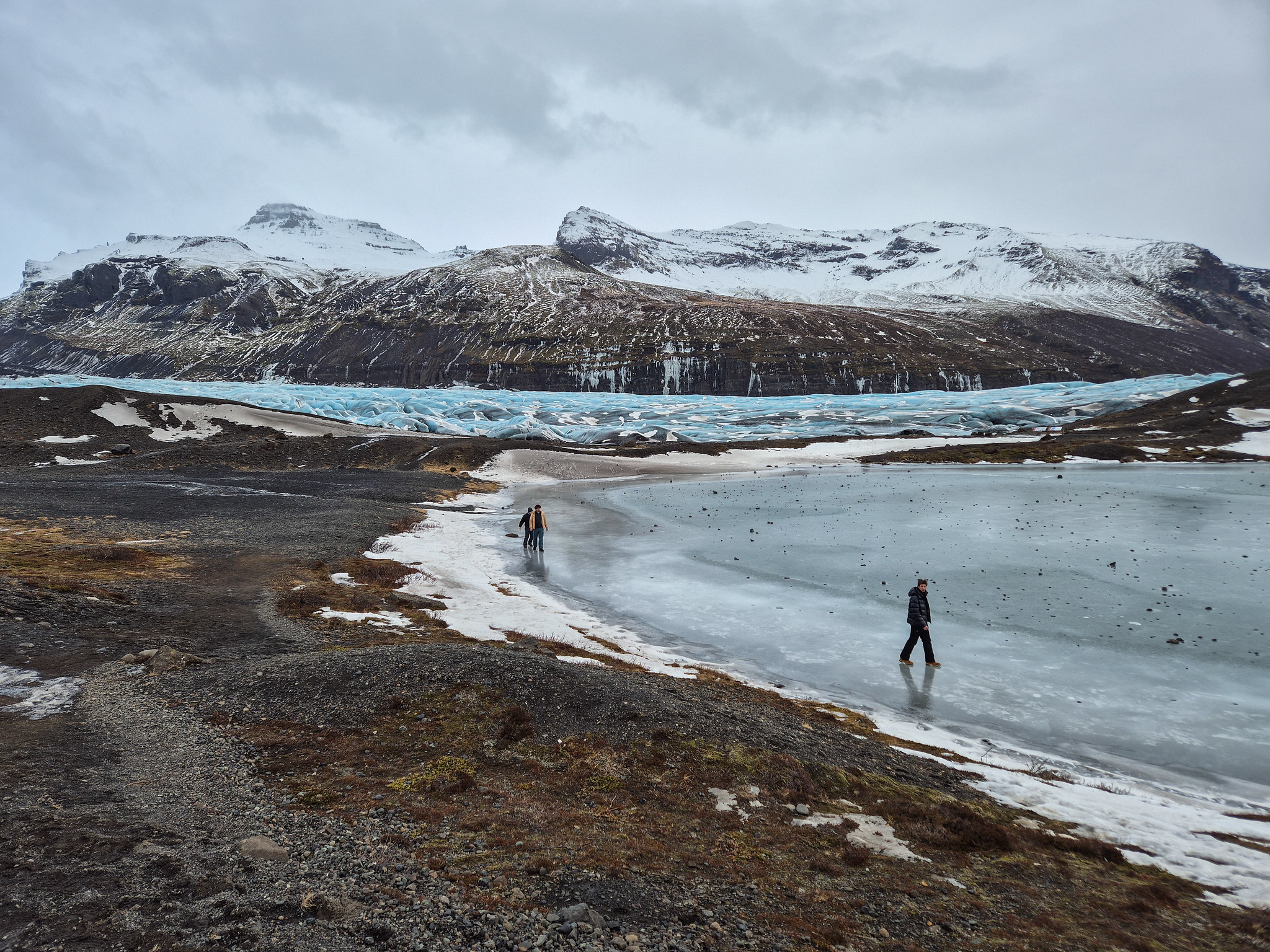
You watch the occasional snowdrift sweep across the dividing line of the ring road and still you can hear the sound of the glacier popping, cracking, exploding from within: near the Svínafellsjökull meltwater pool you crouched down in the gravel and dirt with the pieces of black translucent ice and you listen to the detonations from inside the glacier going off like subsea depth charges, resonating through the frozen mass, each one a sobering, echoing announcement.
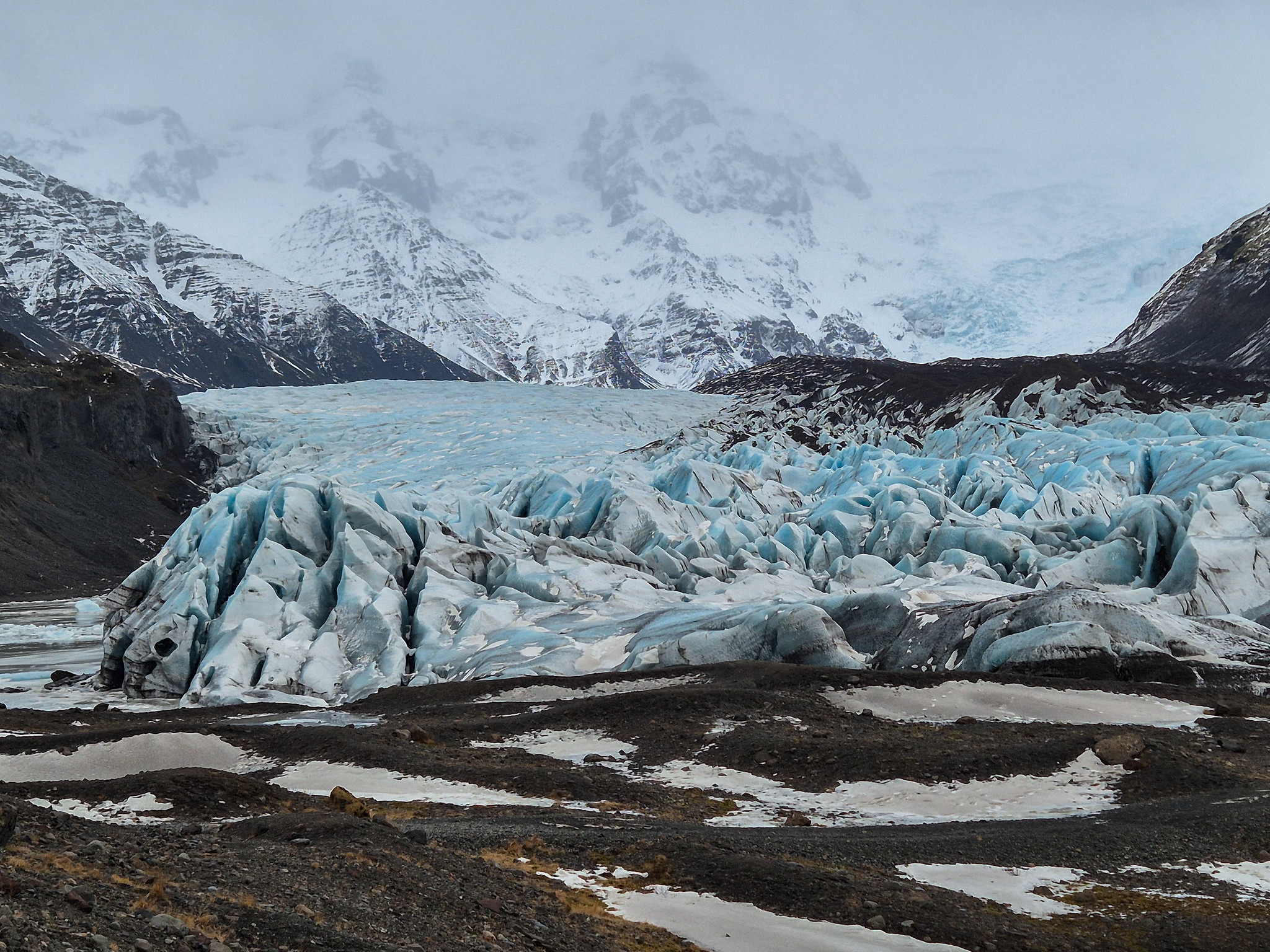
If you have ever left your freezer door open to defrost, then you will recognise the sound of a melting glacier, just multiple the emotional impact exponentially. You see people walking into the cracks of the glacier tongue, jagged ice pieces all cracked up, and others walking next to dystopian black-and-gray formations that look like homes, and then the bright fluorescent blue of compact ice that also refracts an impossible light from within. Humans like to touch the glacier to feel for the light.
You hear people speaking English, Spanish, French, and Japanese in the distance; they are walking around the meltwater pool that oozes from the glacier, forming a growing pond at its base. Everyone is taking photos, capturing the moment, recording the spectacle of a melting glacier. A buzzing drone passes above the pool and heads up over the snow towards the blue-tainted wall far above. The wind is whistling and whirling ice particles sting your face.
A black raven swoops over the Svínafellsjökull pond that looks like grey blood – the life essence of this tremendous whale that is beached and stranded with its shredded tongue protruding, ripped blue shards of slowly bleeding tissue. The drone has disappeared up the glacier, and you can still hear its humming or the whistling of the wind now. The separator line in the ring road is blinking as you drive past Skeidararjökull on the right; an Arctic tern or fulmar passes before the windshield; and the great Icelandic Nobel laureate, Halldór Laxness, wrote that:
[…] the glacier is illuminated at certain times of the day by a special radiance and stands in a golden glow with a special aureole of rays, and everything becomes insignificant except it.
Halldór Laxness, Under the Glacier, New York: Vintage, 2004, p. 141
This opinion was written in Reykjavik on 3 March 2026 – the day of this trip to the glacier.