
Food Security in Seed Vaults?
Photo: Stuart Reigeluth / REVOLVE
The future of global food security resides unexpectedly and partly in the Svalbard Vault in the Arctic Circle.
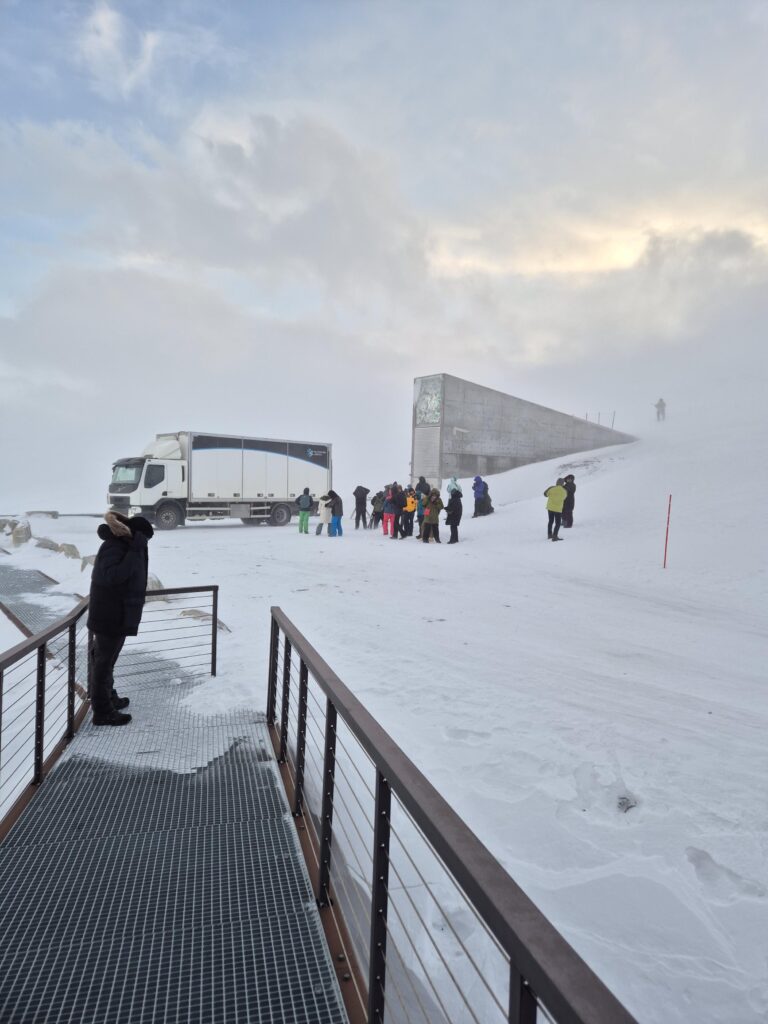
In an unlikely location on a hill just outside of the town of Longyearbyen, stands something resembling a James Bond –style vault. Its entrance to the vault is a vertical concrete rectangle protruding from the mountainside, crowned by a fluorescent green light installation that flickers in and out of the Arctic windstorm.
There is a ceremony taking place organized by the Norwegian Ministry of Agriculture and Food, NordGen, and the Crop Trust – the three partners running the Svalbard Global Seed Vault. For security reasons, no one is permitted inside. Any mishap, officials caution, could jeopardize the future of global food security.
Wind gusts are blowing easily at over 100 kilometres-per-hour and national delegates from South America, Spain, and Africa gather around a truck backed up to the entrance. Inside are newly arrived seed boxes from Guatemala, Taiwan, Niger, and Germany, ready to be deposited into the vault. It’s a day of celebration – albeit one tempered by Arctic winds.
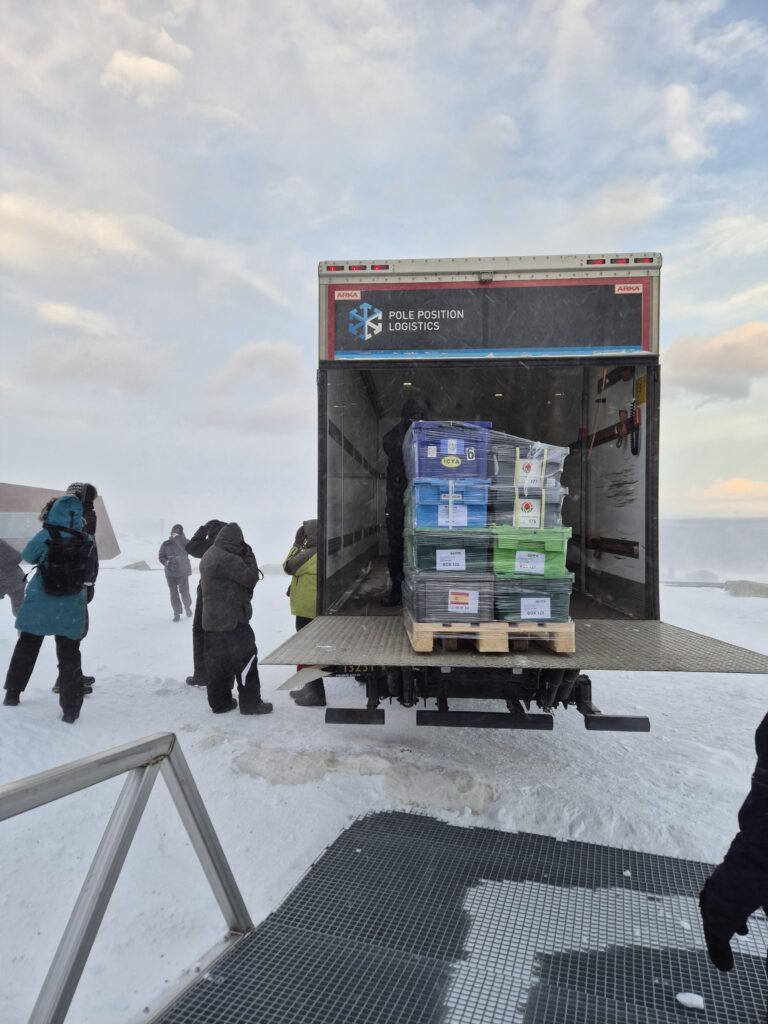
Beyond the spectacle, the event underscores something deeper: multilateral cooperation that transcends geopolitical tensions in the Arctic. Institutions such as the International Center for Agricultural Research in Dry Areas (ICARDA), the World Vegetable Center (WorldVeg), and the UN’s FAO, through the International Treaty on Plant Genetic Resources for Food and Agriculture, are present. Their collaboration represents a rare and powerful example of collective action to confront looming global food security challenges.
The vault descends into the permafrost of the hill overlooking the tiny airport of Longyearbyen. It contains three chambers, two of which are nearly filled with seeds from cereals and vegetables from around the world. The third chamber is empty and ready to welcome new batches of seeds to save genetic materials for duplication.
While there have been issues with the thawing of the permafrost causing water leakages in the vault post-construction, the permafrost and cooling system keep the seeds frozen at -18 Celsius continually. A century-long experiment is now underway to determine whether these seeds can remain viable for 100 years, extending humanity’s genetic safety net far into the future.
For nearly 20 years, the seed bank has grown steadily, with occasional withdrawals that demonstrate its practical value. ICARDA, for example, retrieved seeds to support Syria after the civil war destroyed its gene bank in Aleppo. Between 2008 and 2014, some 116,000 Syrian samples had already been duplicated and stored in Svalbard. Withdrawals in 2015, 2017, and 2019 enabled the establishment of new seed banks in Morocco and Lebanon.
By 2025, those regenerated seeds were redeposited in Svalbard – replenishing the Syrian collection and completing a full-circle recovery. While cereals such as wheat, barley, and sorghum dominate the collection, vegetables are increasingly recognized as equally vital. As Maarten van Zonneveld, Head of Genetic Resources at WorldVeg, noted: “In 2018, only 27% of our vegetable genetic bank was stored in the Seed Vault. Now, in 2026, we have reached 92%, with a target of 100% by 2028.”
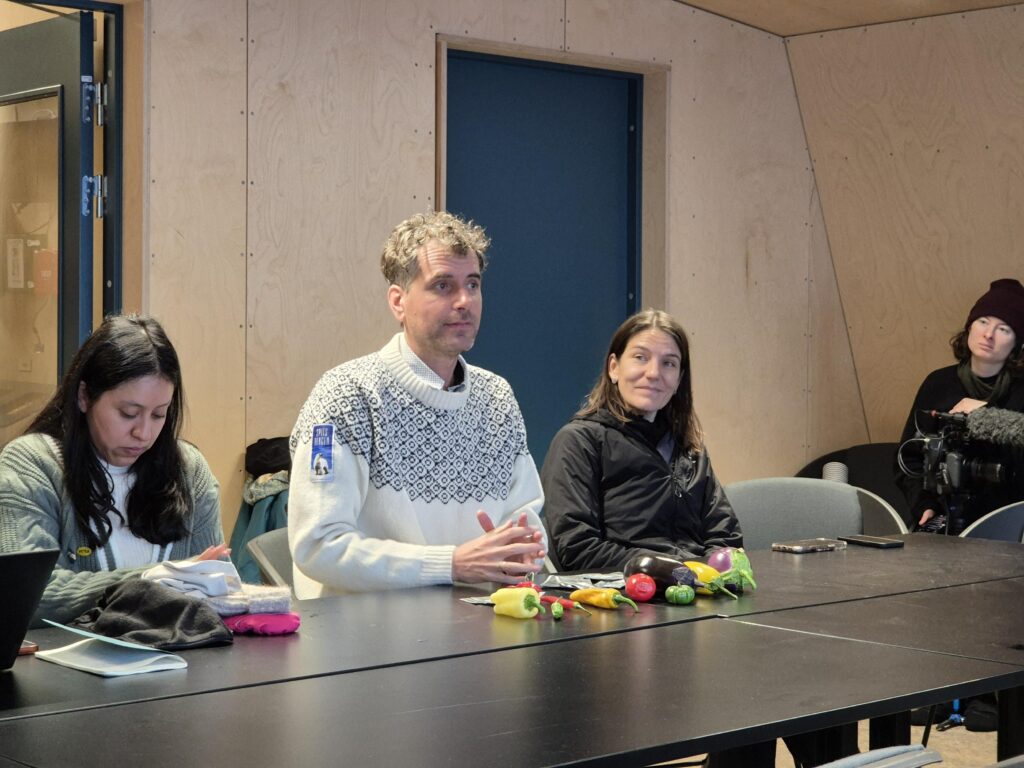
Vegetables are fundamental to nutrition – particularly for children – yet only 2% of global seed distribution consists of vegetable seeds. Significant work remains.
And what if Svalbard itself becomes inaccessible, buried under snow, or affected by climate shifts? Redundancy is part of the strategy. WorldVeg maintains a backup vegetable genetic repository in South Korea, and many institutions worldwide duplicate their collections across multiple sites as part of long-term risk management planning.
Planning for the worst while hoping for the best – safeguarding the genetic foundations of food systems – remains one of humanity’s most complex and urgent undertakings. However many vaults are built, ensuring food security for future generations is a challenge that defies geography, politics, and time.
This opinion piece was written on 25 February 2026 in Longyearbyen, Svalbard, after attending the Svalbard Global Seed Vault ceremony.