
A Circular Source of Cellulose
Photo: Shutterstock
Breakthroughs in cellulose recovery are creating an alternative forest to meet rising resource demand.
Historically, cellulose production has been synonymous with the logging of forests but as Europe seeks to strengthen its resource independence and protect natural ecosystems, the search is on for alternative sources. The EU-funded ICARUS project brings partners together in the search for circular cellulose solutions within the construction sector.
ICARUS partners are working together to validate an efficient system to recover cellulose from urban wastewater (WWTP) and absorbent hygiene products (AHP) through two pilots; Italy and Spain, led by i-Foria and ACCIONA Business.
REVOLVE spoke with i-Foria CFO and Co-Founder Giuseppe Landolfo and ACCIONA Water Business’ Innovation & Technology Transfer Technician Mireia Marcé Escalé to find out more.
We often overlook the sheer volume of cellulose that ends up in our waste systems. AHPs are a good example of this – what makes this waste stream more challenging than others?
Giuseppe Landolfo: (AHPs) include items like baby nappies, sanitary pads, and incontinence products. These are highly complex products made of mixed materials – plastics, cellulose, and superabsorbent polymers – bonded together in multilayer structures. Their contamination with biological waste and the difficulty in separating the materials made them historically “impossible to recycle.”
In Europe, over 8 million tonnes of AHP waste are generated every year. In Italy alone, it’s estimated that AHPs account for around 900,000 tonnes per year, which represents over 4.4% of the total municipal solid waste – more than the textile sector (4.1%).
In Italy alone, it’s estimated that AHPs account for around 900,000 tonnes per year, which represents over 4.4% of the total municipal solid waste – more than the textile sector (4.1%).
We often think of wastewater treatment as just cleaning water, but at ACCIONA, you are essentially mining it. What makes cellulose from wastewater a viable resource?
Mireia Marcé Escalé: Cellulose is the primary component of toilet paper, and depending on the manufacturer, its content can reach up to 85% of the paper’s overall composition. Considering that each European citizen uses between 10 and 50 grams of toilet paper per day, the resulting generation of cellulosic waste across the European Union is substantial and estimated at around 4.3 million tonnes per day.
Beyond the volume of waste, what are the environmental costs of letting these materials go to waste?
MME: Within wastewater treatment, one of the most significant environmental impacts associated with cellulose is the high energy demand required for aeration, which entails energy consumption and an important carbon footprint. Aeration is essential for sustaining the biological processes responsible for degrading organic matter, including the cellulose present in the wastewater influent. Because aeration accounts for the largest share of energy consumption in most wastewater treatment plants, any reduction in organic load becomes crucial for improving sustainability and operational efficiency.
GL: AHPs that aren’t landfilled are often incinerated, leading to greenhouse gas emissions and loss of recoverable materials. Moreover, when mismanaged, they can contaminate organic waste streams—particularly in composting facilities—adding costs and inefficiencies to treatment processes. In many regions, especially in the Global South, used nappies are visibly dumped in the environment, contributing to pollution and health risks.
What is a breakthrough or key element in ACCIONA’s process that makes it possible to recover cellulose?
MME: ACCIONA is using a Rotary Belt Filter (RBF) to retain the small solid fraction present in the wastewater stream. This retained material is particularly cellulose-rich, as cellulose represents a substantial portion of the solid fraction. After the RBF, the retained solids undergo a dewatering step, achieving a dryness level of approximately 25-30% (kilograms of dry solids per kg of wet sample). However, this fraction is also mixed with a significant quantity of other debris, which must be further handled downstream by i-Foria.
Although RBFs are conventionally installed at the end of the wastewater treatment to dewater the sludge, ACCIONA is investigating a novel application of this technology. In this case, the RBF has a mesh size capable of effectively sieving and retaining cellulose fibres present in the wastewater effluent.
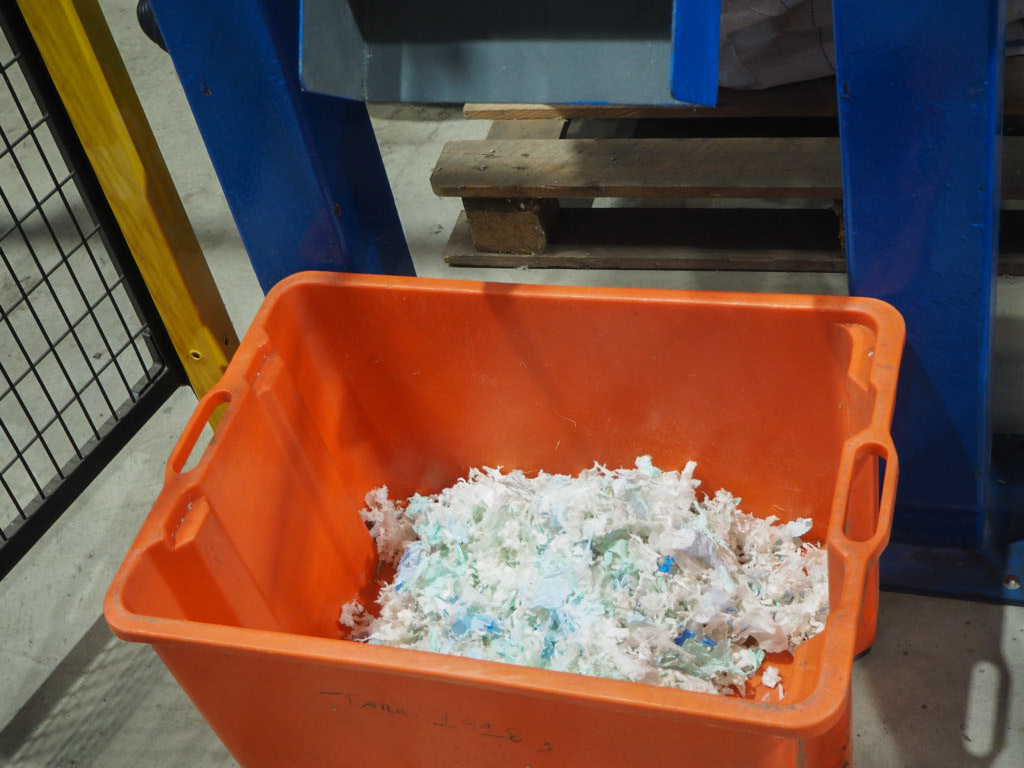
GL: For i-Foria, the breakthrough lies in a mechanical process. Our technology gently separates each material without degrading its properties, recovering cellulose, superabsorbent polymers and plastic in clean, reusable forms. The i-Foria technology is the only one capable of removing drug residuals while complying with the EU’s end of waste (EoW) criteria (which determines when waste becomes a secondary raw material) – all through a low-energy process.
Our technology gently separates each material without degrading its properties, recovering cellulose, superabsorbent polymers and plastic in clean, reusable forms.
How has the close relationship between ACCIONA and i-Foria helped streamline the objectives of the ICARUS project?
MME: The integration of our process with i-Foria’s cellulose recovery technology is essential to revalorise the cellulosic sludge generated at the WWTP. Our process generates a cellulose-rich sludge, but this material cannot be directly used in construction applications. Similar to the absorbent hygiene product feedstocks that i-Foria is using as initial feedstock, too, the cellulosic sludge first requires proper hygienisation and purification to remove contaminants and ensure that the resulting secondary cellulose meets the quality standards necessary for applications such as pavements, cement, and concrete.
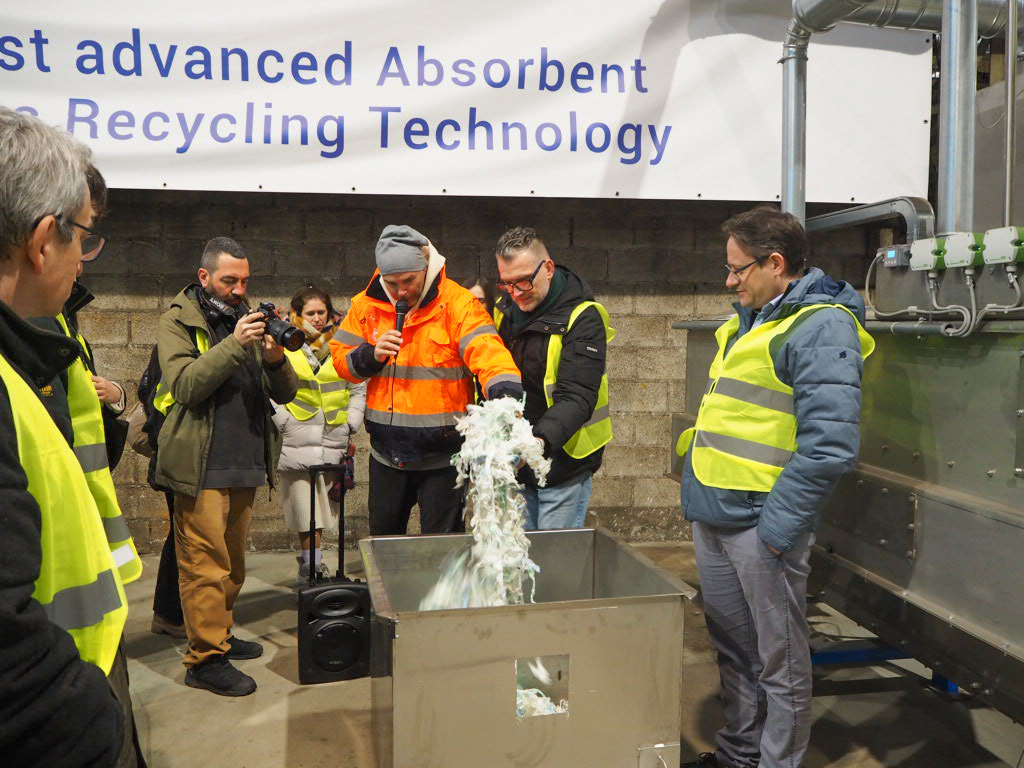
By working closely with i-Foria, we can evaluate how operational adjustments in the RBF process influence the downstream purification and polishing steps and ultimately affect the quality of the recovered cellulose.
What are some real-world applications for recovered cellulose?
GL: Recovered cellulose can be reused in insulation panels, agricultural substrates, or as a raw material for biochemicals. Plastics are suitable for producing construction components, packaging, or urban furniture. Each tonne of recycled AHPs saves virgin pulp and plastic production, significantly reducing carbon footprint and dependency on fossil-based or forest-derived materials.
MME: By recovering cellulose, we are unlocking a new material to be added to construction formulas such as the concrete used in pavements. The properties of cellulose will contribute to diminishing the risk of cracking of this type of pavement due to drying shrinkage. Currently, polypropylene microfibers are used for this purpose, therefore, with the ICARUS initiative we are reducing the reliance of the sector in fossil fuel-based materials, and therefore, also reducing its carbon footprint.
Both of your companies are in pilot phases as of early 2025, what are the next steps to scale the technology up?
MME: The next phase will involve a technoeconomic analysis to evaluate the costs and benefits associated with scaling up this technology. The outcomes will help validate the feasibility of scaling up the technology and provide insight into the potential profitability of the initiative, thereby paving the way for its future integration into a full-scale wastewater treatment plant
GL: We have a pilot that has a capacity of 100kg per batch. With this pilot, we have successfully demonstrated and validated the technology at a meaningful pre-industrial scale. We are now able to produce representative samples compliant to the EoW criteria that allow us to test and validate real downstream applications with our industry partners.
The next step for i-Foria is to license this innovative technology for the construction of the first industrial-scale plant in Tuscany, where there was already a Public Tender last year, and they selected i-Foria technology. This installation in Tuscany is supported by funding from the PNRR (National Recovery Plan) programme, which is enabling the development of 15 recycling facilities across Italy.
What are some of the main hurdles you face when trying to scale up to wider deployment?
MME: On one hand, this particular technology is typically applied to the sludge stream, at the end of the treatment, for its dewatering before its following processing. This stream can be up to one hundred times smaller than the WWTP’s influent flow, the stream targeted in our initiative. For this reason, scaling up the process requires addressing not only an increase in the number of RBF units but also improvements in their efficiency and processing capacity. The separation step must be capable of handling substantially higher flow rates, making technical optimisation essential for full-scale deployment.
GL: AHP collection requires dedicated bins and separate logistics that are already implemented in many Italian cities. Public cooperation is needed, but systems can be user-friendly. The success of municipal pilot programs shows that people are willing to separate AHPs when given the infrastructure. Today in Italy, 20 million citizens are already served by separate diaper collection… Municipalities therefore organise dedicated collections, but paradoxically, diapers collected separately still end up in traditional disposal facilities.
What are some of the regulatory barriers slowing down progress?
GL: The main barrier is the lack of harmonised extended producer responsibility (EPR) schemes for AHPs in most countries, which limits investment in separate collection and recycling. Italy leads Europe with an End of Waste regulation specifically for AHPs and 13 plants under construction via the PNRR. Expanding similar policies in other countries is essential to scale the solution.
The main barrier is the lack of harmonised extended producer responsibility (EPR) schemes for AHPs in most countries, which limits investment in separate collection and recycling.
MME: Measures such as establishing mandatory minimum shares of recovered materials or providing incentives for their use could significantly accelerate market integration and help these materials compete with traditional resources. Although the EU is progressively strengthening its Circular Economy strategy, concrete initiatives to actively support material recovery and its introduction in the industry are still limited and need further development to unlock the full potential of projects like ICARUS.