The Distance Remaining to Low Carbon Transport
Photo: Ato Aikins / Unsplash
Photo: Ato Aikins / Unsplash
The transport sector is undergoing a paradigm shift, with a gradual shift away from the ‘conventional’ internal combustion engine towards lower-carbon mobility. Still, the problem of the billions of highly-polluting vehicles already on the global roads remains. Particulate Matter (PM), Nitrogen Oxides (NOx) and a range of hazardous hydrocarbons and other pollutants contribute significantly to the global air pollution crisis, which kills millions of people prematurely each year. The transport sector also emits nearly a quarter of all energy-related Greenhouse Gases (GHG), with significant impacts on the global climate. With the Paris Agreement commitments and the 2 degrees “carbon budget” likely to be exceeded in the next 10 years (if it’s not already!) due to incorrect accounting and reporting methodologies, how can we clean up this mess?
Zero transport emissions are inevitable; the only question is how to get there … quickly. Since 2011, IGES has worked relentlessly to tackle the multiple challenges of todays’ unsustainable mobility. Through analysis and review of global best practices, we identified some key pillars that we see as imperative to address and ensure truly sustainable mobility. These are:
As the paper is not long enough to discuss all four pillars, we concentrate on the first and the last of these below.
As seen in the ‘dieselgate’ scandal, real-world vehicle emissions are often far from those prescribed by regulations and claimed to be met by vehicle manufacturers. This is true for both old and new cars. There are multiple circumstances that affect real-world emissions, including:
In addition, emissions of smaller, ultrafine nano-particles (sub 23NM) remain largely unregulated. This is a huge concern, as these smaller particles are potentially the most harmful to human health. They can easily penetrate through the lungs, to the blood stream and settle in the brain and vital organs. They also contribute significantly to global climate change. Recent research also shows disturbing evidence of catalyst materials transferring to central brain tissue, possibly exacerbating degenerative mental illnesses.
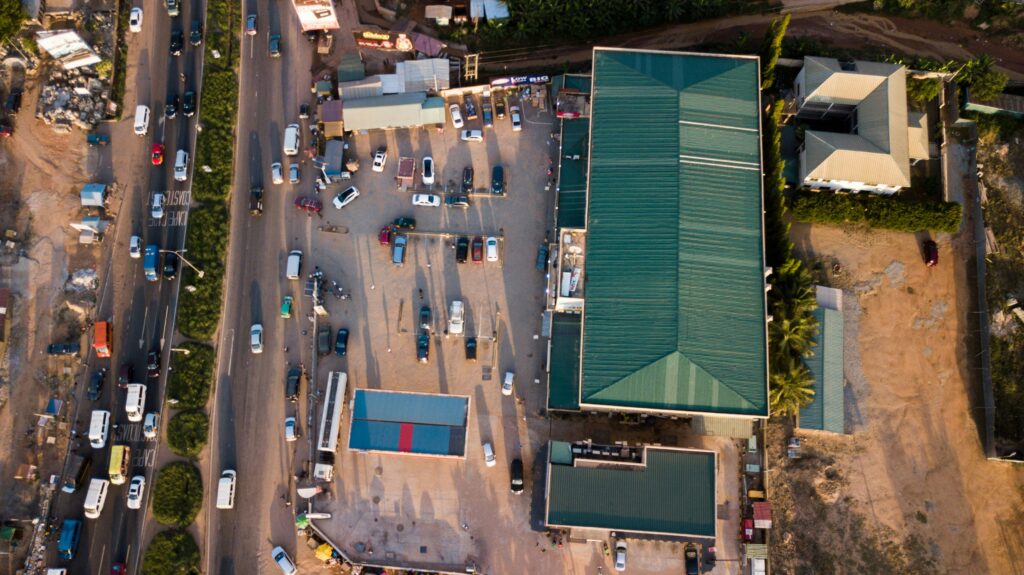
The solution? Real-time MRV of on-road vehicles. This enables identification of high-emitting vehicles that contribute disproportionately to overall emissions. Actions to reduce the emissions of those vehicles can then be taken in an effective, cost-efficient and equitable way. Real-world MRV also allows regulators to enforce meaningful regulations, emission standards and establish accurate emission inventories.
In 2015, IGES carried out a ground-breaking real-world MRV project in Accra, Ghana. Ghana recognizes that a robust MRV system is the cornerstone for successful implementation of its international and national climate change mitigation and adaptation commitments and low emission, sustainable development.

This is particularly important in the transport sector, where no emission baselines, standards or compliance schemes were in place. The Government of Ghana needed appropriate tools to regulate and reduce the emissions of the vehicle fleet, which comprises predominantly second-hand imports. These vehicles emit high levels of CO2, Short-Lived Climate Pollutants (SLCPs) and other harmful pollutants, posing serious threats to human health, climate change, the environment and an obstacle to low-emission development.
To support Ghana’s climate mitigation and sustainable development efforts, IGES implemented this 1st of-its-kind real-world transport MRV project in Africa. The project collected and analysed real-time data on road-vehicle emissions, providing an example for future deployment of transport MRV technologies. The over-arching project goal was to build local capacity to measure and reduce the emissions of transport pollutants.
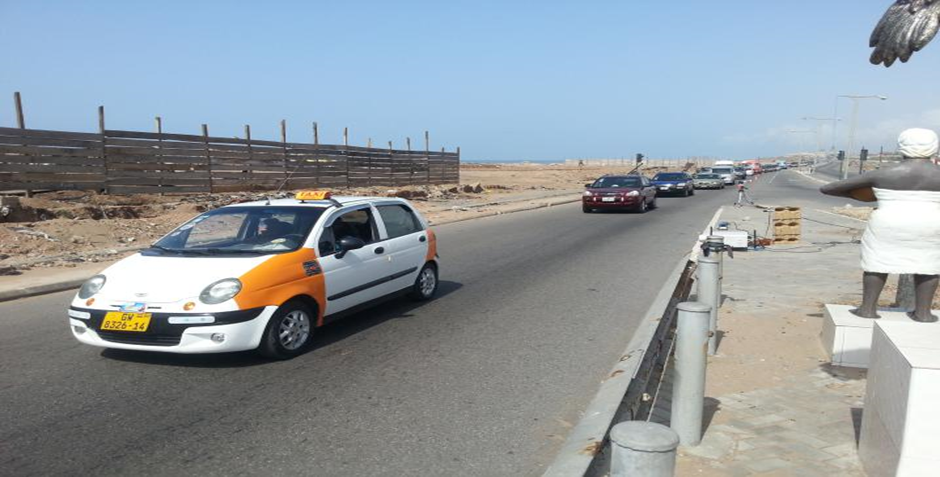
The project measured the roadside emissions of vehicles in the city of Accra, using advanced MRV technologies. Emissions of 14,500 buses, mini buses (Tro-Tros), Heavy Duty Vehicles, taxis and passenger cars were monitored over a two-week period. Data were collected and analysed to show fleet average emissions and distribution of pollution according to vehicle category and individual vehicles, verified to highest international standards.
Vehicle emissions were measured by strategically-placed devices able to monitor vehicle speed, climatic conditions and actual emissions. Results were recorded according to vehicle license plate numbers, allowing for identification of the most polluting vehicles (high emitters). The identification of high emitters allows regulators to develop policies and maintenance schemes, whereby the owners of these vehicles are obliged to bring them back into a road-worthy condition or retire them.
The project highlighted some significant challenges to reducing transport emissions in Ghana:
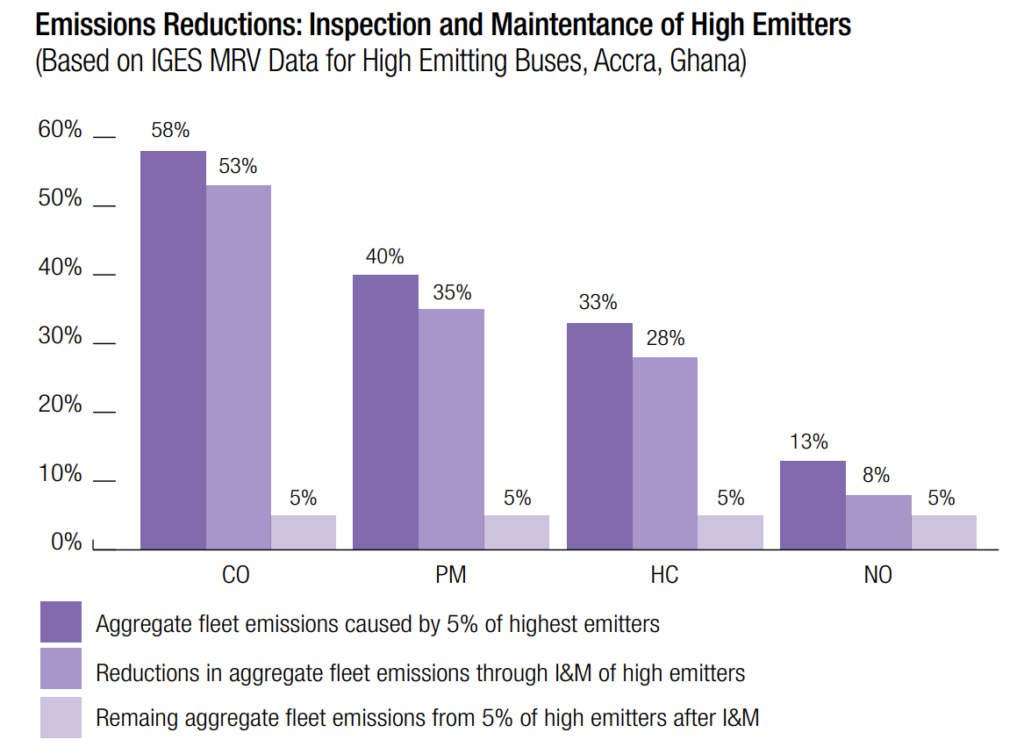
These findings indicate that transport emissions and air quality issues in Accra are of an order of magnitude greater than expected. This problem is likely to prevail across cities in the developing world, where older vehicles predominate. On the bright side, these findings suggest that with localized real-world MRV data and appropriate policies, governments can be empowered to reduce transport emissions at source, in cost-effective, efficient and equitable ways.
To support Ghana’s climate mitigation and sustainable development efforts, IGES implemented this first-of-itskind real-world transport MRV project in Africa.
The MRV methodology used in this project can be applied in various transport projects internationally. The support and collaboration of government stakeholders, including the Ministries of Environment, Transport, Finance and the Environmental Protection Agency, as well as private stakeholders were key to enabling implementation and scaling up. Further MRV projects are being developed for verification under international climate change initiatives. As part of the development of the wider Ghana Eco-Transport Program, IGES is developing innovative business models, based on public-private partnerships, access to carbon markets, leverage of private investment and green bonds.
Our experience shows that policymakers, NGOs and other stakeholders often do not have the necessary information and tools to bring about the change they want to see. For this reason, we have supported a number of capacity-building and training activities.
One of these is the 365 Campaign, an on-line database of transport and climate change actions and a knowledge product of the Paris Process on Mobility and Climate (PPMC). The database contains a maximum of 365 examples from around the world covering all modes of transport, collected under key words that allows the database to be searched according to region, area of activity (urban, rural, passenger, freight), UN mechanism (LPAA initiative, NAMA, INDC etc) and mode of transport (road, rail, waterborne etc).
PPMC is a major international partnership to support effective action on transport and climate change and strengthen the voice of the sustainable transport community in the United Nations Framework Convention on Climate Change (UNFCCC) process, especially at the Conference of Parties (COP23). COP23 will be held in November in Bonn, Germany, with Fiji presiding over the climate talks. It marks the start of how governments will concretely deliver on their pledges to climate action.

The 2015 Paris Agreement established a dedicated partnership mechanism to enable a long-term connection between the UN climate process, countries and the 77 voluntary and collaborative actions launched by public and private entities and partnerships since COP 21, as part of a Global Climate Action Partnership. COP 23 will see the start of the scaling up of this partnership mechanism between 2017-2020, supported by High-Level Champions and bring likeminded initiatives and countries closer together. The 15 transport commitments launched under the Lima Paris Action Agenda (LPAA) are listed in the 365 database.
In another new and exciting initiative IGES, in conjunction with Global ISO Standards training Pro Captum and PECB, are implementing a global platform to enable key decision-makers to understand and prioritise emission mitigation techniques, methodologies and advanced sciences into bankable financial mechanisms including Green Bonds. This training is suitable for policy makers, practitioners, researchers, NGOs and other stakeholders interested in taking effective action to mitigate the health and climate change impacts of transport-related emissions, in a way that creates co-benefits and maximizes the wellbeing of people, climate and the environment.
For more information please contact projects@impactglobalemissionsolutions.com