Electric Vehicles Enabling Renewable Energy
Photo: Kaique Rocha
Photo: Kaique Rocha
The transport sector is a key driver of economic development and welfare and, alongside the power sector, is the main global greenhouse gases (GHG) emitter, according to EUROSTAT. Contrary to the power sector, transport still relies heavily on fossil-derived fuels, mainly petroleum-based fuels. In the European Union (EU), GHG emissions from the transport sector since 1990 have increased by 15% while those of energy production have decreased by 25%, which caused the share of GHG in the transport sector to rise from 11% to 27% of the total emissions.
Since 1990, GHG emissions from the EU transport sector have increased by 15% while those of energy production have decreased by 25%
The main contributors to such high GHG emissions are private cars, which account for 58% of total EU GHG emissions, according to EUROSTAT, despite the fact that clean energy technological solutions already exist to replace fossil fuels with electricity (electric vehicles) and hydrogen (fuel cell vehicles). Among these options, EVs have strong and concrete potential to reduce dependence on fossil fuels by relying on hybrid systems (with a classic engine and an electric engine) or full electric systems. In recent years, EVs have witnessed impressive growth around the world. As reported by the International Energy Agency (IEA), registrations of electric cars hit a new record in 2016, with over 750,000 sales worldwide. China is by far the largest EV market in 2016, with 336,000 new electric cars registered, followed by the United States (US), where EV registrations in 2016 rebounded to 160,000 units after a slight drop in the previous years. Similar growth has also been observed in the EU (Figure 1) where sales numbers are not as impressive but several European countries are seeing significant EV uptake rates, such as Norway and the Netherlands.
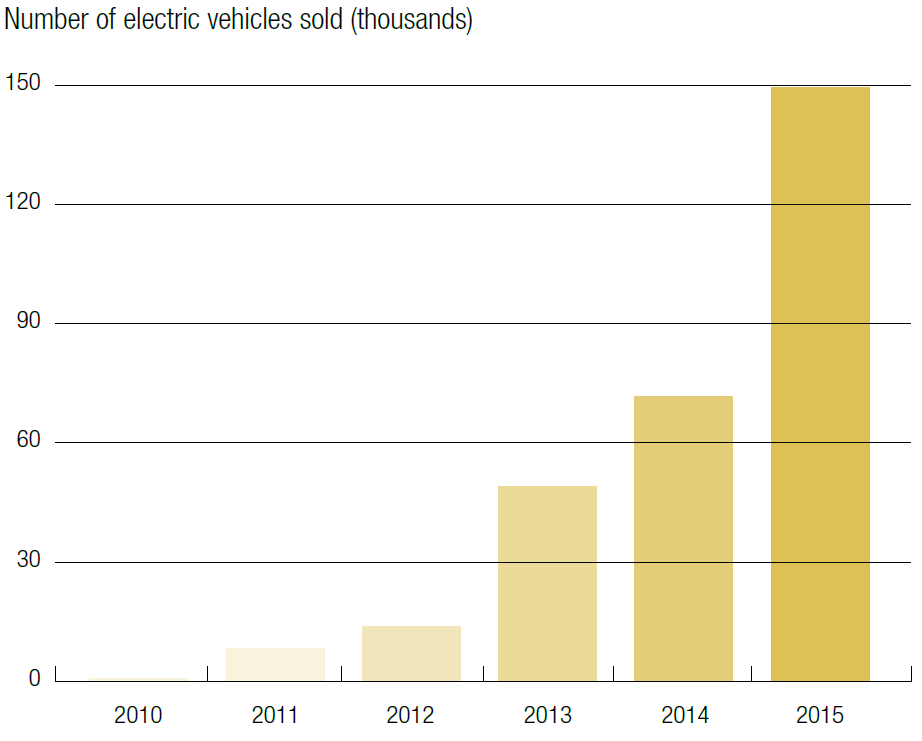
Norway is the clear pacesetter in Europe with EVs adding up to 6.2% of total car sales in 2013, followed by the Netherlands with EVs at more than 4% of new car sales. Generally speaking however, despite the market growth rate and some economic incentives, the share of EVs in Europe is still small compared to its full potential, as EVs represent only 1 in 700 vehicles of the current fleet.
The gradually increasing momentum behind EV adoption suggests growth will continue in the coming years and that EVs will play an important role in Europe’s mobility going forward. The main factors behind such growth are threefold.

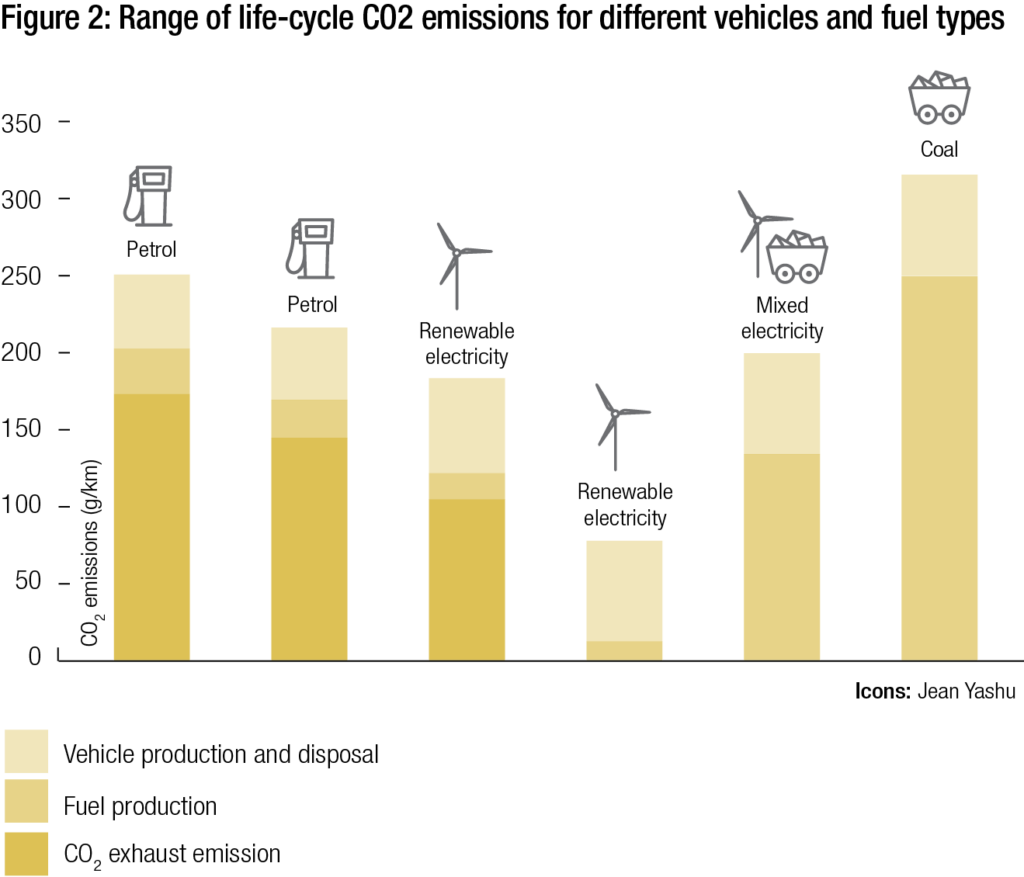
Several scenarios have been established to predict the embrace of EVs in the future, all pointing at a EV revolution hitting hard in the next decades. Models predict that EVs in the EU will range from 20-90 million units representing between 7-32% of the total fleet. Such growth, even in the pessimistic scenario, would have major impacts beyond the transport sector and primarily on the power sector, as the switch from fossil fuels to electricity will obviously increase global electricity demand. For instance, within the above-mentioned scenario, the electricity demand rises from 47 TWh to 202 TWh, which represents the annual production of 4 and 19 nuclear plants respectively. To be in line with GHG reductions, increased demand must be filled with renewable energy capacities: keeping the same 2015 energy mix of fossil fuels would drastically impede the potential gain on emissions (Figure 2).
The transmission and distribution of additional production will have to adapt, especially in countries with aging infrastructure and/or in remote areas where the extra demand due to electric vehicles may exceed the capacities of the local grid, triggering major power cuts from household to country levels.
At first glance, EV development will demand major investments in the power sector from generation to transmission and distribution. However, a deeper analysis shows that the energy transition to renewables proves that EVs constitute a key enabler towards the creation of new interactions with the electricity grid and of greater flexibility with the power system.
Electricity is a very special asset.
The golden rule for the management of an electric grid is that production must always be equal to the consumption. Historically, this equation has been solved thanks to a mix of fossil fuels and in some cases, uranium to cover the base load production and demand peaks. The production of electricity could be fully planned given the specificities of each source, such as low reacting coal and nuclear plants being used for the baseline production whereas highly-reacting gas and oil plants being used during peak hours. In the context of a transition towards renewable energies, the classic production schemes become obsolete and create a strong need for innovative models to re-organise the production of electricity.
Introducing electric vehicles changes the situation, creating a vast new electric storage capacity which can be equal to almost half of installed renewable energy capacities. For instance, EV batteries can be used in several ways at each stage of their life time. They can be used as means of direct electricity storage while charging individually or as a means of stationary storage for second hand batteries. Power utilities would be able to store extra electricity coming from renewables when the production exceeds the demand and have stored power ready and usable when needed. Storage of extra power would allow more renewable-installed capacity as the surplus of production could be easily kept in the EV batteries. And the batteries could release their stored electricity into the grid to compensate for insufficient production. In a country with a high share of solar power production, EV owners would be incentivised to charge vehicles during the day, when solar production is at its maximum, while at night, owners could choose between not charging their vehicles and selling their stored electricity into the grid. Implementing such a splendid scheme requires three key considerations:
The link between developing renewables and integrating EVs is straightforward. New renewable-installed capacity can provide sufficient electricity for electric vehicles charging and EVs can provide the necessary storage capacity to achieve grid stability and optimisation of intermittent renewables production. However, three main barriers need to be overcome to implement smart charging:
EVs are making fast progress, sales are rising and the overall outlook is positive in most scenarios. Not only do they represent a very promising technology to replace fossil fuels in the transport sector but they are also a key enabler to the development of renewable energy. At the end of the day, electric vehicles are a replacement technology, and will not decrease the number of metal boxes on our roads. Who will jump the curve and find the next mode of transporting humans independently and efficiently?