Data on Water
Photo: Amanda Chen / Unsplash
Can floating, hydrogen-powered data centres offer Europe a way out of its digital infrastructure crisis?
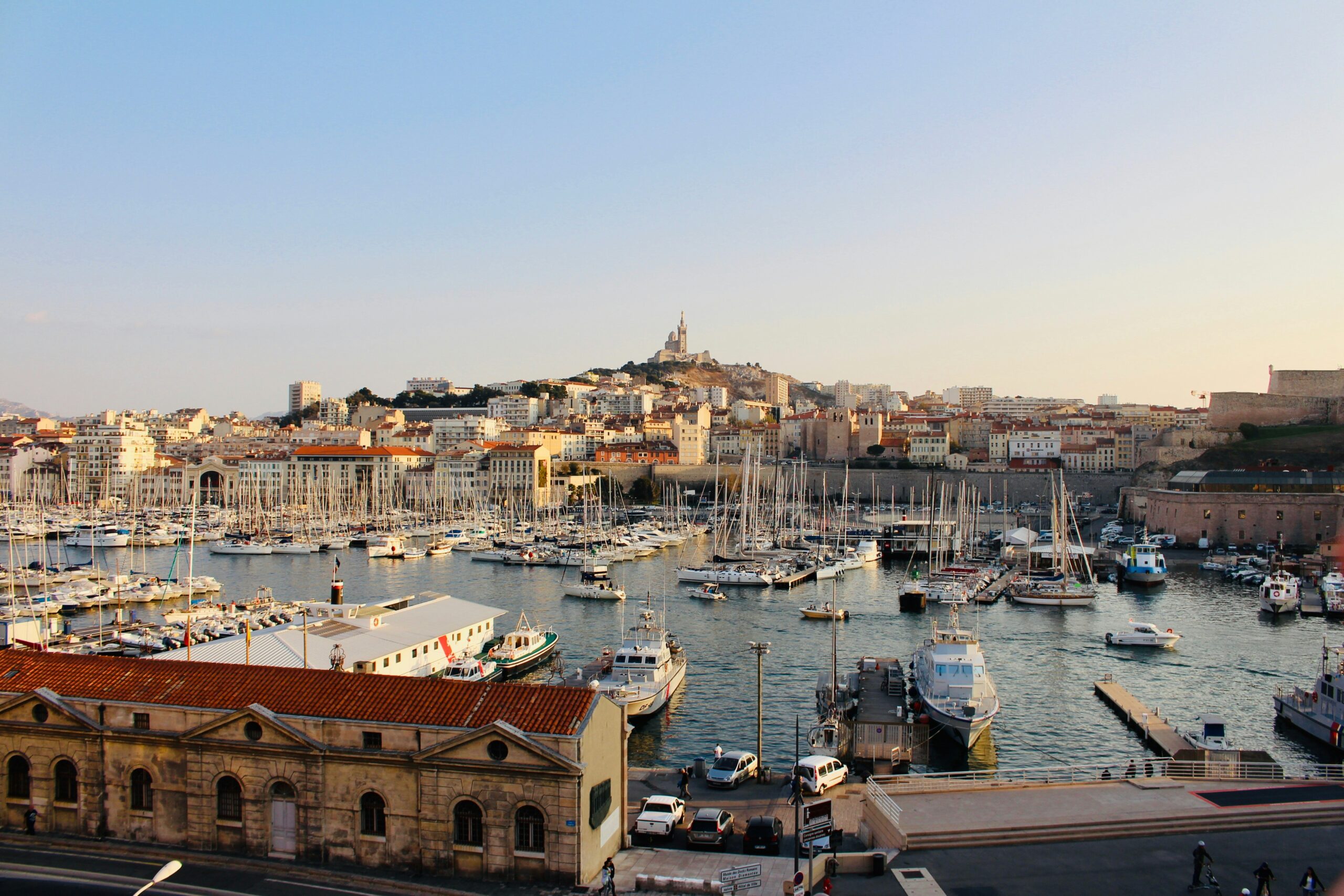
Fourteen subsea cables run from the Grand Port Maritime de Marseille to Europe, Africa, the Middle East, and Asia. They carry the majority of data traffic between Europe and the rest of the world, and they have turned France’s second city into one of the most strategically significant digital infrastructure hubs on the continent. Marseille is not usually mentioned in the same breath as Frankfurt or Amsterdam when European data centre markets are discussed. But by any measure of connectivity, it is the Mediterranean’s undisputed digital gateway, and it’s growing fast.
As of 2025, the city hosts 77 megawatts of operational data centre capacity, with a further 107 megawatts in various stages of planning and permitting, according to a January 2025 investigation by La Quadrature du Net. The bulk of those facilities sit within the port perimeter itself, drawing their power from the Saumaty source substation in the Saint-André district and, in some cases, discharging thermally altered cooling water back into the Mediterranean Sea. A public inquiry into that practice identified risks of eutrophication and raised concerns about ecological impacts that, in the investigators’ own assessment, are not fully understood.
Residents of the 16th arrondissement, whose lives are shaped by the port’s noise, air pollution, and industrial activity, have submitted formal objections calling for a halt to all further data centre construction in the city. Sébastien Barles, Marseille’s deputy mayor responsible for ecology, summarised the community’s position in Le Monde with a directness that left little room for interpretation: data centres, he said, currently produce only negative effects for the neighbours who live alongside them.
This is a tension that is playing out in different forms across almost every major digital infrastructure hub in Europe. In places like Frankfurt, connecting a new data centre to the electricity grid can take up to seven years, with some cases stretching to 13, according to Ember Energy, a consultancy. In Dublin, a de facto moratorium on new connections has been in place since 2023 and will not lift until 2028. In Spain, data centre developers are encountering community opposition over water and energy resources.
Europe says it wants to triple its data centre capacity within five to seven years, as set out in the EU’s AI Continent Action Plan published in April 2025. The ambition is clear. What is less clear is where the power, the water, and the space for that tripling are supposed to come from.
The ambition is clear. What is less clear is where the power, the water, and the space for that tripling are supposed to come from.
Against this backdrop, a concept that has spent years on the fringes of infrastructure planning is attracting renewed attention: data centres built on water and powered by hydrogen. The idea is not new, but the conditions in which it is being reconsidered most certainly are.
A solution looking for the right problem
The basic logic of a floating data centre is straightforward. Water has a thermal capacity roughly 3,500 times greater than air, making it a vastly more efficient medium for absorbing the heat that server racks generate continuously. A facility positioned on or near a body of cold water can use that water for cooling without the energy-intensive chillers and cooling towers that conventional onshore facilities depend on.
The result is a measurable reduction in what the industry calls Power Usage Effectiveness (PUE): a metric that expresses the ratio of total energy consumed by a facility to the energy used for actual computation. A perfect PUE score is 1.0, meaning that every watt of electricity powers computation with zero spent on cooling.
A conventional data centre in central Europe typically operates with a PUE of between 1.3 and 1.5. Facilities that use natural seawater or fjord water for cooling have recorded PUE values of between 1.07 and 1.15. In practical terms, a water-cooled facility can achieve the same computational output while consuming roughly 20 to 30 percent less total energy than its land-based equivalent. According to data published by Hydrogen Europe in September 2025, eliminating cooling towers and mechanical refrigeration alone reduces overall power consumption by around 23%.
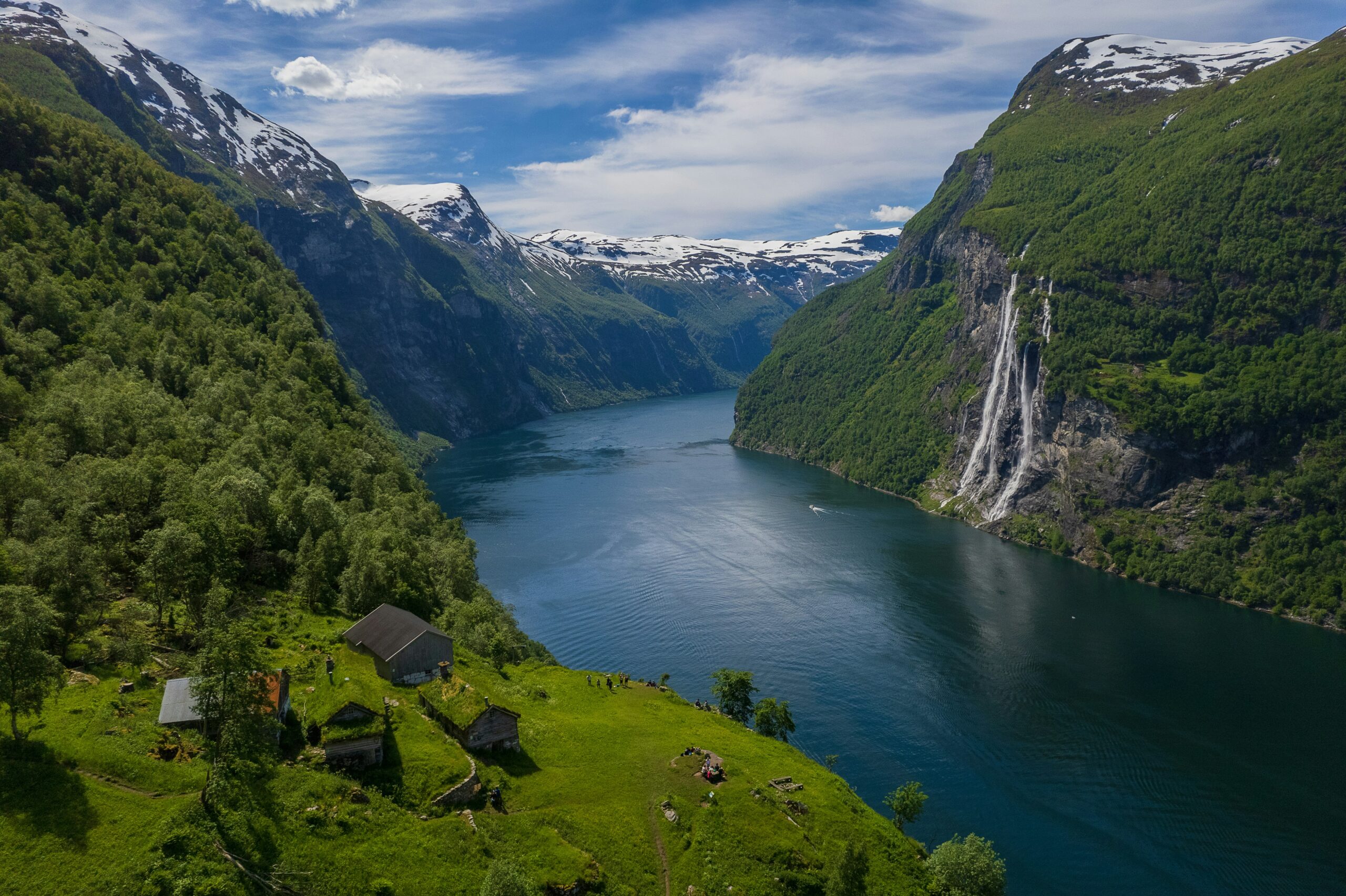
Norway has quietly demonstrated what this looks like in practice for over a decade. Facilities built into fjord-side locations draw seawater at a stable temperature of around 8C year-round, a natural heat sink that does not require mechanical cooling. The Nordic region more broadly achieves average PUE values of between 1.1 and 1.2 routinely, according to various studies. Cool ambient air, available for eight to 10 months of the year across Scandinavia, combined with hydroelectric and wind-generated electricity, gives these facilities an environmental profile that urban data centres in Frankfurt or Amsterdam simply cannot match.
Building a floating data centre takes this logic one step further. Instead of constructing a facility near a body of water, a barge or platform-based facility is positioned directly in a harbour, on a river estuary, or in sheltered coastal waters. No land acquisition is required. No urban planning queue. No long grid connection process. The facility can, in principle, be moored and operational in a fraction of the time it would take to site, permit, and connect a conventional facility in a congested European city.
Powering data centres with hydrogen
A proposition is underway to use hydrogen fuel cells to power data centres with the aim of bringing the PUE closer to a 1.0 score. When hydrogen is fed into a fuel cell, it reacts with oxygen to produce electricity, emitting only water vapour. Coupled with on-site storage, fuel cells can provide continuous, dispatchable power that does not depend on a grid connection nor on the intermittency of solar and wind generation. Hydrogen Europe’s September 2025 briefing noted that if European data centres offered just 30 hours of grid flexibility annually, drawing instead on on-site generation and storage, the grid capacity available to the sector could more than double.
In South Korea, a 900 megawatt hydrogen fuel-cell facility at the Dangjin Green Energy Hub, due online at the end of 2027, will be among the first commercial-scale plants in the world built explicitly to feed data centres. In the United States, Plug Power has agreed to supply Amazon’s AWS facilities with hydrogen back-up generation.

Across Europe the hydrogen experiments are smaller, but they are converging fast. In Dublin, where new grid connections have been effectively frozen since 2023, Microsoft and the Irish utility ESB are running a green-hydrogen fuel-cell trial that supplies 250 kilowatts of clean electricity to a Microsoft campus, designed to test whether hydrogen can stand in for the diesel generators that have long served as the industry’s invisible insurance policy.
The engine manufacturer INNIO is deploying a 60 megawatt hydrogen-ready island-mode plant for another hyperscale operator. In the United Kingdom, the Nottingham-based firm GeoPura, backed by Siemens Energy, is shipping containerised hydrogen units of up to 50 megawatts directly to developers who cannot wait on grid reinforcements.
A floating data centre is a combination of two ideas: water cooling and hydrogen power. It is a data centre independent of both terrestrial grids and freshwater supplies, deployable in harbours along Europe’s extensive coastline, and potentially powered by green hydrogen produced from the offshore wind capacity that the continent is building at scale.
From renderings to the dock
The clearest signal that floating, hydrogen-powered data centres are moving from slide deck to project pipeline arrived not from Europe but from Singapore. Singapore, like Marseille, has effectively run out of suitable land; unlike Marseille, it has chosen to push the energy plant onto the water first, in advance of the facility it will eventually power.
In March 2026, the developer Bridge Data Centres and the Chinese renewables firm Concord New Energy unveiled plans for the city-state’s first barge-mounted hydrogen power plant for AI workloads, engineered with Nanyang Technological University. The plant is designed to float while hydrogen handling sits offshore, kept clear of the IT halls. Marseille seems to have taken note: among the development projects registered at the Grand Port Maritime is a floating data centre concept from the infrastructure developer Nautilus, to be moored in the port waters rather than built on land.
The required parts for floating data centres are converging on the Mediterranean. Marseille’s own Fos-sur-Mer complex has positioned itself as a green-hydrogen and data-centre hub, with hyperscalers including Microsoft and Equinix expanding nearby. Barcelona’s port authority is preparing hydrogen bunkering infrastructure under Spain’s H2Med pipeline plans. Italy is pushing the SoutH2 Corridor, a hydrogen pipeline running from North Africa through Sicily and Tuscany up to Bavaria. On the southern shore, Algeria has signed memoranda to feed SoutH2; Egypt is courting investment in green-hydrogen complexes around the Suez Canal Zone.
The hidden costs of green hydrogen
Powering European data centres with hydrogen could end up absorbing between 8 and 27 percent of the bloc’s projected clean-hydrogen supply by 2030, according to Hydrogen Europe’s own scenarios – molecules that would then not be available to decarbonise “hard-to-abate” sectors like steel, fertiliser, or shipping.
Water does not disappear because the platform floats. In communities such as Talavera de la Reina, in Spain, where the Tu nube seca mi río movement has rallied alongside SEO Birdlife against hyperscale projects drawing on already-stressed rivers, the cloud’s freshwater footprint is being contested in real time. Floating the facility offshore does not erase that cost. It shifts where it lands.
This could be tackled with a new frontier of hydrogen production under exploration: direct seawater electrolysis. This involves splitting seawater into hydrogen and oxygen without desalinating it first. Pilot rigs are now being tested at sea, with new catalysts able to resist chloride corrosion long enough to keep the cells running. If the technology matures at industrial scale, a floating data centre moored off Almería or Catania could one day produce part of its own fuel from the water it sits on.
Floating, hydrogen-powered data centres are not fiction anymore. They are being engineered, financed, and permitted, and the Mediterranean has the wind, the sun, the coastline, and the political momentum to host them at scale. What they will not do, by themselves, is absolve the choice. AI’s appetite for energy is going to keep growing. Whether communities along the Mediterranean coast end up with a greener version of the cloud, or simply a new infrastructure that shifts the same costs abroad, will depend on whether this expansion is carried out transparently, agreed upon with local communities and subject to the necessary controls to minimise environmental impact.
Redefining Europe’s coastline
The deeper implication of floating, hydrogen-powered data centres is that they are not simply proposing a new type of facility. They are proposing a different geography for the digital economy itself. For two decades, Europe’s data infrastructure has concentrated around inland financial and connectivity corridors: Frankfurt, Amsterdam, Paris, Dublin, London. The logic was proximity to users, exchanges, and fibre optic routes. But the rise of AI is changing the scale equation. Training large language models and processing real-time AI workloads require levels of electricity and cooling capacity that many of Europe’s traditional hubs can no longer provide without triggering political backlash, ecological stress, or outright grid saturation.
The deeper implication of floating, hydrogen-powered data centres is that they are not simply proposing a new type of facility.
The coastline, once peripheral to the digital economy except for the landing points of subsea cables, is rapidly becoming strategic territory again. Ports are evolving into energy-and-data interfaces. Marseille is the clearest Mediterranean example, but it is far from alone. Across the basin, infrastructure planning is beginning to follow a new logic: place data where renewable energy can be generated and imported most efficiently, rather than where land happened to be historically available. Ports that once depended on fossil fuel logistics are repositioning themselves around hydrogen terminals, subsea cable landings, offshore renewables, and AI infrastructure. The port of the future may look less like a traditional shipping hub and more like a hybrid industrial ecosystem where cloud computing, energy conversion, and maritime logistics operate side by side.

The shift is particularly visible in Southern Europe, where the energy transition and digital transition are beginning to overlap geographically. Spain’s eastern coast, southern Italy, and parts of Greece combine three strategic assets rarely found together at scale: abundant renewable energy potential, direct access to subsea connectivity routes, and proximity to emerging hydrogen corridors linking Europe to North Africa. This creates the possibility of entirely new industrial clusters. In the same way that cheap coal shaped the geography of nineteenth-century industry and oil terminals shaped twentieth-century trade, renewable electricity and hydrogen availability may increasingly determine where twenty-first century AI infrastructure is deployed.
That evolution could alter long-standing economic relationships across the Mediterranean. For decades, North African energy exports to Europe were defined by hydrocarbons moving northward through pipelines and Liquefied Natural Gas (LNG) terminals. The emerging hydrogen economy introduces a more diversified model, one where energy molecules, renewable electricity, industrial processing, and digital infrastructure become interconnected. If Europe succeeds in scaling green hydrogen imports from the southern Mediterranean, the region may evolve from being simply an energy supplier into a strategic partner in Europe’s digital transition itself. Data infrastructure, in that sense, becomes part of a broader geopolitical architecture.
At the same time, this concentration of digital and energy infrastructure along coastlines raises difficult questions about resilience and security. Subsea cables already carry more than 95 percent of intercontinental internet traffic, making coastal infrastructure one of the least visible yet most critical components of the global economy. Integrating energy generation, hydrogen storage, and hyperscale computing into the same maritime zones may improve efficiency, but it also concentrates strategic assets in ways that governments are only beginning to evaluate. Cybersecurity, maritime security, environmental risk, and energy sovereignty are converging into the same infrastructure discussion.
Data centres are about more than energy
The implications extend beyond energy policy. Whoever hosts the infrastructure of artificial intelligence will shape the economic geography that comes with it: cloud services, advanced computing, research clusters, and industrial innovation. Europe has spent years debating digital sovereignty in terms of software regulation and semiconductor production. But sovereignty also depends on something more physical: where the servers are located, how they are powered, and who controls the infrastructure supporting them.
This may ultimately explain why the debate around floating data centres feels larger than the technology itself. Coastal regions that historically sat outside Europe’s main technology corridors may suddenly find themselves central to the next wave of infrastructure investment. Mediterranean cities long associated with tourism, shipping, and energy transit are beginning to position themselves as future AI gateways.
The infrastructure underpinning the digital world is no longer invisible. It is becoming materially and politically impossible to ignore.
Floating data centres sit at the crossroads of multiple transitions taking place simultaneously: decarbonisation, digitalisation, maritime industrial renewal, and geopolitical realignment. They are not a silver bullet, and they may never become the dominant model for hyperscale computing. Yet their emergence signals something important. The infrastructure underpinning the digital world is no longer invisible. It is becoming materially and politically impossible to ignore.
Featured in