
Of Birds and Fish
Photo: Jake Threadgould / REVOLVE
Under the Glacier
Halldór Laxness
New York: Vintage, 2004. 240 pages
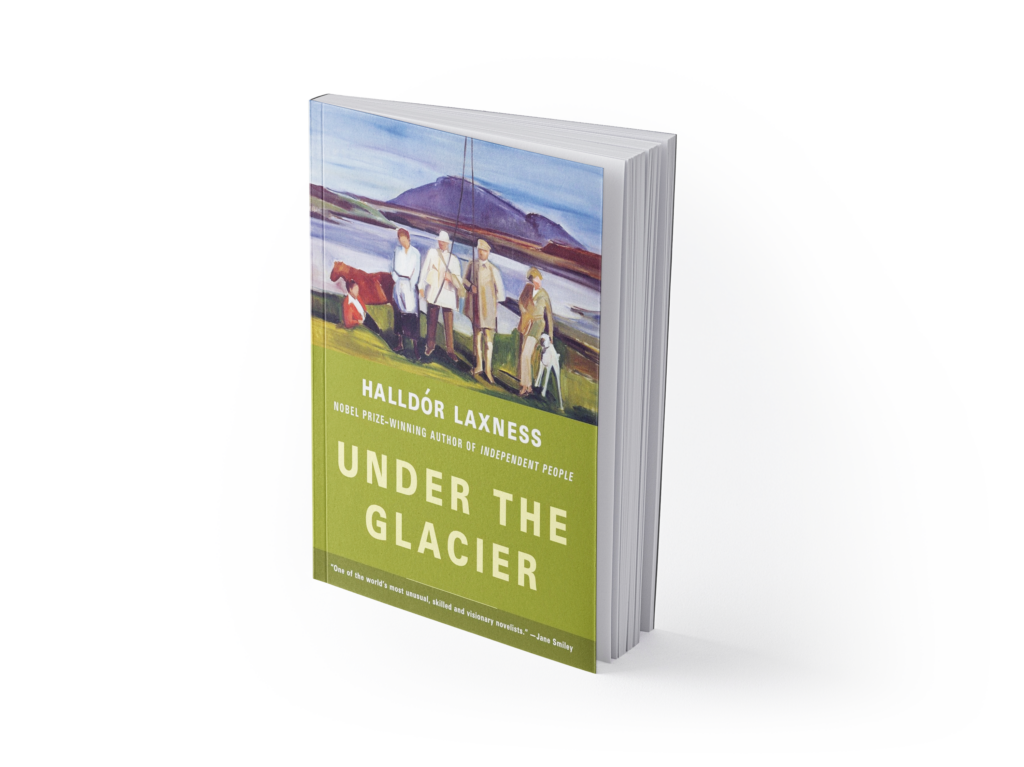
Susan Sontag’s introduction, appropriately called ‘Outlandish’, describes Under the Glacier as many types of novels in one: science fiction, dream, visionary, philosophical, comic novel, but she omits the nature writing angle or the environmental novel genre which goes to show that every reader and commentator has their prism, neither better or worse, simply different perspectives. To be sure, this is not a descriptive nature of writing, but the birds say a lot, and the frozen salmon sums it all up.
Original titled “Christianity at Glacier” (1968) in Icelandic (the Viking island converted to Christianity in 999 AD), Under the Glacier in its English translation actually does give that more nature-oriented narrative feel that comes through in Halldór Laxness’ description of birds and fish that recur as leitmotifs reflecting the surround environment of the bizarre plot about this young ‘emissary’ who is sent to the Snaefelljökull Glacier to investigate and report on what the local bishop is (not) doing.
A witty response to Jules Verne’s Journey to the Center of the Earth (1864) that starts with the expedition of descending into the Snaefelljökull volcano, Under the Glacier is a quest and very much a critic of religion’s relation to nature. The piques at institutionalised religion are subtle, and the simple insights are profound. The casquet left on the glacier actually contains a salmon frozen in a block of ice that starts to melt when they move the coffin to actually bury the container.
The young emissary is sent to find out why the local pastor has left the coffin for so long on the glacier and finds that the pastor has for all intents and purposes lost his faith entirely serving more as a repair ‘handyman’ for the community: the pastor has not preached for years and seems to forget his official lines at a funeral, but he puts into practice the handy work of repairing more important things like the ‘quick-freezing plant’ that gives him a sense of purpose. Pastor Jon is beyond official religion, in the realm of spiritual ‘uselessness’.
The most unexpected aspect of this deeply amusing and witty novel by Iceland’s Nobel Prize for Literature laureate (1955) is his recurrent descriptions of birds that come back in shrieks throughout the narrative. The naive young narrator stares “passively at this phenomenon of nature” when different species of birds – great skuas, herring gulls, black-backed gulls, kittiwakes, fulmars – congregate to dispute an important matter above the churchyard. Nature here is above religion, literally sitting on it without even noticing it:
Now they sat still as if they were holding a meeting over some matter of importance that had taken placeand only screeched one at a time. More and more of them took off and flew away in silence to the sea. Others peered all around as if they were waiting for another miracle. (p.208)
This timeless short scene echoes the 12th century Persian Sufi mystic Farid al-Din Attar’s Conference of the Birds in which the birds discuss and debate issues of enlightenment and reach spiritual levels far beyond regular institutional belief.
Similarly, as Laxness juxtaposes religion and nature, he sees the Almighty not in the pews of the church but rather in the snow bunting – a little white bird with black wings with rust-orange fringes that can withstand tremendous Arctic winds:
Often I think the Almighty is like a snow bunting abandoned in all weathers. […] He wields his fragile head against the gale, with his beak to the ground, wings folded close to his sides and his tail pointing upwards; and the wind can get no hold on him, and cleaves. Even in the fiercest squalls the bird does not budge. He is becalmed. (p.82)
The Almighty in Nature is Laxness’ leitmotif. This visual passage invites you to see the snow bunting braving the elements, embodying the ways of the environment; and here again on a sharp cliff overlooking the sea that surrounds Iceland is a colony of kittiwakes in action doing their thing:
Most of these birds are nesting now and have started laying – and excreting. The coal-black cliffs are white. Those who love the metropolitan cities of the world would doubtless call it salvation to be allowed to sit here for the rest of their lives.
Many are sitting motionless for hours on end and seem to be doing mental arithmetic. A few are gliding without any effort over the deeps in the front of the precipice on some inscrutable errand, like snowflakes drifting in a calm. (p.103-104).
And what about the fish then? Those wingless birds with fins under the water. Well, she is reincarnated in the frozen salmon that was in the coffin that was being kept cool ‘on ice’ on the glacier by the faithless pastor who was married to the woman. It’s confusing, it’s funny, it’s really worth the read, and it’s worth recalling that: “there’s a risk that there would be little left if birds and fish are not to count.” (p.208)
