Biomass Jet Fuel Innovation Has Reached Cruising Altitude
Photo: Ivan Shimko / Unsplash
An innovation milestone moves biomass-based sustainable aviation fuel past the departure lounge and toward its final ascent.
The Circular Fuels project has reached a key milestone with the successful production of a small initial sample of sustainable aviation fuel (SAF), marking an important step in the development of renewable alternatives to conventional jet fuels. Led by VTT Technical Research Centre of Finland, the achievement validates an early-stage production pathway that converts waste-based biomass into potential aviation-grade fuel components.
The project focuses on producing sustainable aviation fuel from feedstocks such as agricultural residues, forestry side streams, and demolition wood, using fast pyrolysis and solar-driven technologies. While the sample is still limited in volume and not yet certified as an SAF, it demonstrates that sustainable feedstocks can be converted into promising fuel fractions for further testing, optimisation, and scale-up.
In this conversation, Alexander Reznichenko, Research Team Leader at VTT and project manager for VTT’s work in Circular Fuels, speaks with Ahmetcan Uzlaşık about what this milestone means, why current SAF feedstocks are not enough, and what it will take to bring waste-based aviation fuels closer to commercial deployment.
Sustainable aviation fuel already exists. What makes this production milestone different?
It is important to be careful with terminology. Officially, a fuel becomes sustainable aviation fuel when a specific production pathway has gone through certification and is included in the relevant ASTM annexes. More generally, however, people use SAF to mean fuels that can power aircraft but do not come from fossil feedstocks.
Today, SAF does exist and can be purchased. Most of it is produced from what is known as the HEFA pathway, using feedstocks such as used cooking oil, fats, greases, and other fatty residues. These are good feedstocks in many ways. They are energy-rich and relatively close to fossil feedstocks, which makes them easier to process in refineries.
The problem is availability. There is only so much used cooking oil in the world. Even if we collected it very efficiently, it would not be enough to meet future SAF demand or significantly decarbonise aviation. There are also questions around sustainability, land use, and transparency in some supply chains.
What makes the Circular Fuels milestone interesting is that we are working with more challenging feedstocks, such as lignocellulosic biomass – plant material rich in cellulose, hemicellulose, and tough lignin – from forestry and agricultural residues. These are more abundant and more widely available in Europe, but they are technically harder to convert into high-quality aviation fuel components.
What feedstocks were used in this production, and where does solar energy fit in?
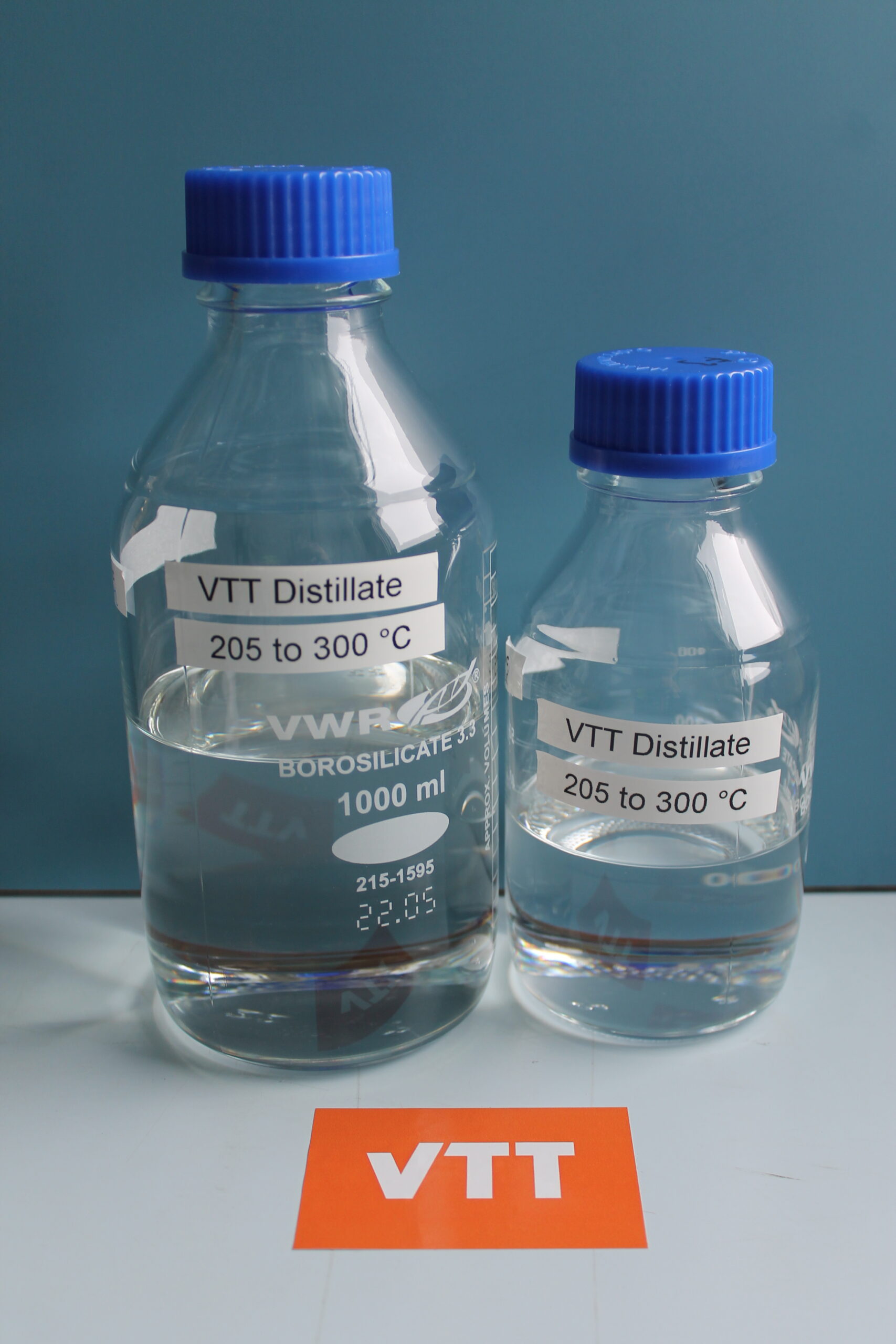
The physical feedstock used in this milestone came from forestry side streams, mainly sawdust and bark from sawmill operations. These materials are usually used for energy production, but in this case they were liquefied through pyrolysis to produce oil.
Circular Fuels also looks conceptually at solar-driven pyrolysis, which is a very interesting approach. However, there are not yet enough installations capable of producing the required quantities through that route, so this milestone used a more traditional pyrolysis setup.
The project is also looking at agricultural biomass residues, such as straw. These are widely available in different parts of Europe and are often underused. I would be careful with the word “waste”, but these are certainly side streams that are not currently being used to their full potential.
The advantage of these feedstocks is that they contain biogenic carbon, are relatively inexpensive, and are available domestically. The challenge is that they require more demanding processing to become aviation fuel components.
When passengers pay extra to support SAF while booking a flight, does that actually help?
It probably does not mean that your specific aircraft will be fuelled with a higher share of SAF. Usually, this works through accounting systems. Airlines may use voluntary contributions, sometimes combined with their own commitments, to purchase certain volumes of SAF from producers or refineries.
But the current share of SAF in aviation remains very small. One reason is cost. Even SAF made from relatively easy feedstocks is still significantly more expensive than fossil jet fuel. The question of who pays that price difference is still unresolved. It could be passengers, airlines, fuel producers or the wider value chain.
EU mandates are designed to gradually increase SAF use and create stronger demand. The hope is that this will encourage investment in production capacity. But right now, SAF exists technically and commercially, while still being limited by feedstock availability, cost, and scale.
What does this first SAF sample represent for the Circular Fuels project?
The project is still in the research stage, but we set an ambitious goal: to produce meaningful quantities of fuel by the end of the project for detailed analytical and combustion testing. Before doing that at a larger scale, we wanted to prove that the full conversion route works.
This milestone shows that we can go through the main stages. First, biomass is liquefied through pyrolysis to produce an oil. Then that oil is stabilised, including with a catalyst developed for the process. After that, it is further refined to produce fully deoxygenated hydrocarbons, followed by distillation to isolate the fuel fraction.
At this stage, we produced around one litre of what we call a prospective SAF component from lignocellulosic feedstock. It is not officially certified SAF yet, and we need to be careful with that wording. But chemically and in terms of properties, it already meets many of the technical criteria typically required from SAF components produced through other routes.
For us, this is a confidence-building step. We have shown that the pathway works, and now the project partners can use that learning to produce larger amounts and improve yields, quality and process performance.
How feasible is it to scale this process?
Scaling is the central question. Producing one litre is very different from producing the tens of tonnes needed for aircraft operations. But industrial scale-up always happens step by step.
In Circular Fuels, we first need to confirm that the process is stable, reproducible, and technically understandable. That means studying mass and energy balances, catalyst performance, product quality, and reactor behaviour under industrially relevant conditions.
We also use techno-economic analysis and life-cycle assessment to understand whether the process could eventually become economically viable. Something that works in the lab does not automatically work at commercial scale.
The next steps would include larger demonstrations, probably at semi-industrial scale, before moving to full commercial plants. These are capital-intensive processes, so investors need confidence that the technology works and that feedstock supply, catalysts, reactor operation, and product quality can all be controlled reliably.
That is what this milestone helps with. It reduces technical uncertainty and highlights where further optimisation is needed.
What are the next steps for the project?
The next step is to replicate and expand the process with project partners. VTT has demonstrated the pathway at a smaller scale. Partners, such as Orlen, are responsible for producing larger quantities of the fuel, while others will carry out more detailed testing.
Universities and research partners will analyse how close the product is to existing SAF standards, what advantages it has and what technical bottlenecks remain. Other partners will also update cost models and life-cycle assessments using real data from the process.
We are not promising that SAF from these feedstocks will be cheaper than fossil jet fuel. That is not realistic in the near term. The more realistic goal is to become competitive with current first-generation SAF pathways, while offering a more scalable and regionally resilient feedstock base.
This matters for Europe because many current SAF feedstocks, such as used cooking oils and fats, are imported. Forestry residues, agricultural residues and other lignocellulosic feedstocks can be sourced more locally, which improves supply security.
In partnership with