
Ships Are Ready for New Fuels, Are Ports?
Photo: Federal Beaufort / Unsplash
Hundreds of new vessels are being ordered to run on alternative fuels, but infrastructure is lagging.
Shipping is in the midst of a radical fuel transition. In 2024 alone, shipowners ordered 515 vessels capable of running on alternative fuels, a 38% increase from the year before, according to risk management provider DNV. Liquified Natural Gas (LNG) was the preferred fuel choice for those orders, with methanol and ammonia close behind. International Maritime Organization data shows that more than 230 new LNG carriers are due to enter service between 2026 and 2030, with 2026 set to become the busiest delivery year on record.
What stands out is not just the scale of the shift, but its speed. Container ships and car carriers accounted for nearly two-thirds of all alternative-fuel orders, driven by cargo owner pressure, tightening climate regulation, and long-term fleet renewal needs.
Yet behind the surge in newbuilds sits a quieter, more difficult question: will ports and fuel suppliers be ready when these ships arrive?
Why infrastructure now matters more than engines
For decades, shipping’s decarbonisation debate focused on ship technology: engines, fuels, hull efficiency. Today, that focus is shifting toward infrastructure.
The International Renewable Energy Agency (IRENA) estimates that global shipping consumed nearly 11 exajoules of energy in 2018, producing around 1 billion tonnes of CO₂, roughly 3% of global greenhouse gas emissions, almost the same as Germany. International shipping enables up to 90% of global trade and accounts for about 70% of shipping’s energy emissions, making it one of the hardest sectors to decarbonise.
IRENA’s modelling is clear: meeting climate targets means replacing fossil fuels with renewable alternatives, primarily advanced biofuels in the short term, and e-fuels such as methanol and ammonia in the medium to long term.
Engines alone cannot deliver that. Transition fuel availability, bunkering systems, safety approvals, and port investment will determine which fuels actually scale.
LNG’s head start
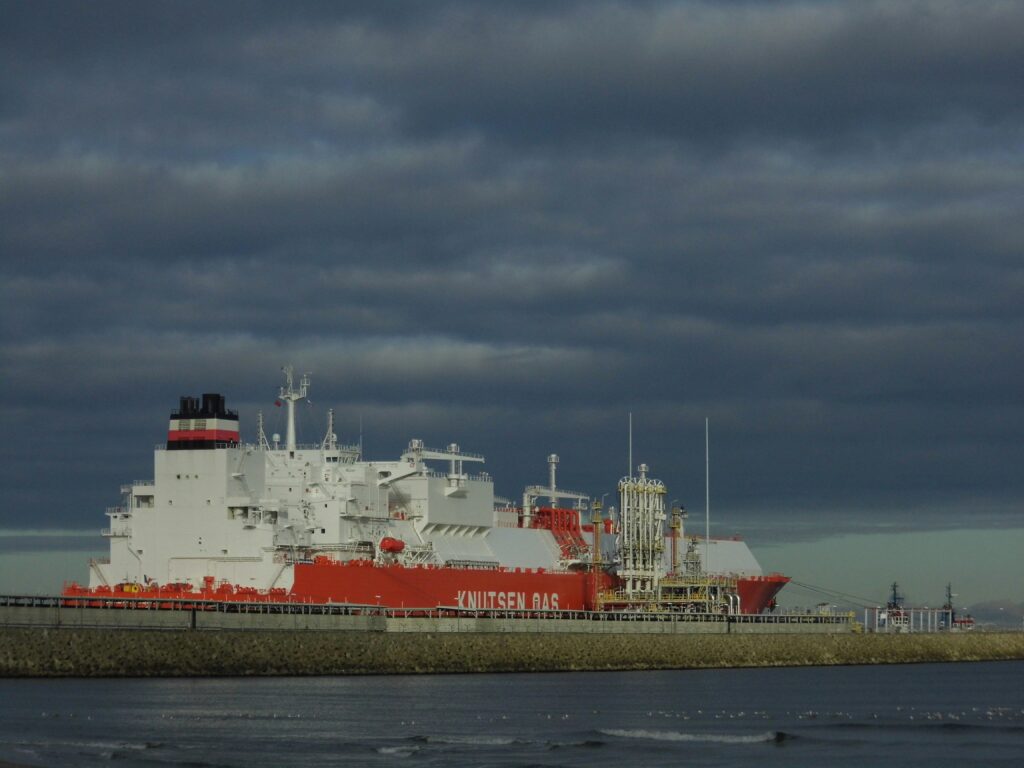
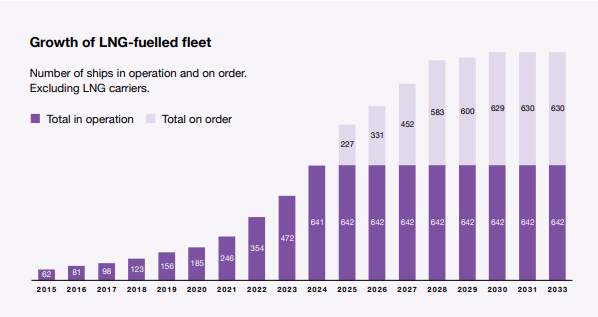
LNG currently enjoys a significant infrastructure advantage. The number of LNG-fuelled vessels in operation doubled between 2021 and 2024, reaching more than 640 ships worldwide. According to the Bunker Index, bunkering networks for LNG are expanding across major ports, supported by decades of experience in gas handling and existing investments in storage, safety systems, and supply chains.
Transition fuel availability, bunkering systems, safety approvals, and port investment will determine which fuels actually scale.
That level of preparedness is the factor that is shaping fleet decisions. LNG accounted for roughly two-thirds of alternative-fuel container ship orders in 2024, making it the dominant transitional choice for large operators. For many shipowners, LNG offers a practical bridge in cutting CO₂ emissions. According to SEA-LNG’s 2024 report: LNG, and its pathway, “is the most viable current and practical solution for decarbonisation of the maritime space.”
Jesper Soerensen, Global Head of Alternative Fuels & Carbon Markets at KPI OceanConnect, says bottlenecks now span the entire value chain.
“Fuel supply, bunkering capacity, port readiness, and regulatory approvals all feature in the lamentable slow pace of infrastructure developments for alternative fuel,” he says. “LNG itself is a globally traded commodity, but access to molecules, bunkering capacity, and port readiness are limited even at some of the biggest ports in the world.”
Climate credibility under scrutiny
LNG’s long-term climate credibility is increasingly under scrutiny. A key challenge is methane slip, which is unburned methane that is released during combustion and fuel handling. Because methane has a global warming potential 25 times – or as much as 28 times according to some sources – higher than CO₂, even small leakage rates can significantly erode LNG’s emissions advantage. According to DNV, methane slip can account for up to 24% of GHG emissions from an LNG-fuelled vessel.
This is where targeted technology efforts are emerging. The EU-backed GREEN RAY project, for example, is developing engine upgrades and exhaust after-treatment systems designed specifically to reduce methane slip in LNG vessels. By improving combustion efficiency and converting residual methane in exhaust gases, the project aims to preserve LNG’s short-term climate benefits while remaining compatible with future renewable methane fuels.
Moreover, recent onboard trials by Japanese partners including Mitsui O.S.K. Lines and Yanmar have already demonstrated methane slip reductions of up to 98%, showing that near-elimination of leakage is technically achievable.
Regulation makes infrastructure decisive
At the same time, policy pressure is also intensifying. Since January 2024, the EU Emissions Trading System has applied to maritime transport, covering CO₂ emissions from all large vessels calling at European ports, including 100% of emissions on intra-EU voyages, 50% on routes between the EU and the rest of the world, and all emissions produced while ships are at berth.
Crucially for LNG, the system expanded again in January 2026 to include methane and nitrous oxide on a CO₂-equivalent basis. Shipping companies will be required to monitor and pay for these emissions through annual allowance purchases, with compliance rising from 40% of emissions in 2025 to full coverage by 2027.
That shift will directly link infrastructure performance to operating costs.
“What we have consistently seen is that fuel choice is informed by infrastructure and supply availability,” Soerensen says. “For alternative fuels, however, fuel choice is mainly driven by regulation. Without a regulatory requirement, shipping will stick with the most cost-effective solution.”
That shift means methane leakage will no longer be a hidden climate cost. For LNG operators, methane slip will translate directly into higher operating expenses, potentially narrowing or eliminating LNG’s economic advantage compared with genuinely zero-carbon fuels such as green methanol and ammonia.
The infrastructure squeeze behind LNG’s boom
Aside from methane slip, infrastructure itself is becoming a growing constraint on LNG’s expansion.
While LNG-fuelled ships have surged past 640 vessels in operation, with the fleet expected to double again by the end of the decade, the bunkering systems that supply those ships are scaling far more slowly. According to DNV data, LNG consumption by shipping increased by more than 500% between 2020 and 2024, a pace that far outstrips the growth of bunkering capacity.
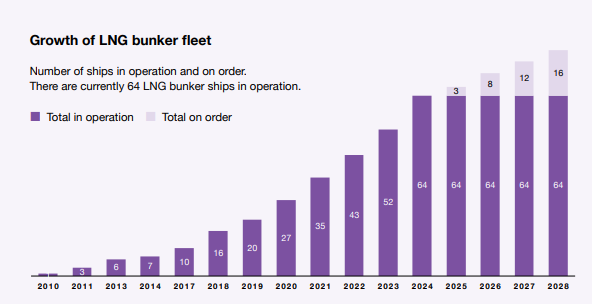
In early 2025, there were some 64 LNG bunkering vessels in operation worldwide, with only 16 additional vessels on order through 2028, according to an article by DNV Maritime’s Global Business Director for Gas Carriers and FSRUs, Martin Cartwright. These ships, which act as floating fuel stations transferring LNG directly to vessels in port, form the backbone of today’s LNG supply chain. But their numbers are not keeping pace with fleet growth, creating a widening gap between fuel demand and bunkering supply.
The port picture tells a similar story, Cartwright argues. In 2024, only 191 ports globally had active LNG bunkering facilities, such as dedicated storage tanks, transfer systems, and approved safety infrastructure. Another 81 ports were under construction, but even if all are completed on schedule, the expansion remains modest compared with the scale of LNG vessel orders now in the pipeline.
Regionally speaking, the LNG bunkering capacity is uneven. According to DNV, around 42% of bunkering vessels operate in Europe, 28% in Asia, and 18% across the Americas, leaving large parts of the global trading system with limited or no access to LNG refuelling. For shipowners running global liner networks, this uneven coverage complicates route planning and increases reliance on a small number of equipped hubs.
Soerensen says that the gap is less about LNG production and more about access.
“The growing supply-demand gap is less about global LNG availability and more about terminal accessibility, including bunker slot availability, port coverage, and logistical readiness across global trading routes,” he says. “Where supply remains concentrated in a limited number of hubs, shipowners face operational and commercial risk if vessels cannot reliably bunker LNG when required.”
The growing supply-demand gap is less about global LNG availability and more about terminal accessibility, including bunker slot availability, port coverage, and logistical readiness across global trading routes
“This challenge is probably best reflected in Southeast Asia”, he explains, where Singapore’s LNG bunkering system is approaching full capacity, prompting authorities to invite new operators to expand supply.
Ports entering a multi-fuel reality
If LNG infrastructure is strained, methanol and ammonia are even further behind.
“Ports around the world are doing their best to meet the demands of clients in an emerging multi-fuel world,” Soerensen says. “But decision making is very challenging, for ports and for fuel buyers, who need to understand the infrastructure landscape, the demand for a specific product, and where it is available to confidently meet their operational and regulatory obligations.”
Methanol bunkering remains limited to a small number of early-adopter ports. Ammonia infrastructure, outside pilot projects, is largely non-existent.
Solutions for ammonia
As the fleet shifts rapidly toward alternative fuels, early infrastructure projects are beginning to move from planning to construction, particularly around ammonia, which many long-term decarbonisation models identify as a major future marine fuel but which as of 2026 lacks dedicated bunkering networks.
In Norway, several of the most advanced efforts are focused on building the first commercial-scale ammonia fuelling systems. Azane Fuel Solutions has created a separate infrastructure company to develop and operate bunkering terminals designed specifically for ammonia-powered vessels. In late 2025, the group secured public funding of NOK 442 million (approximately €38–40 million) to support construction of three terminals along the Norwegian coast, in Florø, Stavanger, and Mongstad, with operations targeted before the end of the decade. and Mongstad, with operations targeted before the end of the decade.
The projects aim to provide refrigerated ammonia storage, transfer systems, and fuel logistics for early ammonia-fuelled ships, infrastructure that currently does not exist at scale in most ports worldwide.
Alongside fixed terminals, partners involved in the Ammonia Fuel Bunkering Network are developing floating bunkering barges that can deliver ammonia directly to vessels. Designed to be relocatable, the units are intended to allow ports to begin supplying ammonia without committing immediately to large permanent facilities, reflecting uncertainty around how quickly demand will grow.
The infrastructure build-out is being paired with early vessel deployment. Norwegian operators are preparing ammonia-capable bulk carriers and container vessels intended to run initially on dual-fuel systems before transitioning toward higher ammonia shares as supply becomes available. Fuel producers, including Yara Clean Ammonia, have announced plans to support early bunkering hubs with low-carbon ammonia.
Even in these frontrunner markets, challenges remain. Permitting processes for hazardous fuel handling are complex, safety standards are still evolving, and early demand volumes are expected to be too small to fully utilise infrastructure in the short term. Research modelling by research organisation SINTEF suggests that ammonia consumption in maritime transport will grow slowly through the 2020s before accelerating in later decades.
The pattern echoes the early days of LNG bunkering, which began with mobile fuelling solutions before expanding into large shore-based terminals as vessel numbers increased. Today, LNG benefits from nearly 200 active bunkering ports globally, a scale that alternative fuels have yet to approach.
Infrastructure as the real fuel selector
As emissions regulation tightens, infrastructure availability is likely to become one of the most decisive forces shaping which fuels ultimately scale.
“What we have consistently seen is that fuel choice is informed by infrastructure and supply availability,” Soerensen explains. “For alternative fuels, fuel choice is mainly driven by regulation, but without regulatory requirements, shipping will stick with the most cost-effective solution.”
Looking ahead, he argues that collaboration across the value chain will determine whether the industry can move fast enough to meet climate targets.
“The industry needs active collaboration to develop pathways and infrastructure, from feedstock supply to fuel production and offtake,” he adds. “Ensuring coordinated investment, strong partnerships and knowledge sharing will be critical to enabling a commercially viable energy transition.”